|
Let's walk to the rue de Archives nos.22-26, site of the CARMES-BILLETTES convent. It was on this spot that the house of a Jewish moneylender (the only trade that was permitted to Jews in the Middle Ages, since it was forbidden to Christians), Jonathas is said to have lived. Like it was often the case, at the arrival of Easter, the classic "blood murders and other crimes perpetrated by Jews" surfaced again. In 1290, an old Christian woman claimed that when she went to Jonathas to retrieve pawned objects, he demanded, in return, her Eucharistic host from Easter mass. In front of her own eyes, he plunged a knife in the host from which sprang blood. Plunged into boiling water, the host rose miraculously above them. Jewish moneylender (the only trade that was permitted to Jews in the Middle Ages, since it was forbidden to Christians), Jonathas is said to have lived. Like it was often the case, at the arrival of Easter, the classic "blood murders and other crimes perpetrated by Jews" surfaced again. In 1290, an old Christian woman claimed that when she went to Jonathas to retrieve pawned objects, he demanded, in return, her Eucharistic host from Easter mass. In front of her own eyes, he plunged a knife in the host from which sprang blood. Plunged into boiling water, the host rose miraculously above them.
Consequences were swift and without any mercy: Jonathas was arrested and burned alive, the house confiscated by king Philip the Fair (you bet!!) and given to a Christian townsman, who happened to be by coincidence a relative to the old woman.
This was not new, I would say, just cyclical return of Anti-Jew hatred and massacres that happend all along the centuries until last WW.
The ploy of the French state was to win allegiance from the bourgeoisie at the expense of the Jewish community. A classic move was to expel the Jews out of Paris, with the result that Christian's debts to Parisian merchants were cancelled: and that's what good king Phillip Auguste did in the 12th century. Some will find the comparison far sought, but in my honest opinion, times may have changed, the methods stayed: when Petain (the modern Phillip) aided in deporting Jews during WWII, the latter's property often ended up in others hands, just by coincidence the ones who helped with the denunciations.
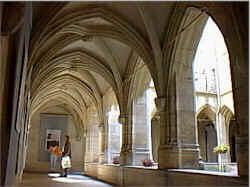 But let's end on a more pleasant note: the famous BILLETTES cloister here is often open, hosting several exhibitions.
Tel: 01 40 72 38 79. Open 10h-19h (concerts). Step in, and find yourself in the last medieval (1427) cloister extant in Paris. Because the adjoining church was very badly restored and rebuild in the 18th century, the main point of interest is the intimate cloister itself. Turned to a salt storehouse during the French revolution (the church) and carpentry shop (the cloister), it was finally handed over to the Lutheran Church in 1808. But let's end on a more pleasant note: the famous BILLETTES cloister here is often open, hosting several exhibitions.
Tel: 01 40 72 38 79. Open 10h-19h (concerts). Step in, and find yourself in the last medieval (1427) cloister extant in Paris. Because the adjoining church was very badly restored and rebuild in the 18th century, the main point of interest is the intimate cloister itself. Turned to a salt storehouse during the French revolution (the church) and carpentry shop (the cloister), it was finally handed over to the Lutheran Church in 1808.
Note again that all I told you in this article was researched by Mr. Arthur Gillette and included in his stroll no.8 of the Marais. I thank him again for his benevolent cooperation and permission to quote his text.
Bibliography
Main source: Paris through the ages, stroll no.8, the Naughty Marais, by Arthur Gillette (ed. Media-Cartes, Paris)
(with the obliging permission of Arthur Gillette)
|
