|
 The
10th arrondissement can be considered as the area of the gare du Nord, gare de
l’Est, the Canal Saint Martin, quartier Saint-Martin and Saint-Denis. The
10th arrondissement can be considered as the area of the gare du Nord, gare de
l’Est, the Canal Saint Martin, quartier Saint-Martin and Saint-Denis.
It’s a bit an untidy area where there is a lot of unofficial (black) work
especially ion the garment industry. It’s also part of the areas that changed
most since the renovation of Paris by Baron Haussman
in the middle of the 19th century. The large boulevards between the
gare du Nord and gare de l’Est give this area a city allure.
large boulevards between the
gare du Nord and gare de l’Est give this area a city allure.
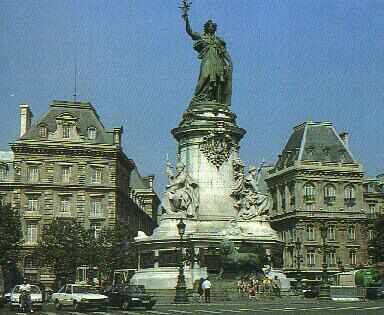
From the place de la Republique, a realization of Baron Haussman, all major
avenues start out
in all directions: Magenta, Republique, Voltaire, Turbigo, who, in the mind of
the baron, would break the traditional foyers of popular insurrections. Via the
rue du Faubourg du Temple you arrive at the square F.Lemaitre where you make a
left in the quai de Jemappes. From here you follow the canal Saint-Martin
direction bassin de le Villette to the place Stalingrad. This canal, dug during
Restauration connects the canal de l’Ourcq with the Seine. A lot of tanneries
and paper factories settled down in the 19th century. Except a few
reminders like at no.132, quai de Jemappes, most of these building have been
torn down and replaced by luxury apartments or ateliers.
Like the other Paris canals (St. Denis and Ourcq), the 4.5 km Saint-Martin Canal was built by order of Napoleon I between 1806 and 1825. It is supplied by the Ourcq canal (actually the canalized Ourcq River which has its source in the Department of Aisne, 109km from Paris).
The traffic is not heavy, the canal is mainly used during the floods of the Seine River and when the barges
can no longer flow 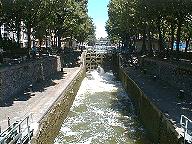 under the bridges.It starts at the under the bridges.It starts at the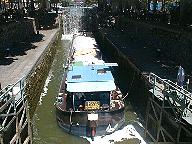 Port de l'Arsenal, the new Paris marina, built in the old moat of the Fort of La Bastille (left side of the square) and surrounded with 9000 square meters of landscaped areas with, among others, a kindergarten with the reproduction of an old galleon and a fort for children. Port de l'Arsenal, the new Paris marina, built in the old moat of the Fort of La Bastille (left side of the square) and surrounded with 9000 square meters of landscaped areas with, among others, a kindergarten with the reproduction of an old galleon and a fort for children.
This marina is named after the old arsenal located nearby, now a library. The marina can accommodate 230 boats with a maximum 25-meter
length. An underground vault, its longest section was built by Haussman and extended in 1906
(concrete part).This magnificent stone vault is 2km long; it used to be lit by 37 lanterns which gave it day-like light. The lanternswere located in the middle of the boulevard and were designed for the canal ventilation. They used to show the bargemen the way when the barges were neither lighted nor
self-propelled.
The canal Saint-Martin disappeared almost in the early 1970's when the
"Conseil de Paris" voted a four-lane freeway project to cover the
canal. The mobilization of the
riparians and the gross imbecility of this project aborted this
stupidity. A promenade along the peaceful ebankments of the
canal Saint-Martin is worth the effort, especially between the square Frederic
Lemaitre and the rue Recollets.
From
the turning bridge in the rue de la Grange-aux-Belles you can see at the end of
the street the
HOSPITAL SAINT LOUIS. It was built at the beginning of the great Plague
epidemics in 1608 and is composed by lonely small houses, meant to isolate the
infection danger. This practically unknown complex is worth a visit.
At the corner of the rue de la Grange-aux-Belles and the rue des Vinaigriers
appears the famous decor of the movie by Marcel Carne "l'Hotel du
Nord" and the foot-bridge where thanks to the movie Hotel du Nord by Marcel Carne,
whereArletty had her famous line: "
Atmosphere? Atmosphere? ..." was saved from demolition. When the hotel was recently slated for
demolition, neighbours and cinephiles protested so strongly that the famous
facade was saved. To tell the truth, this scene was shot in a
studio where the décor was entirely reconstituted. You can visit these decors in the cinema museum in the palais Chaillot at
the place du Trocadero.
Bibliography
--Vie
et histoire des arrondissements de Paris, ed.Hervas (1985-1988--Nouvelle
Histoire de Paris, ed.Hachette--Le Pieton de Paris, by L.P.Fargue, ed.Gallimard
199 --Dictionnaire historique des rues de Paris, by J.Hillairet, ed.Minuit
--Guide du Routard 1998-1999 (Ed.Hachette)--Paris, 2000 d'histoire, by J.Favier,
ed.Fayard 1997—Cahiers du Cinema, by J.Dutourd (ed. Lageaume 1986)—Le Paris
des canaux (brochure Ville de Paris)
|