|
At
the marina “basin de l’Arsenal” it is possible to make a very agreeable
3-hour ride on boats, looking like barges, at the rhythm of the canal-locks. "La
Guepe buissonniere" and "Le Canotier" depart from the quai
Anatole France ( near the pont de la Concorde), tel 0142409697. A departure from the musee d'Orsay every day at 9.30 from
end March to mid-November. You can also choose if you want to descend the canal:
departure every day from the parc de la Vilette in front of the center "La
Folie de Visites Guidees", arrival quai Anatole-France. Better reserve by
phone. After
your first underground passage described in previous article, you will pass under
the July Column, the oldest section (1835). The Bastille column was erected to commemorate the victims of the three glorious days of July (July 27-29, 1830).
Now comes the "Ecluse du Temple" (double lock)
Named after the old Paris priory of the Order of Templars who were founded in 1128 during a
crusade, as reward for services rendered.
Now the Ecluse des Recollets (double lock) and then the Ourcq Basin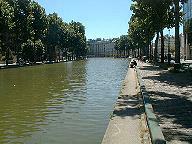
This basin is a meeting place for fishermen; eight different types of fish coming from the Ourcq Canal can be caught here. At this point, the canal goes over about one hundred 8-10m high pillars. Just like the ground under Notre Dame, this part of the canal rests on pillars.
Ecluse des Morts (double lock).Named after a Merovingian necropolis found here from the 4th-5th century, the lock walls are covered with fresh water shellfish very much enjoyed by the
ducks. At quai Valmy and quai
de Jemappes you emerge again in trees and gardens and yet another unique Paris
landscape. Wait patiently at the locks, note how the moss on the canals often
hides fresh water mussels. Near the basin de la Vilette the canal divides in to
two parts. The canal Saint-Denis and the canal de l’Ourcq, two working
waterways. This will be the end of your boat ride. The exploration of this
neighborhood will be in the 19th arrondissement.
But
let’s get back to the 10th. Follow the canal southwards until the
rue des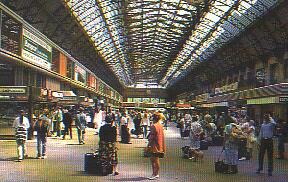 Recollets (do you have your good Paris map with you?). Make a right and soon
you’ll see at your right the galls and iron façade of the Gare de l’Est.
Via the rue de l’Alsace and rue Dunkerque you arrive at the gare du Nord. In
front of the gare the Brasserie Terminus, not bad for its foie gras and seafood.
Recollets (do you have your good Paris map with you?). Make a right and soon
you’ll see at your right the galls and iron façade of the Gare de l’Est.
Via the rue de l’Alsace and rue Dunkerque you arrive at the gare du Nord. In
front of the gare the Brasserie Terminus, not bad for its foie gras and seafood.
Take now the very old rue du
Faubourg Saint-Denis. At no.39, the
smallest house in Paris: 1m and 1 centimetre facade, one floor, and height 5
meters. The marche du Faubourg-Saint-Denis is a very animated and cosmopolitan
market.
This
street is connected to numerous alleyways to the rue du Faubourg Saint-Martin.
Passages du Prado, de l’Industrie and Passage Brady that became a little
India, bringing colour to this old, stuffy corridor. Indian and Pakistani
grocery shops. it swarms with people during the day. The most diverse shops are
lining the street and the gourmet restaurant Julien at no.16 kept its Art
Nouveau interior of glass and metal. The same with restaurant Flo in the Cour
des Petites Ecuries.
At rue du Faubourg Saint-Denis
no.54 starts the Passage Reilharc that leads via several inner courtyards to the
Boulevard de Strasbourg boulevard built by Haussman to connect the gare du Nord
and gare de l’Est with the center of the city.
Bibliography
--Vie et histoire des
arrondissements de Paris, ed.Hervas (1985-1988--Nouvelle Histoire de Paris,
ed.Hachette--Le Pieton de Paris, by L.P.Fargue, ed.Gallimard 199 --Dictionnaire
historique des rues de Paris, by J.Hillairet, ed.Minuit --Guide du Routard
1998-1999 (Ed.Hachette)--Paris, 2000 d'histoire, by J.Favier, ed.Fayard
1997-Cahiers du Cinema, by J.Dutourd (ed. Lageaume 1986)-Le Paris des canaux
(brochure Ville de Paris)
|
