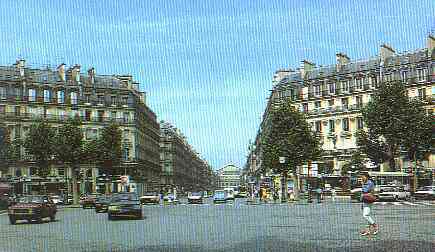
|
Art and
trade…all this can happen around the Opera Garnier area.
Indeed,
this 9th arrondissement has many faces. First of all, in the
department stores of Lafayette and Printemps it is always busy and hectic.
You’re looking for silence? A romantic atmosphere? Then you can move to
the new art area of “Nouvelle Athènes”. And the boulevard de Clichy?
That’s a horror!….
It became a 3 km
long connecting the Opera to the place de la Bastille and the loitering,
promenade itinerary of many Parisians. Alas! Today they leave me more an
impression of being neglected and highly commercialized! The unique charm of old
times, sung by Yves Montand in “J’aime flaner sur les Grands Boulevards”
seems far away…. The Grands boulevards were traced for the first time under
Louis XIV in 1675, where the old ramparts of Charles V used to be. During the
"Ancien Regime", this promenade, planted by four rows of trees had
different levels giving the opportunity to have magnificent viewpoints.
Enlivened by the presence of luxurious mansions, but also a lot of spectacles
and distractions, soon becoming theatres, the grands boulevards were during two
centuries THE place to be seen and to get entertainment. From 1850 on it
were the newspapers whose articles wre the catalyst of several political
gatherings, then photography and finally motion pictures at the end of the 19th
century.
The popularity of the Grands Boulevard didn't resist because the model they
created moved in different areas wich vibrate more like les Halles, Saint-Germain or St. Michel and of
course the Marais, boulevards Hausmanniens, Champs Elysees.
Today what makes the area in the 9th still popular is the possibility to participate
in Parisian nightlife, with its numerous restaurants,
bars, cafes, movie theatres and theatres called "theatres de boulevard”. You can see a theatre play at the, let’s say, “Bouffes
Parisiennes”, and have an after theatre supper at one of the numerous open
restaurants.
But I propose you some walking through several passages, still
undiscovered my many a tourist.
The Passage des Panorama a superb 18th
century gallery with the world famous copper etchings .. gravures and stationary
shop “Stern”.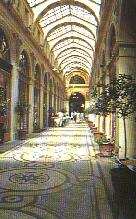 The first etages are always decorated with flowers. When you
cross the boulevard Montmartre at the end of the passage you can enter the
Passage Jouffroy but you can find anything, like a shop selling only canes, and
walking sticks (M&G Segas). Also cinema buffs should find their pick in
"Cinedoc" with over 4,000 film posters , postcards and books. Rue de la Grange-Bateliere, rush into the passage Verdeau (at
the other side of the street) . Shops here complain of a lack of clients but are
full of countless treasures and rarities. Take your time to loiter and discover
treasures by browsing through the shops items. It is the kingdom of the
antiquarian bookshops and old prints. Librairie Roland Buret has a lot of comic
books and memorabilia, The first etages are always decorated with flowers. When you
cross the boulevard Montmartre at the end of the passage you can enter the
Passage Jouffroy but you can find anything, like a shop selling only canes, and
walking sticks (M&G Segas). Also cinema buffs should find their pick in
"Cinedoc" with over 4,000 film posters , postcards and books. Rue de la Grange-Bateliere, rush into the passage Verdeau (at
the other side of the street) . Shops here complain of a lack of clients but are
full of countless treasures and rarities. Take your time to loiter and discover
treasures by browsing through the shops items. It is the kingdom of the
antiquarian bookshops and old prints. Librairie Roland Buret has a lot of comic
books and memorabilia,
But
finally, the main centre of interest for the first time tourist is the place de
l’Opera of course.
And for
the ladies and shoppers the department store Galeries Lafayette and Printemps
are a must and a not to miss opportunity to leave some good cash in France’s
pocket;-).
But I
will develop all this in my next articles. First we will do a walk starting at
the place de l’Opera, join the boulevard Haussman with the wallet-dangerous
Galeries Lafayette and walk further in less known areas.
Bibliography
--Vie et histoire des arrondissements de Paris, ed.Hervas
(1985-1988--Nouvelle Histoire de Paris, ed.Hachette--Le
Pieton de Paris, by L.P.Fargue, ed.Gallimard 1997--Histoire et dictionnaire de
Paris, by A.Fierro, ed.Laffont, 1996-Guide du Routard 1998-1999 (Ed.Hachette)--Paris,
2000 d'histoire, by J.Favier, ed.Fayard 1997--Naissance de Paris, by M.Fleury,
ed.Imprimerie Nationale 1997--Paris 19eme siecle, l'immeuble et la rue, by
F.Loyer, ed.Hazan, 1994-
|