|
Paris Opera Garnier Site Home - What's New?-Feedback - About Jack-Travel/Art Links |
|
Introduction et Grands Boulevards Opera Garnier |
Paris-9th arrondissement-Opera Garnier, history and anecdotes |
|||||||
|
“This, Madame, is
the Napoleon III
style”, says a legend affirming this is what Baron Haussman told empress
Eugenie when he presented the project for the new opera after she made him the
remark that she saw no Greek or Louis XVI style in the building. In fact, she
thought the whole plan was worthless…
Today, the Opera Garnier is as impressive as when it opened in 1875. The hexagon
formed by the adjoining streets with the place the l’Opera, avenue de
l’Opera leading to the Louvre and the Comedie Française was the ultimate
high-minded of the “urbanist” baron Haussman. Built in 1862, at the same time than the
Haussmann’s works,
it was only dedicated
in 1875 by
Mac-Mahon for Napoléon
III. It
has been in 1875. It’s one of the bigger theaters of the world : 172
meters of length, 101 of width and 79
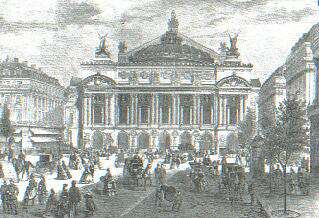
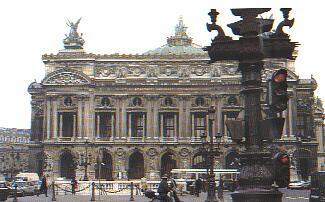
Outside, the main façade is composed of a series of arcades at ground level and
the high colonnades of the main storey, and towering above them, the crown-like
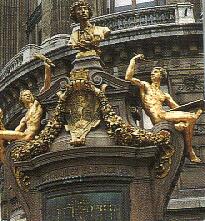
dome of the auditorium. Enormous sculptured groups (allegories of music, lyric poetry and dance, this one being a copy by
the sculptor Belmondo, yes, the father, of the original of Carpeaux, today in
the Orsay museum) adorn the front and the corners of the façade. High up
medallions contain the likenesses of famous composers Bibliography: --Vie et histoire des arrondissements de Paris, ed.Hervas
(1985-1988--Nouvelle Histoire de Paris, ed.Hachette--Le
Pieton de Paris, by L.P.Fargue, ed.Gallimard 1997--Histoire et dictionnaire de
Paris, by A.Fierro, ed.Laffont, 1996--Dictionnaire historique des rues de Paris,
by J.Hillairet, ed.Minuit --Guide du Routard 1998-1999 (Ed.Hachette)--Paris,
2000 d'histoire, by J.Favier, ed.Fayard 1997--Naissance de Paris, by M.Fleury,
ed.Imprimerie Nationale 1997--Paris 19eme siecle, l'immeuble et la rue, by
F.Loyer, ed.Hazan, 1994—Garnier, vie et œuvres, by P.Gaxotte ed. Rencontre. |
 of
height. The architect, Charles Garnier, used various materials to build it :
stone, marble, bronze. In front of the entrance stands a reproduction of
Carpeaux’ sculpture called « La Danse ». Inside the monument,
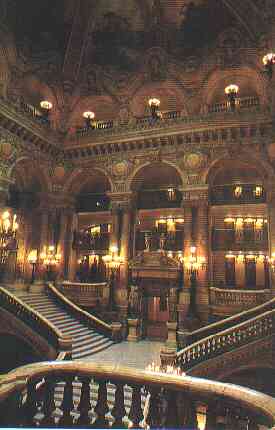
three elements are worth seeing : the
Great Staircase in white marble with a red and green marbled balustrade, the
Main Foyer with its mosaic ceiling, the
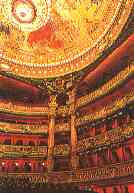
auditorium where Chagall has decorated the false ceiling in 1964.(see below)
of
height. The architect, Charles Garnier, used various materials to build it :
stone, marble, bronze. In front of the entrance stands a reproduction of
Carpeaux’ sculpture called « La Danse ». Inside the monument,
three elements are worth seeing : the
Great Staircase in white marble with a red and green marbled balustrade, the
Main Foyer with its mosaic ceiling, the
auditorium where Chagall has decorated the false ceiling in 1964.(see below)