|
Back
to Hidden, unknown Paris
I'm sorry not to be able to give you the right address of the Musee Edith Piaf, since to visit it, you MUST phone first tel 0143555272. A certain Mr. Marchois, in whose house the museum is located will give you the appropriate codes to enter the backyard and up the not so young stairs to the fourth floor,leading you to this moving museum, especially for those who loved and still dream about the incredible sensible and passionate voice of "the little sparrow" as she was nick named. I can unveil that it is located in two small rooms of Marchois flat in the Paris suburb of Menilmontant. An unpretentious black plaque on the wall of the house marks the location of the museum dedicated to the ``Parisian sparrow''.
A faded brown photo is stuck on the door, showing the face and expressive hands of Piaf. In the first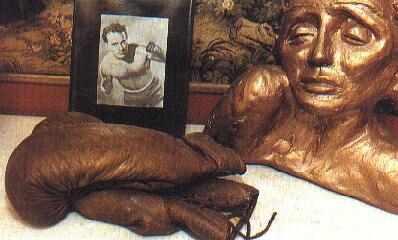 room a life-size figure of the singer stands, which, measuring a scant 1.47m, hardly reaches to the shoulders of most of the visitors. Next to the figure, sitting in an armchair, is an almost identically-sized teddy bear, a present to Piaf from her last husband, the young Greek Theo Sarapo. Piaf could almost have been his mother. The wall is adorned with portraits and photos of Edith Piaf, along with placards, letters and postcards. On a sideboard are located the museum's newest acquisitions, the boxing gloves of Marcel Cerdan, the Algerian-born Frenchman, who was involved with the chanteuse. room a life-size figure of the singer stands, which, measuring a scant 1.47m, hardly reaches to the shoulders of most of the visitors. Next to the figure, sitting in an armchair, is an almost identically-sized teddy bear, a present to Piaf from her last husband, the young Greek Theo Sarapo. Piaf could almost have been his mother. The wall is adorned with portraits and photos of Edith Piaf, along with placards, letters and postcards. On a sideboard are located the museum's newest acquisitions, the boxing gloves of Marcel Cerdan, the Algerian-born Frenchman, who was involved with the chanteuse.
THE BLACK dress on the tailor's dummy looks as if had been cut for a child. But for Bernard Marchois it is the most important item in his collection:
``This is the dress in which she sang, revelled in the applause and in which she suffered,'' says Monsieur Marchois, who looks after his ``Edith Piaf Museum'". You can also see red stage gown and two dresses she wore on 1951 when she played "La Petite Lili", a theatre play by Marcel Achard.
Mr. Marchois has all her records, he knew here from 1958 to 1963 and wrote two books about her you can buy. The visit is free and you can put whatever you want in the a little money tray
The museum, founded by the society in 1977, is however only a stopgap measure. The Friends of Piaf want a ``Museum of French Chansons'', where they can see their Piaf memorabilia displayed.
But for let's have a brief history of Edith Piaf for those of you who don't know her.
She was born in 1915, only a few streets away, daughter of a fairground singer and a carnival ``snake man'', in the same area of Menilmontant. As a child she sang in the backyards of Menilmontant, to the east of the capital, and when she died on October 11 1963, she was buried in the Pere Lachaise cemetery in the same suburb. At her funeral, thousands of people lined the route to pay their respects. ``Non, je ne regrette rien'' - no, I regret nothing - Piaf summed up her life shortly before her death, a life marked by alcohol, drug abuse and illness.
Bibliography
Edith Piaf, le temps d'une vie by Marc Bonel, La mome Piaf,
by Auguste Le Breton.
Paris
main page
|
