|
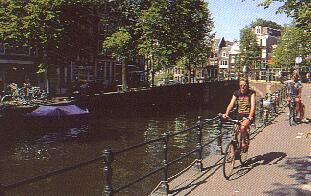
Amsterdam is a city for
walkers and to loiter in all quietude. It�s the cheapest transport system you
can use in Amsterdam. Yes, yes, it's a fact. The ancient centre of Amsterdam is
relatively small, there are no hills to contend with, and most of the cities
outstanding historic and cultural sights are compacted in a few square
kilometres, the distances are short. For instance to go from Central Station to
Damplaats, not even 10 minutes. From the Dam to Leidsplein about 20 minutes.
From Waterlooplein to the Westerkerk and the Jordaan quarter (west of the
canals) about 20-25 minutes max. Within the city center, traffic is light and
pedestrians are respected as in few other European cities�though you have to
watch out for trolley buses and bicycles! At daytime they are very numerous,
popping up when you don't expect them. Their approach is silent, rapid and
unexpected! And during the night they are even more numerous and ride without
lights. Watch also out for the trams. Take also care and beware for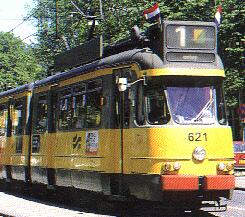 pickpockets,
particularly active as soon as night falls, in the area of nightclubs, around
the Leidseplein as well as in the Red Light district (while lurking, your eyes
and nose upwards, the pretty girls in their display windows). Avoid engaging in
the narrow and deserted alleyways of the Red district at night, there have been
aggressions. And if you�re aggressed please don�t play the hero � Clint
Eastwood type�, especially with the drug addicts, they could be dangerous. If
you have a car, don�t leave any apparent value on sight if you park your car
for a longer time. Take only the valuable objects you will need during the day
and leave the rest at the hotel. Avoid wearing and parading with the perfect
tourist panoply: camera on a shoulder strap, wallet in the banana and city map
in your hand. Routine!!! Just a bit of common sense, like in any big city,
that�s all. pickpockets,
particularly active as soon as night falls, in the area of nightclubs, around
the Leidseplein as well as in the Red Light district (while lurking, your eyes
and nose upwards, the pretty girls in their display windows). Avoid engaging in
the narrow and deserted alleyways of the Red district at night, there have been
aggressions. And if you�re aggressed please don�t play the hero � Clint
Eastwood type�, especially with the drug addicts, they could be dangerous. If
you have a car, don�t leave any apparent value on sight if you park your car
for a longer time. Take only the valuable objects you will need during the day
and leave the rest at the hotel. Avoid wearing and parading with the perfect
tourist panoply: camera on a shoulder strap, wallet in the banana and city map
in your hand. Routine!!! Just a bit of common sense, like in any big city,
that�s all.
Few Europeans speak English so fluently and willingly as the Dutch,
communicating should no be a problem.
Public transportation is efficient and plentiful: whenever your feet get tired
there is a handy bus, tram; metro train or canal cruiser to take you home.
You can save money buy buying an Amsterdam Culture and Leisure Pass. Thos carnet
of 28 coupons gives you free entry top many of Amsterdam�s museums and
attractions including the Rijksmuseum, Van Gogh museum, Stedelijk Museum of
Modern Art, Amsterdam Historical Museum, Rembrandt House and a lot more. Be
aware that the individual entrees are quite expensive, let�s say 5 to 7 USD
average. Not very much of them propose a discount for students. But the less
than 16 or 18 years old pay less, as well as the seniors.
It's fascinating to visit a civilized city where it is possible to get lost.
Nothing looks more as a canal than another canal. In this concentric city, laid
out like a spider's web, an honest street is never straight without mentioning
the numerous small alleyways sometimes not wider than a bike handlebar. Another
odd sight: several streets have the same name in the same area. To differentiate
them, they are numbered: eerste (first), tweede (second), derde (third) or a
directional indication: dwars (transversal).
Dutch weather can change from warm and sunny to chilly and wet in the blink of
an eye, even in high summer. Pack a light waterproof or carry an umbrella.
Winters are cold: warm clothes, waterproof footwear, hats and gloves are
recommended from October until the end of April. The best walking months are
between mid-April and mid-October.
But before we start our Amsterdam walks, you�ll have to pass my history lesson
;-). Remember my motto. You visit much better and more interesting when you have
some notion about the history of the city you visit.
That�s for next articles�
Bibliography
Holland,
by Adam Hopkins (Faber and Faber, 1988), Penguin Guide to Amsterdam (ed.Vincent
Westzaan, Penguin 1990), Guide du Routard 1998 (ed.Hachette), De Nederlandse
Realiteit, by J.Oostkamp (own folders), The Embarrassment of Riches, by Simon
Schama (Collins 1987) is a scholarly but accessible interpretation of Dutch
culture.
World
War II
|