|
In 1602, the famous
East-Indian Company (Oost-Indische Compagnie) is founded by the merchant cities
of Holland and Zeeland, but more than half of the invested funds come from
Amsterdam, where the company has its headquarters. Several times a year, a fleet
leaves for the Orient, and the company obtains the monopoly of import of all
Indonesian spices (nutmeg, pepper and clove), Chinese and Japanese vases, Indian
fabrics. South Africa, the Mauritius islands, Ceylon and Indonesia are
colonized. All this by a little, tiny country!!
The fact that the war with Spain had closed down the ports of Spain and Portugal
to Dutch traders, promptly set them out to forge their own trade routes to the
New World. After the founding of New-Amsterdam (future New York) overseas, in
1614, under Peter Stuyvesant (smoking his first cigarette??), the Company of the
Occidental Indies was created (West Indische Companie) in 1621, in Amsterdam.
With its own navy and army to protect its ships and factories the West Indische
Companie was enormously powerful and incredibly wealthy. This company controlled
the transport of slaves between Africa and the Americas (not very Calvinistic or
Lutheran as a business!!). The island of Curacao became the main market of
slaves in the New World. Amsterdam, becoming the import centre of sugar, tobacco
and cacao imported from Brazil, and a lot of other products became the most
important stock exchange in the world! Typical Dutch machinery, the windmill,
helped to transform large quantities of raw materials in semi-finished products.
Thousands of windmills in Amsterdam and the surrounding areas (Zaandam) were
unheard of industrial park for that epoch (and still a stunning touristy park
today). The symbol of the prosperity and power of this town was the New Town
Hall on the Dam square, edified with German imported stones, as enormous as
hideous, and built from 1648 on 13,000 wooden piles. But slowly, inside the
Republic, Amsterdam loses its political role in the 18th century to
the prejudice of the princes of Orange (Prinsen van Oranje) residing in The
Hague. And because the sandbanks invade more and more the access to the
Amsterdam port from the Zuiderzee, it abandons a part of the commerce to the
Dutch cities located nearer to the North Sea, like Rotterdam, and foreign
cities, like London and Hamburg. Nevertheless, the wealth accumulated during the
Golden Century, keeps Amsterdam in its position of the European financier and
banker until 1780. windmill,
helped to transform large quantities of raw materials in semi-finished products.
Thousands of windmills in Amsterdam and the surrounding areas (Zaandam) were
unheard of industrial park for that epoch (and still a stunning touristy park
today). The symbol of the prosperity and power of this town was the New Town
Hall on the Dam square, edified with German imported stones, as enormous as
hideous, and built from 1648 on 13,000 wooden piles. But slowly, inside the
Republic, Amsterdam loses its political role in the 18th century to
the prejudice of the princes of Orange (Prinsen van Oranje) residing in The
Hague. And because the sandbanks invade more and more the access to the
Amsterdam port from the Zuiderzee, it abandons a part of the commerce to the
Dutch cities located nearer to the North Sea, like Rotterdam, and foreign
cities, like London and Hamburg. Nevertheless, the wealth accumulated during the
Golden Century, keeps Amsterdam in its position of the European financier and
banker until 1780.
In the 17th and 18th centuries wars start again! At the
zenith of its glory, the new Dutch republic, still dominant on the maritime
front, has to fight a lot of enemies: Portuguese, Spaniards, French, Swedes and
above all these damn English;-) (a humble apology for my English readers
that’s how the French called the English at that time, “ces sacres Anglais!).
Its handicap of being a small country had its first consequences in its
colonies. England and France sapped the country’s energies and drained its
coffers. In 1795 revolutionaries backed by the new French Republic overthrew the
government of Stadhouder Willem V and the States-General and declared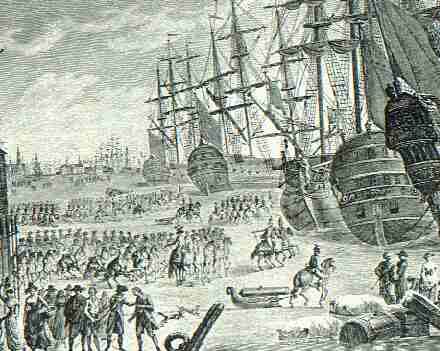 the
Batavian Republic. This was soon swept away and Louis Bonaparte (1778-1846) was
installed King of the Netherlands. It’s really an astonishing fact that the
French revolution will provoke a diametrically opposed reaction as in other
countries. Republic will be abolished and monarchy restored! This must be the
special way of the Dutch to have the “right of difference”! Louis Bonaparte
transforms Town Hall on the Dam in Amsterdam into a royal palace and proclaims
Amsterdam capital of the country. However on the economic level, the city is
becoming impoverished and on the calamities list they find: continental block
(like an embargo) obligation to participate in all Napoleon war campaigns, the
loss of South Africa and Ceylon. After the defeat at Waterloo, the Netherlands
and Belgium are reunited again. the
Batavian Republic. This was soon swept away and Louis Bonaparte (1778-1846) was
installed King of the Netherlands. It’s really an astonishing fact that the
French revolution will provoke a diametrically opposed reaction as in other
countries. Republic will be abolished and monarchy restored! This must be the
special way of the Dutch to have the “right of difference”! Louis Bonaparte
transforms Town Hall on the Dam in Amsterdam into a royal palace and proclaims
Amsterdam capital of the country. However on the economic level, the city is
becoming impoverished and on the calamities list they find: continental block
(like an embargo) obligation to participate in all Napoleon war campaigns, the
loss of South Africa and Ceylon. After the defeat at Waterloo, the Netherlands
and Belgium are reunited again.
End of this thriller in next article…..
Bibliography
Holland, by Adam Hopkins
(Faber and Faber, 1988), Penguin Guide to Amsterdam (ed.Vincent Westzaan,
Penguin 1990), Guide du Routard 1998 (ed.Hachette), De Nederlandse Realiteit, by
J.Oostkamp (own folders).-Die Niederlande in Europa Geschichte (Dieter
Verlag-Munchen 1986)—De Gouden Eeuw van Amsterdam, by Jan Van Heirstra (ed.New
Holland 1996)
|