|
Water, this was the master
word. It guided the route everywhere. More than 400 bridges bend their spine to
honor the water. You don’t easily change between sidewalks in Amsterdam, you
have to look for the next bridge to get at the other side. And we are seduced!
Around the canals, thousands of stunning houses bending softly over the water
and whispering: “ Canal, canal, am I still the most beautiful house in the
area?” Visitors and walkers, you are here in front of one of the most
extraordinary display windows of all times. An open city. Here you will not find
any shutters at the windows. Nothing to hide, you loiter as in a large village.
And that’s the special magic of this city to offer itself without any
deception or false pretension. This is a city smiling and humble at the same
time, always friendly, almost loving. You will like Amsterdam because it’s
like it is.
You’d like to find a wrong note but suddenly a bouquet of young girls
on bicycles pass by, their backs straight up and high handlebars, accompanied by
crystalline laughter. An old ageless café calls us with its dozens of small
candles glistening in the window. No need to invoke the museums, the street has
so much to offer!
“”I would prefer Amsterdam to Venice: because in Amsterdam, you have
the water without being deprived of the land”””” said the French philosopher Montesquieu)
Amsterdam is an upstart among the great cities of Europe. Most of the buildings
you will see on your walks around the city date from no earlier than the 17th
century, contrarily to Flemish cities like Bruges Ghent and Antwerp. On the
other hand, much of city’s historic heart survives intact or restored, with
surprising little modern intrusion.
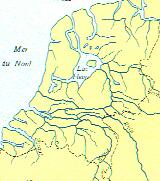
In prehistoric Roman times, and through the Dark Ages, the site on which
Amsterdam stands now was empty, swampy and very inhospitable. “ What the hell,
we don’t care, “ said the inhabitants of the county of Holland. Later it became a little fisher settlement and before the early 13th
century it had become a prosperous little merchant town within the territory of
the bishop of Utrecht. Fishermen settled down on the right bank of the mouth of
the Amstel, building a dike, which should protect them from the tumultuous tides
of the Zuiderzee, the “Zeedijk”. Because there was another enemy they had to
fight: the North Sea. Though the sea brought prosperity, it continuously
threatened to overwhelm the city and the farmland around it. The struggle with
the sea shaped Amsterdam. The sea gave Amsterdam a highway to ports all over
Europe, while the rivers carried its trade goods far inland. On the Amstel also
a passage was built equipped with locks, near the embouchure called “dam”.
The place and the village which will develop from that settlement takes the name
Amstel-Dam which will become…you’re not stupid, you guessed it already;-)… Amsterdam. It’s in 1300 that Amsterdam receives its city rights
in the county of Holland and develops more and more on the left bank called
“Nieuwe Zijde” (New side) higher up the Amstel around the present Rokin.
Through the Middle Ages Amsterdam’s prosperity was boosted by commerce and by
the mid 15th century it had become the most important port in
northern Europe, trading across the length and the breadth of the mighty Holy
Roman Empire. In 1489 Emperor Maximilian I granted the Imperial Seal. With its
population of 9,000 it was one of the biggest cities in Europe.
More in next article…..
Bibliography
Holland,
by Adam Hopkins (Faber and Faber, 1988), Penguin Guide to Amsterdam (ed.Vincent
Westzaan, Penguin 1990), Guide du Routard 1998 (ed.Hachette), De Nederlandse
Realiteit, by J.Oostkamp (own folders).-Die Niederlande in Europa Geschichte
(Dieter Verlag-Munchen 1986)
|