|
About 1550 later the city
counts 30,000 inhabitants. It
disposes of an interior port (the actual Damrak) and a system of canals and
locks which could regulate the level of the Amstel, partially diverted out of
town, and to clean the canals by using the current of the stream and the tides
of the Zuiderzee. The city lives from its fishery and commercial exchanges.
But times change. The radical ideas of the Protestant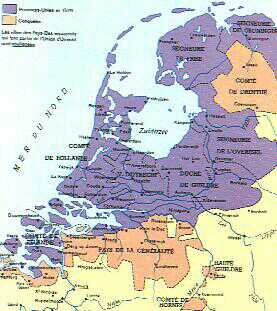 Reformation are quickly taken up by the traditionally independent-minded and
tolerant Amsterdammers. The ideas of Luther and Calvin spread all over Europe
and coincide with the reattachment of the Netherlands to the very catholic Spain
The city, now ruled by Philip II of Spain (1527-1598), patron of the notorious
Spanish Inquisition, nevertheless became a refuge for Protestants from all over
Europe. Soon they turned into armed resistance in 1568 with prince Willem of
Oranje (Willem the Silent), and his “Geuzen" against the brutal
occupation of Amsterdam by the duke of Alva. Finally the Spanish troops are
evicted from the country and Amsterdam is besieged and surrenders to Willem in
1578.The country (present Netherlands) frees itself from the yoke of the Spanish
invaders and becomes the republic of the Nine United Provinces, while the
southern part (today’s Belgium) stays under Spanish domination. The overthrow
of Spanish rule ushered in a Golden Age while its greatest former rival,
Antwerp, stays in Spanish hands. Antwerp is sacked in 1584-85 and refugees from
there brought wealth and new skills to Amsterdam.
Reformation are quickly taken up by the traditionally independent-minded and
tolerant Amsterdammers. The ideas of Luther and Calvin spread all over Europe
and coincide with the reattachment of the Netherlands to the very catholic Spain
The city, now ruled by Philip II of Spain (1527-1598), patron of the notorious
Spanish Inquisition, nevertheless became a refuge for Protestants from all over
Europe. Soon they turned into armed resistance in 1568 with prince Willem of
Oranje (Willem the Silent), and his “Geuzen" against the brutal
occupation of Amsterdam by the duke of Alva. Finally the Spanish troops are
evicted from the country and Amsterdam is besieged and surrenders to Willem in
1578.The country (present Netherlands) frees itself from the yoke of the Spanish
invaders and becomes the republic of the Nine United Provinces, while the
southern part (today’s Belgium) stays under Spanish domination. The overthrow
of Spanish rule ushered in a Golden Age while its greatest former rival,
Antwerp, stays in Spanish hands. Antwerp is sacked in 1584-85 and refugees from
there brought wealth and new skills to Amsterdam.
The instability in England and France and also the occupation of its main
competitors (Lisbon in 1580 and Antwerp in 1585) by the Spaniards will give
Amsterdam, during a whole century, a disproportional and overwhelming commercial
supremacy and produce an unheard material, financial and cultural wealth! The
city becomes a haven for painters and philosophers. The 17th century
will become for Amsterdam the “Golden Century”.
Mid 17th century Amsterdam is the home for more than 200,000 people.
Prosperity and intellectual eclecticism! The fall of Antwerp and Lisbon attracts
a huge immigration of Portuguese and Jewish merchants to the new Republic,
mostly to Amsterdam.
Works began as early as 1613 on the three concentric canals (Herengracht,
Keizergracht and Prinsengracht) on the other side of the Singel, closed by a new
fortified canal, the “Buitensingel”, separating historical old Amsterdam
from the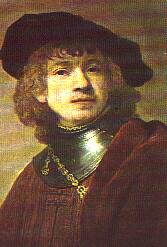 later outer suburbs. Rich merchants build luxurious townhouses along
the new canals and their wealth trickles down to painters and craftsmen. The
houses are like said “with the feet in the water”. later outer suburbs. Rich merchants build luxurious townhouses along
the new canals and their wealth trickles down to painters and craftsmen. The
houses are like said “with the feet in the water”.
The wealthiest merchants living in the Gouden Bocht (Golden Curl) of the
Herengracht, while the peripheral area of the Jordaan between the Prinsengracht
and Buitensingel houses the work and craftsmen (today the area becomes trendy
again but the workmen are still very faithful to the neighbourhood). Four
Protestant churches which divide the city into squares (the Noorderkerk,
Westerkerk, Zuider and Oosterkerk) are built in this new areas.
The elite commissioned Rembrandt and his peers, visitors were awed by the
city’s prosperity, clean streets and public works. By 1670, cities like London
and Paris were mostly sewage-scented slums, while Amsterdam boasted streets lit
each night by 2,000 oil lanterns.
This history will continue in next article….
Bibliography
Holland,
by Adam Hopkins (Faber and Faber, 1988), Penguin Guide to Amsterdam (ed.Vincent
Westzaan, Penguin 1990), Guide du Routard 1998 (ed.Hachette), De Nederlandse
Realiteit, by J.Oostkamp (own folders).-Die Niederlande in Europa Geschichte
(Dieter Verlag-Munchen 1986)
|