|
The union with Belgium was
not to last long. In 1831-32 the southern provinces rose in revolt and Belgium
became an independent kingdom with Leopold I, a German prince, as first king.
Amsterdam recovers very slowly and its population finally reaches again the same
as in the 18th century: 200,000 inhabitants. The age of steam made
Amsterdam a vital link between Europe’s booming railway networks and the
transatlantic liner and freight services, while wealth poured into the city from
the newly discovered South African diamond mines.
 |
|
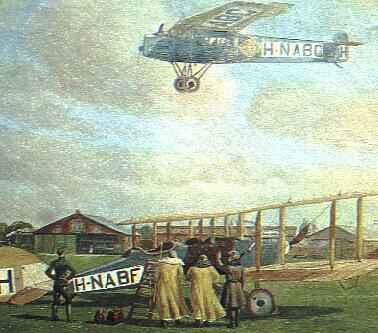
First KLM double-deckers |
The reprise of thecommerce
with Indonesia and Surinam, the drainage and drying up of the Haarlem Lake, the
industrialization and digging of a canal connecting Amsterdam with the North sea
(Noordzeekanaal), will increase the population of Amsterdam spectacularly. A
belt of popular quarters is built outside the Buitensingel, interrupted in the
south only by the Leidsplein and the Museum plein where the concert hall
“Concertgebouw” and the modern art museum “Stedelijk Museum” are built.
A park is added: Vondelpark, in 1889 a railway station in the old port.
During the first world butchery, the Netherlands remained neutral. The city
builds more and more to embellish and you lose count of the houses and edifices
decorated with brick and stone, which style will be called “the Amsterdam
school” (de Amsterdamse school). But the economic crisis of 1933 hits without
pity, and a lot of foreign refugees start pouring in, like Jews and Germans.
Germany occupies the
Netherlands during WW II but curiously Amsterdam was never seriously bombarded.
Another very bizarre fact I just mention without wanting to enter in a debate is
that almost the total Jewish population (100,000) will be deported by the
Germans. Now this is a very controversial and painful episode of Dutch history.
I first thought of not mentioning the facts to my readers, but I have to stay
honest. This happened and there is no way of hiding it for the sake of keeping
an ideal image of Holland. Is it possible to deport 71.4 % without some active
aid from local authorities, police and …population? Let’s not get too deep
in that given that some historians claim that the proof the population was not
collaborating and anti-Semite is the solidarity strike of February 1941 the
attitude of the whole country facing the oppressor forcing admiration of
international community. Underground resistance groups and individuals helped
shelter Jews and other fugitives. The example of the aid given to Jewish
families, like Anne Frank, hiding in a house of the Prinsengracht, will become
highly symbolic. Amsterdam, 262
Prinsengracht. The revolving bookshelf leading to the roof rooms where
Anne Frank was hidden. It's here that at the libertaion the moving,
terrible diary was found.
I would incline to that explanation even if finally…. Anne
Frank was deported and died in concentration camp because of a denunciation of
Dutch neighbours.
I personally believe that the special regime and administrative efficacy of the
German administration was the cause of the high percentage of deported and not
the collaboration of the people of Holland.
Let’s not forget that the Dutch authorities, especially queen Wilhelmina,
called the Dutch up to resist the invaders, from England. After the disastrous
battle of Arnhem and the starvation winter of 1944, the Canadians only liberated
Amsterdam on the 8th of May.
Those who know the Dutch today cannot believe that they could be a collaborating
nation with the Nazis.
The proclamation of the independence of Indonesia in 1949, gives the “tropical
commerce” of Amsterdam a heavy blow. It’s the port of Rotterdam, directly
connected to the Rhine that will grow and extend to the disadvantage of
Amsterdam. This loss of income will only partially be compensated by the
development of Schiphol airport. The city diminishes its industries and
specializes in the service sector.
The modern city of Amsterdam is a mixture of bohemianism, sleaze and solid
respectability. On the Old Side, it is not unusual to see an elderly housewife
carrying her shopping into an apartment doorway flanked on one side by a
neon-lit window in which a plump prostitute displays her charms and on the other
by a “coffee-shop” where the fumes of hash are heavy on the air. The age-old
tradition of turning a blind eye continues to thrive.
The compact city-centre---within the inner Singel canal---buzzes with tourism
the year around, but the heart of the city is still very much a place where
local people live, work and play. In the more modern suburbs outside the old
city centre ---and even in the Jordaan and the harbour neighborhoods---there is
hardly a visitor in sight
Today, Amsterdam has found his right place in the concert of Dutch cities. If
Rotterdam holds the industrial power, the Hague the political power, this modest
fisher village, which became for a while the centre of earth, stays—with its
central bank, its two universities, its three grand museums and its historic
centre---the financial, university, artistic and historic capital of the
Netherlands. ……
Bibliography
Holland, by Adam Hopkins (Faber and Faber, 1988),
Penguin Guide to Amsterdam (ed.Vincent Westzaan, Penguin 1990), Guide du Routard
1998 (ed.Hachette), De Nederlandse Realiteit, by J.Oostkamp (own folders).-Die
Niederlande in Europa Geschichte (Dieter Verlag-Munchen 1986)
Encyclopedia of the Holocaust in Holland, by the Simon
Wiesenthal center—Nederland in de oorlog, moed of collaboratie? byTom
Vanderlinden (Noorderuitg.1955)
|