|
Be
aware that this city is totally unfit for an automobile! Walk, walk and walk or
eventually rent a bicycle. The best that could happen to you is to get lost in
the small streets when a canal or a bridge will suddenly appear behind a corner,
a church ignored by the crowd, an old tavern where the time stopped. This city
is incredibly romantic so don’t go alone but be in couple. Strolling hand in
hand along the canals, you will feel like in timeless moments, touching from
time to time the wall to see if this is real stone and not Disneyland cardboards
or artifices. You will forge souvenirs for a lifetime. Small, intimate
estaminets, cordial and convivial cafes, restaurants where the good Flemish food
will easily go be digested, if you follow my advices, since tourist traps are
everywhere. To ask your fiancée to be yours forever, this is the place!
Pick out the right season to visit Bruges. The summer months are not the best
moment to go, overwhelmed with visitors. Springtime is much better, when the
jonquils cover the Beguinage lawns or in the fall when a stroll along the
embankment to see the
 collectibles open market or visit the treasures of Flemish
painting in the Groeninge and Memlinc Museum. collectibles open market or visit the treasures of Flemish
painting in the Groeninge and Memlinc Museum.
It is impossible to see all in Bruges in one day. My itinerary in will cover two
days: you will have visited about 90% of the museums and monuments.
Let’s
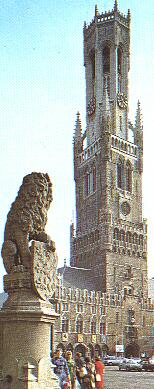
start at the “MARKT, since ages the centre of old Bruges. The majestic gothic
“Hallen” with its proud BELFRY rises 83 meters high. This complex was built
in the 13th century, when the power of Bruges was expanding and the future
looked bright. The building reflects the mentality of the inhabitants at that
time, proud and with a strong, pure line. The floor of the belfry was used as
marketplace, where the linen and the spices were sold. The first floor was used
as city hall. To get on top of the belfry you will have to mount 366 steps. The
reward is a magnificent panorama of Bruges and the surrounding Flemish
countryside. At the east side of the Markt you see buildings in neogothic style,
the post office built in 1887.
Go from the Markt to the “BURG"
. A more detailed visit of the Markt will follow in another articel together
with a more detailed visit up the belfry.
This beautiful square, surrounded by important buildings is the oldest centre of
Bruges. It’s here that the history of the city began with the foundation of
the count castle by Boudewijn van Vlaanderen, at the east side of the Burg.
At the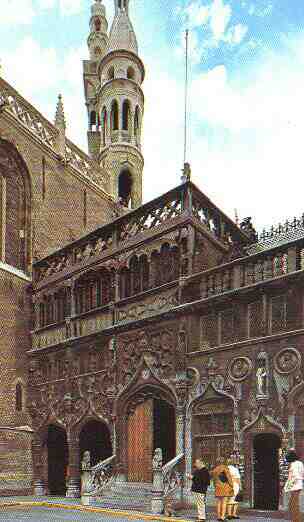 southwest side of the Burg, the very peculiar
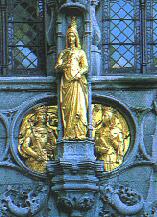 BASILICA OF THE HOLY
BLOOD”(Heilig Bloed Basiliek). It's in fact a double church. A first Roman
style building was imbricated in a later build Gothic church, the whole thing
being connected with a beautiful exterior Renaissance stairway. On a Rococo
altar you can see a precious relic (a little bottle) containing the holy blood
of Jesus brought by Thierry d'Alsace during the 12th century, probably during
the looting of Constantinople in 1204 (the legend says he received a few drops
of Jesus blood from the Patriarch of Jerusalem during a crusade) Jan Crabbe made
for this holy item in 1617a marvellous casket. BASILICA OF THE HOLY
BLOOD”(Heilig Bloed Basiliek). It's in fact a double church. A first Roman
style building was imbricated in a later build Gothic church, the whole thing
being connected with a beautiful exterior Renaissance stairway. On a Rococo
altar you can see a precious relic (a little bottle) containing the holy blood
of Jesus brought by Thierry d'Alsace during the 12th century, probably during
the looting of Constantinople in 1204 (the legend says he received a few drops
of Jesus blood from the Patriarch of Jerusalem during a crusade) Jan Crabbe made
for this holy item in 1617a marvellous casket.
 |
|
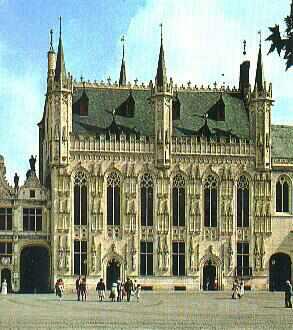
City Hall |
Next
to the basilica is CITY HALL, is a jewel of Gothic art, dating from 1421. It is
not build out of bricks but of stone. In the Middle Ages it showed some
prestige. A dazzling facade!! It decorates the square with all its beauty and
was built after the fire that destroyed the Hallen. Started in 1376, the
building was finished in 1420. It must have been a great event for the Bruges
people to build this city hall, symbol of city civil power, on the Burg, old
strongholds of nobility power.
 |
|
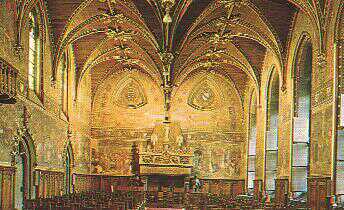
Gothic hall |
Inside
you should visit the GOTHIC HALL. It is decorated with paintings, but not
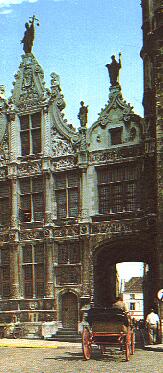
authentic. The building in lively Flemish Renaissance style, built next to City
Hall is the “Old Civil Clerk building”, elevated between 1534 and 1537.
To end the visit of the Burg just a few words about the building at the east
side of the Burg. It’s the “OLD COURTHOUSE” (Oude Gerechtshof). This
friendly building in classicistic style rose in the 18th century and
hides a surprise: the former alderman’s rooms from an old palace that used to
stand here in medieval ages. In this rooms stands a world famous open fire in
oak wood, heavy marble and alabaster, a Renaissance master work; This fantastic
work was made in honour of Carolus V victory in Pavia, 1525 on the French king
Francois 1er!
The Tourist Office is nestled at the
"BURG" in the ancient "Justitiepaleis" People working there
are highly competent and treat you with angel's patience.
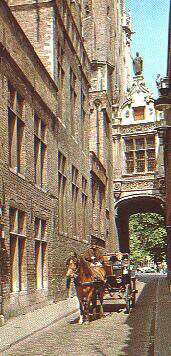
Just next to City Hall you will see a little passage under a cute little arch
leading to street with a bizarre name: Blinde Ezelstraat (Blind Donkey street)
going down to the "Reie", a waterway. Wait for me there, I’ll be
back in next article……
 |
 |
|
Old Clerkhouse |
Blind Donkey street |
Bibliography
The
fair face of Flanders, by Patricia Carson,Ghent 1969---De Vlaamse
Krijgsbouwkunde , by M.Van Hemelrijck, Tielt 1950---Gids voor Benelux, by Jozef
van Overstaete, VTB 1985---Guide du Routard 1999, ed.Hachette.
|


