 |
|
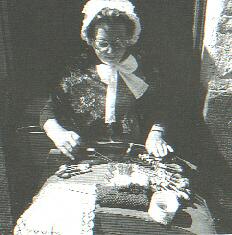
Making lace (old postcard) |
This is the name that this
Northeast part of Bruges was called, once populated by foreign merchants,
especially Venetians, Florentine and Genuans. Less frequented by tourists but
there are some interesting spots.
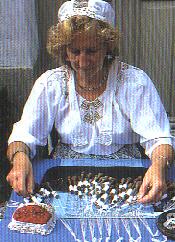
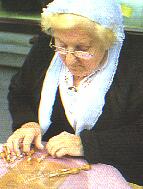
The “Kant centrum” (LACE CENTER) open 9.30-12.00 and 14.00-17.00, is housed
in old “godshuisjes”; (houses of god) of the 15th century while
the ateliers are located in the ancient home of a Genoan family, the Adornes.
The lace makers are at work in the afternoon. According to a guide the “real
and genuine “Bruges lace” is unfindable. Those, sold in the boutiques are
authentic because the techniques and models are, but they are manufactures in
Asia in ateliers where religious missionary sisters teached everything to the
young Philippine girls.
Next to the museum, the JERUSALEM CHURCH was built in 1421 by the Adornes
family. Model of the building was probably the Holy Sepulchre church in
Jerusalem where the Adorned brothers went for pilgrimage. Inside you can see the
graves of the Adornes, like the one of Anselme Adornes, rich merchant, mayor of
Bruges, and his wife.
The Museum of Volkskunde (FOLKLORE MUSEUM), open 9.30-12.00 and 14.300-17.00 is closed on Tuesdays in low season, is also
housed in godshuisjes and built around a centre courtyard. You walk around in a
in this adorable small museum where the life of 100 years ago is reconstituted.
Walking around you will meet an ancient shoemaker’s shop, a schoolroom, a
kitchen, a grocery a pipes and tobacco room, a pharmacy and a confectionary
where they still make titbits.
North of the Carmerstraat is the
“Schuttersgilde St.Sebastiaan” (ARCHERS GUILD), housing a nice collection of
silverware. Founded in 1302 the guild received Charles II of England when he
lived in exile in Bruges, chased by Cromwell. It’s since then that all kings
of England are automatically member of this guild. In
the same street is the “Schuttersgilde St.Joris.
The “St.Janshuismolen” (MILL OF
SAINT JOHN) is one of the three last still working mills on the Vesten. You can
visit it 9.30-12.00 and 13.00-18.00. Imagine that in the 15th
century, 28 mills used to turn here. Their machineries are still very
impressive. More south, the KRUIPOORT is one of the four medieval gates of
Bruges.
Leaving this area of an outdated quietness, take the Oostgistelhof, the Spaanse
brug and Spanjaarstraat that leads you to the cute Van Eyckplein,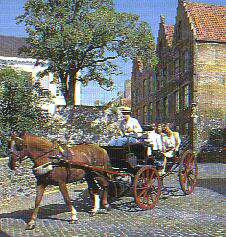 where the
massive OUDE TOLHUIS (Taxhouse) built in 1478 stands. It is now an archive for
the 130,000 volumes of the communal library. Here
you are in the centre of the Hanseatic Bruges, an association of ports in the
Baltic Sea affiliated with Bruges and Amsterdam. where the
massive OUDE TOLHUIS (Taxhouse) built in 1478 stands. It is now an archive for
the 130,000 volumes of the communal library. Here
you are in the centre of the Hanseatic Bruges, an association of ports in the
Baltic Sea affiliated with Bruges and Amsterdam.
The SINT JACOBSKERK , hall-church with
three naves. Built in 1239 and was enhanced many times by numerous donations.
But most everything was looted by the iconoclasts.
The itinerary ends by a return to the Grote Markt through the Sint Jacobstraat.
There are still n numerous spots to explore but I leave you the pleasure of
discovery.
As
a pleasant extension to all that walking in Bruges you can take a boat ride
along the canals. You have 5 piers where you can embark, no fixed schedules.
They wait until the boat is full to depart. Usually running from 10-18 h and in
wintertime only on weekends and during vacation periods like Christmas. If the
commentary during the trip is very dull and not interesting (they have to
satisfy everybody in 5 or 6 languages) the boat uses during 30-min. passages
where only a boat can come. And if during the navigation some nauseous emanation
will tickle your nostrils, be sure that the municipality makes immense efforts
to cleanse and purify the canals. But Bruges is the victim of his own success:
15 years ago a development study had foreseen a tourist frequency of 500.000 a
year. In 1994 Bruges had 4 million visitors!!! This explains that.
Bibliography
The fair face of Flanders, by Patricia
Carson,Ghent 1969---De Vlaamse Krijgsbouwkunde , by M.Van Hemelrijck, Tielt
1950---Gids voor Benelux, by Jozef van Overstaete, VTB 1985---Brugge te voet,
ed.Van Mieghem, Oostende 1995-Guide du Routard 1999—Reishandboek Belgie, by De
Roy van Zuidewijn (ed.ELMAR 1992)
|