|
Are
you all there? Ok. We passed the cute arch of the blind Donkey street and are
now on a bridge where looking in both directions is full of charm.
The view from the bridge in both directions is full of charm. On the left the
Fish market, surrounded by pillars and arches, a gift from Napoleon Bonaparte in
the first half of the 19th century. To the right, the "Huidevettersplein"
(Tanners place) where they used to tan the leather, but are transformed today in
cafes and restaurants. It is marvellous to loiter in this maze of small a street
where the charm of Bruges impresses most and to cross those little bridges that
gives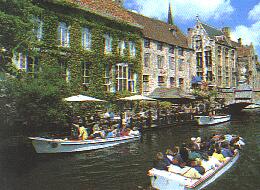 you
each time another view. you
each time another view.
Continue, pass the excursion boats landing and you arrive at
the"Rozenhoedkaai" (Rosary Embankment) where the wooden houses, the
water, the ivy, the willows, the belfry, the City Hall turrets........Between
March and November the Rozenhoedkaai and de Dyver are the starting points of
most of the boat tours. This is the easiest way to make a quick acquaintance
with the main sites and buildings of Bruges. The neat little gardens and
flowerpots decorating the waterside give the whole journey something festive.
 |
|
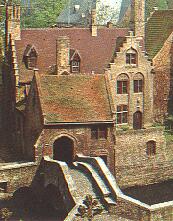
Hump back bridge |
Gliding
in these dark waters, surrounded by swans, at the foot of medieval brick houses
where time left its patina, covered with ivy, passing a humped-back bridge in is
a magic and unforgettable experience. A tour lasts between 30 to 40 minutes.
The promenade goes on along the Duyver and while walking the canals you see
clearly the social stratification of the ancient city: to the patricians and
rich merchants the houses with a pier, to the handy craftsmen the houses with a
gable-end, the lower class the small low little houses. Along the Dyver, on
weekends you have a permanent, bric a bric, second hand junk market.
We arrive at the most important museum of Bruges, if not from Belgium: the
GROENINGHE MUSEUM. It’s always one of the highlights of a visit to Bruges.
Very well designed and lighted, the museum contains a unique and top-class
collection of old and modern Flemish paintings, especially centred on the
“primitives”, like the virtuoso painters of the 15th century are
named. A must, even if you don't like paintings. Absolutely one of the most
dazzling collections of Flemish Primitives. Van Eyck, Hugo Van der Goes, Rogier
Van der Weyden, Hans Memling, Gerard David, Hieronymus Bosch, Brueghel !!! There
is also a modern art section featuring Magritte, Delvaux 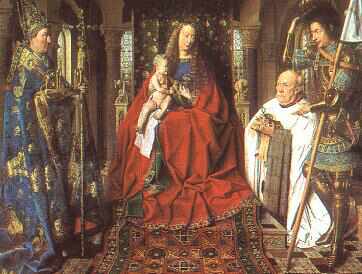 and
others. You can’t get enough from them! and
others. You can’t get enough from them!
The Flemish primitives are characteristic of their very rich colour palette.
They revolutionised in their time the ideas about painting and that’ why the
word “primitives” may be a little confusing. It means more that those
painters worked in a renewed style. Besides are not all painters here were born
in Flanders: Memlinc came from Germany and Dirk Bouts from Holland. One of the
best-known paintings is maybe the “Madonna with kannunik Joris Van der Paele”
by Jan Van Eyck. Another famous painting is “The Last Judgment “ by
Hyronimus Bosch. The work seems to jump out of a bad dream.
Just next is the BRANGWIJN OR ARENTSHUIS for them who love lace. Very important
collection.
A magic spot? Behind the statue of humanist Vives, a hump-backed bridge will
lead you to a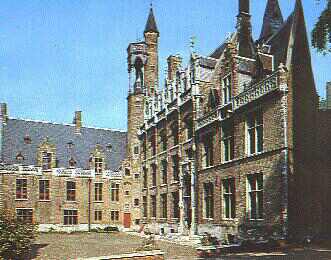 small garden. Silence and freshness reign here where a few rose bushes emerge
and a faced of timber, blackened by the centuries looks at the immobile
waters…At the end the GRUUTHUUSEMUSEUM is located in a gothic palace. This
museum evokes traditional Flanders wit a collection of furniture, weapons, all
sorts of tools used in the past
small garden. Silence and freshness reign here where a few rose bushes emerge
and a faced of timber, blackened by the centuries looks at the immobile
waters…At the end the GRUUTHUUSEMUSEUM is located in a gothic palace. This
museum evokes traditional Flanders wit a collection of furniture, weapons, all
sorts of tools used in the past 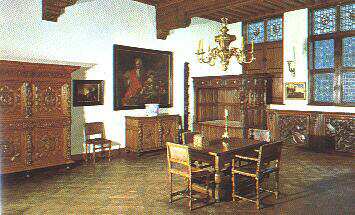 centuries,
tapestries, coins and so on...But this palace can also become the cadre of a
welcome stop! Why not take advantage of the cafeteria to meditate in silence in
front of a beer, even a brunch, if time permits, in the loggia under the warm
hug of a sun, barely hidden in one of those Flemish skies that you just admired
at the Groeninghe museum.
Trough the gardens of the Gruuthuse walk towards the small St. Boniface
bridge, and watch from that bridge all boats going to the Beguinage. It's an out
of this world image, surrounded by all this images and impressions of long gone
ages. centuries,
tapestries, coins and so on...But this palace can also become the cadre of a
welcome stop! Why not take advantage of the cafeteria to meditate in silence in
front of a beer, even a brunch, if time permits, in the loggia under the warm
hug of a sun, barely hidden in one of those Flemish skies that you just admired
at the Groeninghe museum.
Trough the gardens of the Gruuthuse walk towards the small St. Boniface
bridge, and watch from that bridge all boats going to the Beguinage. It's an out
of this world image, surrounded by all this images and impressions of long gone
ages.
See you after this break….
Bibliography
The fair face of Flanders, by Patricia
Carson,Ghent 1969---De Vlaamse Krijgsbouwkunde , by M.Van Hemelrijck, Tielt
1950---Gids voor Benelux, by Jozef van Overstaete, VTB 1985---Guide du Routard
1999, ed.Hachette—Le Patrimoine Monumental de la Belgique, by Jacques Steinnon,
Liege 1974—De Geschiedenis van Brugge, by Jan Van Houtte , Tielt-Bussum
1982---Groeninghe museum, museum brochure.
|

