|
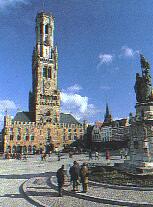 High
above the agitation of the Markt rises the BELFRY, maybe one of the most
beautiful and impressive of Belgium with its 83 meters height. It’s open to
the public but you have to be in good shape to escalade 366 steps and those of
you suffering from vertigo should not continue until the superior level. But
those who will have passed all obstacles will be rewarded for their bravery by a
magnificent viewing point justifying their effort. In the treasury rooms you can
see the charts of the city, guarantees of the communal liberties and kept in
iron chests. Another room holds the keys to the carillon. This carillon player
gives three concerts a week. We can see at one of the levels the whole mechanism
of these carillons with 47 bells of which a few date from 1748. Just one thing.
Don’t find out at the top you forgot your camera downstairs! J At the foot of
the Belfry a small scale model of the ensemble with explanations in Braille. High
above the agitation of the Markt rises the BELFRY, maybe one of the most
beautiful and impressive of Belgium with its 83 meters height. It’s open to
the public but you have to be in good shape to escalade 366 steps and those of
you suffering from vertigo should not continue until the superior level. But
those who will have passed all obstacles will be rewarded for their bravery by a
magnificent viewing point justifying their effort. In the treasury rooms you can
see the charts of the city, guarantees of the communal liberties and kept in
iron chests. Another room holds the keys to the carillon. This carillon player
gives three concerts a week. We can see at one of the levels the whole mechanism
of these carillons with 47 bells of which a few date from 1748. Just one thing.
Don’t find out at the top you forgot your camera downstairs! J At the foot of
the Belfry a small scale model of the ensemble with explanations in Braille.
 |
|
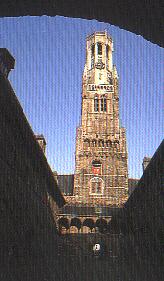
Belfry from Halles |
The
belfry overshadows the HALLEN dating 13th century but often restored since.
Turning your back to the belfry you have a palace on your right side occupied
today by the provincial government of East Flanders of which Bruges is the
capital. On your left the café “Craenenburgh” is set in the house where the
husband of Marie de Bourgogne, the regent of the Netherlands, Maximilian of
Austria, was sequestered in 1488 by a revolted 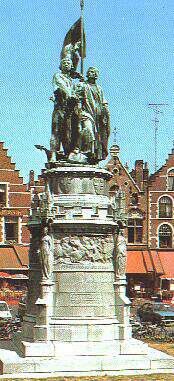 population, while his chancellor’s head was cut off on the Markt. The statue
in the centre of the Markt commemorates Jan Breydel and Pieter de Coninck,
heroes of the “Battle of the Golden Spurs won by the Flemish over the French
army in 1302.
population, while his chancellor’s head was cut off on the Markt. The statue
in the centre of the Markt commemorates Jan Breydel and Pieter de Coninck,
heroes of the “Battle of the Golden Spurs won by the Flemish over the French
army in 1302.
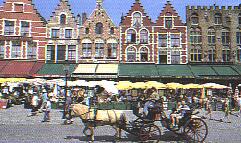
Let‘s now have a real good look at the MARKT. This was already a market in
958!! Even until 1983 when the market was transferred to ‘T Zand. Centre of
the bourgeois life since centuries it’s the Grand Place of the city and there
was even a canal coming to the centre where boats unloaded their goods. At the
foot of the belfry, condemned criminals (or innocents) were pilloried or
executed. It was and still is a magnificent square bordered with impressive
buildings of the 15th and 16th century some renovated in the 19th and facades of
houses that used to be the corporate houses. During high season it is sometimes
difficult to circulate among the crowd attracted by the horse carriages waiting
for the tourists and the high concentration of cafes and restaurants.
If you follow the Steenstraat again, direction ‘T Zand you will see, except
the numerous shops, a lot of corporate house with gable ends, often surmounted
by gilded symbols. On your left, SINT-SALVATORS KATHEDRAAL , the oldest
parochial church of Bruges, originally a Roman church in the 11th century. For a
great part rebuilt in the 18th century it inherited a mostly composite
architecture but conserved beautiful stalls of the 15th century as well as its
imposing gothic porches. Inside I was struck by the elegance of the long space
ruled by a sense of verticality. The church has beautiful furnishing most of
them to see in the museum of the Cathedral. In one of the chapels on the
left you can see a Christ that seems to hit a ball. The legend says that pushed
away an iconoclast that wanted to destroy it.
The museum of the cathedral is open from 14.00 to 17.00 except on Sunday and
Wednesday. It houses important works and is largely worth a visit.
Continue along the Steenstraat and you will arrive at the immense ‘T ZAND,
vast place which received in 1983 the biggest market of Bruges (every Saturday).
In front, the Smedenstraat leads to the SMEDENPOORT, one of the still existing
portals to the city built in the 14th. The bronze head symbolizes the skull of
the traitor who opened the door to the French in the 15th century and was hanged
at the spot.
Next and last article will walk through Hanseatic Bruges and other lace
specialities…
Bibliography
The
fair face of Flanders, by Patricia Carson,Ghent 1969---De Vlaamse
Krijgsbouwkunde , by M.Van Hemelrijck, Tielt 1950---Gids voor Benelux, by Jozef
van Overstaete, VTB 1985---Brugge te voet, ed.Van Mieghem, Oostende 1995
|

