|
 My
last article left us on the St.Boniface bridge. We are just at the great "
ONZE LIEVE VROUWEKERK" (Our Lady My
last article left us on the St.Boniface bridge. We are just at the great "
ONZE LIEVE VROUWEKERK" (Our Lady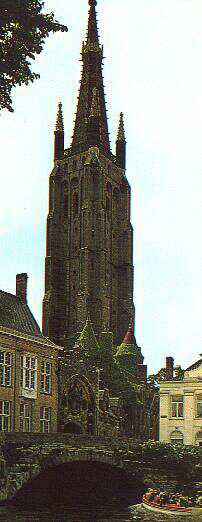 church) waving at us with its slender
spire (122 meters), the highest in the Netherlands except the one in Antwerp.
Build in gothic during the 13th, it is the highest known brick
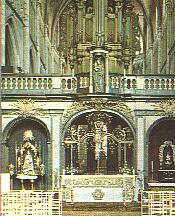
construction in the world. The interior of the cathedral is known for its grave
monuments and art treasures. To catch a glimpse of these is quite difficult in
high season, seen the crowds getting inside! But who gets aggravated by the
noise and people in the church, be consoled by the thought that in medieval ages
churches were not only a religious gathering but also social. Since many
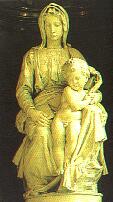
centuries the main point of interest in the church is the Chapel of the Blessed
Virgin where you can admire a "Virgin and child" from Michael Angelo
(as soon as you enter on the right side), a youth work in white marble. Very
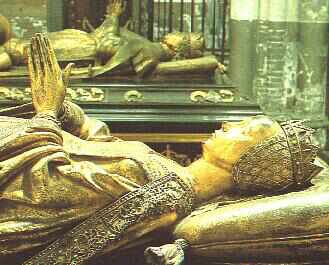
beautiful funeral monument for Marie de Bourgogne and her father Charles le Téméraire. church) waving at us with its slender
spire (122 meters), the highest in the Netherlands except the one in Antwerp.
Build in gothic during the 13th, it is the highest known brick
construction in the world. The interior of the cathedral is known for its grave
monuments and art treasures. To catch a glimpse of these is quite difficult in
high season, seen the crowds getting inside! But who gets aggravated by the
noise and people in the church, be consoled by the thought that in medieval ages
churches were not only a religious gathering but also social. Since many
centuries the main point of interest in the church is the Chapel of the Blessed
Virgin where you can admire a "Virgin and child" from Michael Angelo
(as soon as you enter on the right side), a youth work in white marble. Very
beautiful funeral monument for Marie de Bourgogne and her father Charles le Téméraire.
Especially the gilded statue of the young Maria, deceased in the spring of 1482
after falling off her horse during hunting, lies on a stone sarcophagus.
 |
 |
|
Inside cathedral |
Mary of Burgundy |
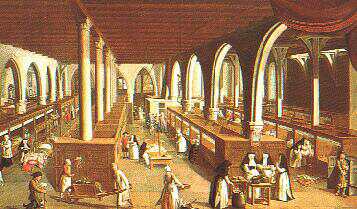
In front of the church is SAINT JOHN HOSPITAL. Housing 6 paintings of Hans
Memlinc, Flemish but a German native painter (see below) and an ancient pharmacy
set in a small cloister with a cute well.
|
|
|
Old painting about
St.Johns Hospital
|
|
|
|
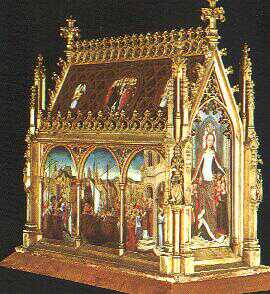
Memlinc reliquary |
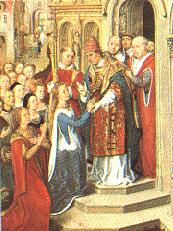
Memlinc painting |
The MEMLINC MUSEUM is situated in
the chapel of the hospital. This immense Flemish painter of the 15th century,
world-renowned. The place was specially designed for the six paintings here but
what paintings!! To see them is a rare privilege!! The reliquary of
Saint-Ursula, the absolute topper of this small collection was made in 1489 by
Memlinc for two religious sisters of the religious hospital. This Sint-Jans
Hospitaal is one of the oldest guesthouses in Europe. Until the end of the 16th
century, sick people were taken care of Sint-Jan. In the rear part of the
renovated hospital several halls are organized for temporary art exhibitions.
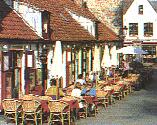
Along the canal is a very agreeable cafeteria, the brasserie
"Promenade".
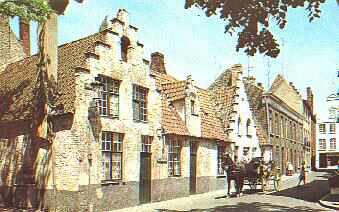
 Leaving St.John Hospital make a right into the very busy Katelijnestraat and
immediately you'll see left and right (Stoofstraat) corridor entrances
surmounted by a name and a date. Go and look closer, you're in front oft the
"Godshuisjes " or "Maisons Dieu" in French. These houses are
typical urban and social Bruges phenomena.
Leaving St.John Hospital make a right into the very busy Katelijnestraat and
immediately you'll see left and right (Stoofstraat) corridor entrances
surmounted by a name and a date. Go and look closer, you're in front oft the
"Godshuisjes " or "Maisons Dieu" in French. These houses are
typical urban and social Bruges phenomena.
Continuing the Stoofstraat, you arrive at a small shadowed square where you can
visit another Brugge attraction: "Brasserie Straffen Hendrik"
(Brewery) Guided visit every hour to see how they made and make now that special
beer. A cooper's workshop and a tavern from 1900 end the visit, which could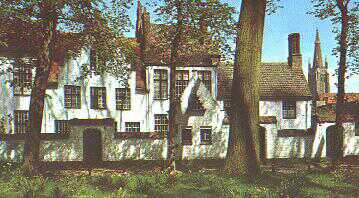 be
much shorter if you would not have to listen to the soporific comments of the
guide in four languages. A good point nevertheless: the view from the roof is
magnificent and the beer tasting is included in the price of the ticket. be
much shorter if you would not have to listen to the soporific comments of the
guide in four languages. A good point nevertheless: the view from the roof is
magnificent and the beer tasting is included in the price of the ticket.
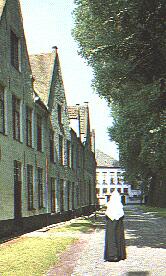 Through the Wijngaardstraat you arrive at one of the most emblematically sites
of Bruges: Het Prinselijk Begijnhof Ten Wijngaerde". This convent of
Beguines is to Bruges what the Eiffel tower is to Paris: a postcard!! There is
an inexpressible poetry fleeing into the atmosphere as if a divine grace was
present in the soughing of the wind in the foliage. The impressionist light of
the sun on the lawns marked with jonquils (it was around Easter), the toddling
of a nun hurrying to the chapel, the red and white frontlet of the cottages
hidden the low walls of their garden, all this contributes to make of the Through the Wijngaardstraat you arrive at one of the most emblematically sites
of Bruges: Het Prinselijk Begijnhof Ten Wijngaerde". This convent of
Beguines is to Bruges what the Eiffel tower is to Paris: a postcard!! There is
an inexpressible poetry fleeing into the atmosphere as if a divine grace was
present in the soughing of the wind in the foliage. The impressionist light of
the sun on the lawns marked with jonquils (it was around Easter), the toddling
of a nun hurrying to the chapel, the red and white frontlet of the cottages
hidden the low walls of their garden, all this contributes to make of the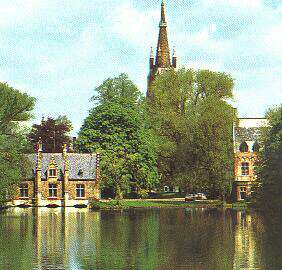 Beguinage a place blessed by the angels. The place is now occupied by a
Benedictine congregation. A little Beguine house is laid out for visits and
transformed into a small museum.
Beguinage a place blessed by the angels. The place is now occupied by a
Benedictine congregation. A little Beguine house is laid out for visits and
transformed into a small museum.
You can continue along another very romantic sight "The Minnewater" or
the " Lake of Love". At the end of the pond, to get back into city
centre take the Katelijnestraat, H.Geestestraat, see the St.Salvator Cathedral
and to the right, strolling along the very commercial Steenstraat, you will be
back at the "Markt", center of Brugge where the Belfry visit will
start in my next article. You must be exhausted by now ;-)
Bibliography
The
fair face of Flanders, by Patricia Carson,Ghent 1969---De Vlaamse
Krijgsbouwkunde , by M.Van Hemelrijck, Tielt 1950---Gids voor Benelux, by Jozef
van Overstaete, VTB 1985---Guide du Routard 1999, ed.Hachette.---Brugge te voet,
ed.Van Mieghem, Oostende 1995
|

