|
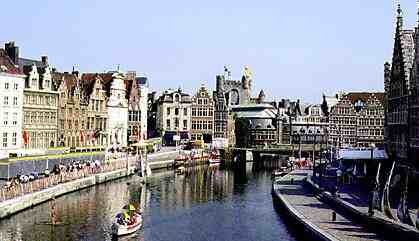
Surrounded by pavement cafes and restaurants lies the KOORNMARKT, in front of the St. Nicolaas kerk. Agreeable and animated, consider it as the main square of Ghent. Just notice a few facades: at no. 7 "Borluutsteen", built in the 13th and showing all characteristics of Roman architecture. At the other side, at no. 20, "Waepen van Zeeland" built in 1702, with its colossal pilasters in a Louis XIV styled façade. At nos. 24-31 the "Meuleken" house (1652) is typical with its pointed façade, announcing the baroque period.
Walk now towards the bridge in front of you: the "SINT-MICHIELSBRUG". Whow! It offer a superb view, maybe one of the most beautiful in Belgium, not only on the three towers of Sint-Baafs,
 |
|
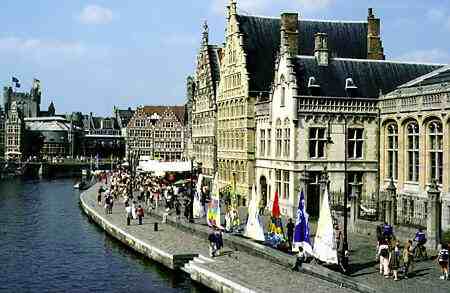
Graslei from bridge |
Sint-Nicolaas and the belfry but on Ghent's oldest harbour, the GRASLEI quay, superbly lined with houses you never saw anywhere else in the world. On the other side of the water, the KOORNLEI, with more classic and baroque constructions.
The Graslei is a row of superb gabled houses, most of which are former guild houses, over a period of 500 years. A perfect testimony of the power and entrepreneurial spirit and prestige of the corporations. The ensemble is admirable.
Next to the bridge there is first the admirable neo-gothic (1905) Post Office house. To its left the "Gildenhuis des Vrije Schippers" (1531)
(Free Boatsmen's House), in late Gothic announcing the baroque fantasies. A waterspout in form of a boat (caravel) stands on the roof. Then the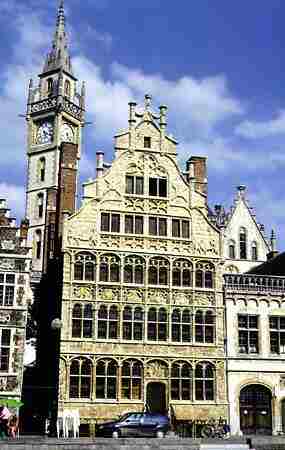 "Guildhuis des "Guildhuis des
 Graanmeters" (1698) (Grain Weigher's House), Flemish Renaissance with some typical touches of late baroque, and a fire pot on its roof. Graanmeters" (1698) (Grain Weigher's House), Flemish Renaissance with some typical touches of late baroque, and a fire pot on its roof.
The small house, at no. 11, "Tolhuisje" (Custom house), (1698), is where the custom officer perceived its taxes. Typical renaissance style.
Next, the impressive, almost 800 years old " Korenstapelhuis " (wheat storage house), also called "Spijker". It's probably the best and most perfect example of civil roman architecture in Europe.
Have a good look at the practical manner of how this house was built. The front wall leans forward by a centimetre for every metre to make the task of raising sacks of grain easier.
Now comes the "Eerste Korenmetershuis" (15th century), which is the first house of the grain weighers.
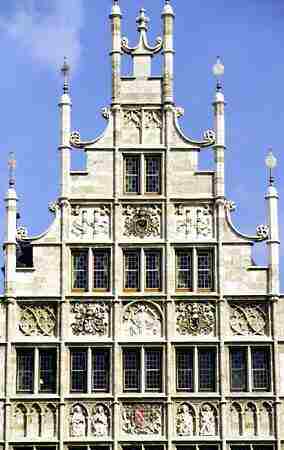
Last but not least, the "Guildhuis van de Metselaars" (Masons house), (1527), with its high
and elegant façade, crowned with graceful pinnacles.
Bibliography
Guido Deseyn, "Gids voor Oud-Gent (Antwerpen-Weesp 1984)-Clemens van Trefois, "Ontwikkelingsgeschiedenis van onze landelijke bouwkunst" (Antwerpen 1950), Gian Giuseppe Simeone, "Les Nouvelles du Patrimoine " Ghent "" (ed.Casterman), Omer Vandeputte "Gids voor Vlaanderen ", (ed.Lannoo), Noortje de Roy van Zuidewyn, " Reishandboek Belgie-Gent " (ed.Elmar 1992)-Patricia Carson, " The Fair face of Flanders " (1969), "Belgische kust en Gent", by Yves Robert (Casterman 1995)
|