|
It's from the Graslei that most of the boat visits and canal cruises depart to see Ghent under a special angle. But beware, the comments are mostly soporific and uninteresting. Be sure to have a print of my page in your bag :-). The Grasbrug, leads you to the other side where the Korenlei presents a more recent aspect, with baroque and classic houses.
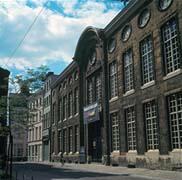
Let's leave the quays and take the Jan Breydelstraat. At no. 7 we have the " Museum of Decorative Arts". On entering the museum one is immersed in the world of a rich, 18th-century Ghent family. The drawing rooms with authentic parquet floors and panelled walls and ceilings are adorned with a wealth of period furniture.
The new extension to the Ghent Museum of Decorative Arts and Design was officially opened in May 1992. Around the inner courtyard, unique pieces are exhibited that have been patiently collected and preserved since the mid-seventies. The 18th-century facade facing the inner courtyard has been completely restored. Behind it there is a light and airy modern building. The one brilliant invention is a huge hydraulic lift in the central section of the building. This makes the floors adaptable. The possibilities for the involvement of visitors in an exciting play of changing levels are almost unique.
Let's head now for ancient fortified castle, the "GRAVENSTEEN", one of the land marks of Ghent. Built in the 12th century by
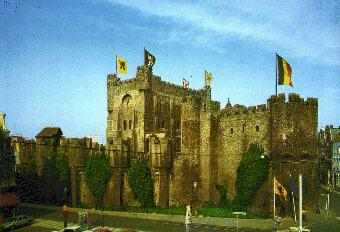 the count of Flanders, this castle has been converted and extended many times. It's a superb example of a medieval fortress, having been for 300 years the residence f the counts of Flanders, who used the formidable defence power only for interior purposes. Indeed, the Ghent population was very often in state of war with their masters and bloody altercations were the normal ay of life! Tired, of sitting cold in their uncomfortable dungeon, the counts left finally to a place a little outside Ghent, "Prinsenhof", which doesn't exist anymore today. The Gravensteen was used for a time as prison and courthouse for a number of tribunals. the count of Flanders, this castle has been converted and extended many times. It's a superb example of a medieval fortress, having been for 300 years the residence f the counts of Flanders, who used the formidable defence power only for interior purposes. Indeed, the Ghent population was very often in state of war with their masters and bloody altercations were the normal ay of life! Tired, of sitting cold in their uncomfortable dungeon, the counts left finally to a place a little outside Ghent, "Prinsenhof", which doesn't exist anymore today. The Gravensteen was used for a time as prison and courthouse for a number of tribunals.
Visiting the chateau today, you will be able to walk on its ramparts, visit it monumental halls, and shiver by discovering the "Museum of Torture", where you can see the gruesome methods that were used to "establish the truth".
Let's return now on the shores of the Lys river, and look where the tramway crosses the bridge. There is a famous café, "Waterhuis aan de Bierkant", where a stop is recommended. Guess why? :-) The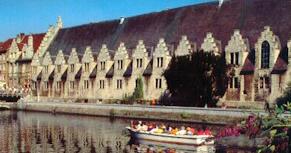 long building you see at the other side of the ware is the 15th century "Vleeshuis" (Butchers house) by the Groentemarkt. It was originally the central processing, store and sales hall for the butchery trade. long building you see at the other side of the ware is the 15th century "Vleeshuis" (Butchers house) by the Groentemarkt. It was originally the central processing, store and sales hall for the butchery trade.
But let's stay at this side of the Lys and enter a maze of lanes called "Patershol" (old tanners quarter), by walking west on the Korenlei. Once also home to manual workers and patrician families, it developed into a working class quarter with the arrival of industrialisation. In recent years, however, artisans, boutique owners and antique dealers have moved in. It's also a spot of nighthawks, restaurants and disco places.
Bibliography
Guido Deseyn, "Gids voor Oud-Gent (Antwerpen-Weesp 1984)-Clemens van Trefois, "Ontwikkelingsgeschiedenis van onze landelijke bouwkunst" (Antwerpen 1950), Gian Giuseppe Simeone, "Les Nouvelles du Patrimoine " Ghent "" (ed.Casterman), Omer Vandeputte "Gids voor Vlaanderen ", (ed.Lannoo), Noortje de Roy van Zuidewyn, " Reishandboek Belgie-Gent " (ed.Elmar 1992)-Patricia Carson, " The Fair face of Flanders " (1969), "Belgische kust en Gent", by Yves Robert (Casterman 1995)
|
