In last article I invited you to enter a maze of lanes called "Patershol" (old tanners quarter), by walking west on the Korenlei. Once also home to manual workers and patrician families, it developed into a working class quarter with the arrival of industrialisation. In recent years, however, artisans, boutique owners and antique dealers have moved in. It's also a spot of nighthawks, restaurants and disco places.
 |
|
Folklore museum |
It's time to make a little coffee break and be aware that some cafés are open very late at -night.
Follow now the river, Kraanlei and you arrive at a very special museum: "Het Volkskundemuseum."
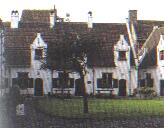
(Folklore museum). Located in an ancient orphanage dating from the 13th/14th century. It's one of the most enchanting spots of Ghent. The visit may be max 40 minutes but I recommend it strongly. Now scattered over 18 "Gods houses" grouped around a central courtyard and built in 1363The visit id a genuine labyrinth, leading you through the different stores of the houses, then the ground floor, cross the chapel and finally, in a quite unexpected way, you descend in the crypt, from where you emerge a few minutes later. The principal theme of the museum shows a series of Flemish interiors and boutiques: herb shops, sleeping room, cooper's trade, etc...... The rooms are packed with funny and moving objects, like old society games, a puppet theatre, and a traditional café still in use. It's magic.
Just behind the museum, cross the Zuivelbrug to Groot Kanonplein, (Grand Cannon square) which take its name from a 15-ton "Dulle Griet" (Mad Meg) canon which was captured from the Burgundians during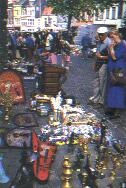 the 15th century. Return on the Kraanlei and look for the bonbons boutique "Temmerman" which has a remarkable sculpted façade. Gourmets and sweet tooth as you all are, will buy tour heart out or cross again the bridge to make provision of (olie koeken)(Belgian gingerbread) at "Albert Van den Abbeele". the 15th century. Return on the Kraanlei and look for the bonbons boutique "Temmerman" which has a remarkable sculpted façade. Gourmets and sweet tooth as you all are, will buy tour heart out or cross again the bridge to make provision of (olie koeken)(Belgian gingerbread) at "Albert Van den Abbeele".
A few steps more and you are at the VRIJDAGMARKT, which has been the political centre of the city since the 13th century. Every Friday (Vrijdag") it's market day, big
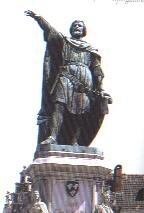 animation and amusement and bargains guaranteed. You will se what they call a "Toreken", in the Tanner's guildhall, which bell announced the opening of the market. The statue at the centre of the square is that of "Jacob Van Artevelde", the rebel who launched the 1338 uprising against the Burgundians on this same square. The "Ons Huis", the huge -turn -of -the -century building on the N.W. side of the square is the headquarter of the Socialist party. A little further you see clearly the two towers of the Sint-Jacobskerk, dating 12th century and presenting in front a nice and cute flea market, three times a week. animation and amusement and bargains guaranteed. You will se what they call a "Toreken", in the Tanner's guildhall, which bell announced the opening of the market. The statue at the centre of the square is that of "Jacob Van Artevelde", the rebel who launched the 1338 uprising against the Burgundians on this same square. The "Ons Huis", the huge -turn -of -the -century building on the N.W. side of the square is the headquarter of the Socialist party. A little further you see clearly the two towers of the Sint-Jacobskerk, dating 12th century and presenting in front a nice and cute flea market, three times a week.
All about Ghent is to find in my web site.
Bibliography
Guido Deseyn, "Gids voor Oud-Gent (Antwerpen-Weesp 1984)- Gian Giuseppe Simeone, "Les Nouvelles du Patrimoine " Ghent "" (ed.Casterman), Omer Vandeputte "Gids voor Vlaanderen ", (ed.Lannoo), Noortje de Roy van Zuidewyn, " Reishandboek Belgie-Gent " (ed.Elmar 1992)-Patricia Carson, " The Fair face of Flanders " (1969), "Belgische kust en Gent", by Yves Robert (Casterman 1995)
|
