 |
|
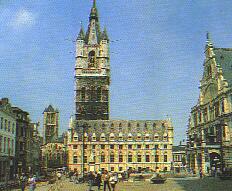
Belfry and Lakenhalle |
Just across the porch of
Sint-Baafskathedraal, the BELFRY is the fierce symbol of civil power, in
opposition to the religious one. Dating from middle 14th century and
heavily restored, the viewing point you have from its 91 meters height is
overwhelming. Notice the weird elevator, looking like a Jules Verne device ;-),
leading you to the top. I advise people suffering from vertigo to abstain
looking down. It will not be a Hitchcock movie but reality ;-)
During middle age it symbolized the power of the corporations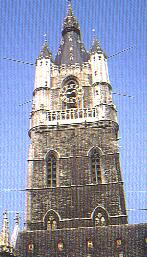 and today it’s still one of the highest towers in town of which it stays a
landmark. The tower is crowned by a gilded copper dragon, dating 1378, which
embodies their unyielding spirit and belligerence. The carillon dating 17th
century has 53 little clocks. It is considered as one of the most remarkable one
in Belgium, the Rolls Royce of the carillons the specialists say. It plays every
quarter of the hour and I advise you to wait to see it in action. A carillon
player gives often carillon concerts, especially during summer weekends.
and today it’s still one of the highest towers in town of which it stays a
landmark. The tower is crowned by a gilded copper dragon, dating 1378, which
embodies their unyielding spirit and belligerence. The carillon dating 17th
century has 53 little clocks. It is considered as one of the most remarkable one
in Belgium, the Rolls Royce of the carillons the specialists say. It plays every
quarter of the hour and I advise you to wait to see it in action. A carillon
player gives often carillon concerts, especially during summer weekends.
The adjoining LAKENHALLE (Cloth Hall), once a show room and warehouse for the
internationally known “Flemish Cloth” was built during the 15th
century. Also used for arbitrage. Then it lost its function and became an
exercise hall for the fencing corporation. When you exit, you will notice at the
corner of the Lakenhalle and the Belfry, a building that was used as a prison
and surmounted by a very curious fronton, “de Mammelokker”, realized after a
Roman legend: the old Cimon, imprisoned and toothless was condemned to starve
and his daughter saved his life by giving him her breast milk through the bars.
What the love of a daughter for her father could accomplish! ;-)
 Next stop,
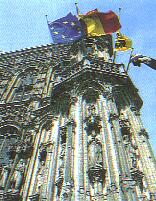
STADHUIS (City hall) on the west side of the Botermarkt was built in different
stages, which is clearly to see at the f-different building styles. Ghent wanted
to build the biggest City hall of Europe at that time. As it took time 400 years
(yes 400) to come to an end they realized a hybrid building. Facing Hoogpoort,
the oldest part is flamboyant Gothic (1518-1520),
facing Botermarkt it is Renaissance even if it was built only 20 years later.
Baroque and rococo dominate elsewhere. In 1576, the “Pacification of Ghent”
was signed in de “Pacificatiezaal”, a treaty which obliged all Low Country
provinces to unite against the occupying Spanish troops. It ended like it would
end today: it lasted for a few months and the country was again in a bloody and
ruthless war, and foe long years to come….. Next stop,
STADHUIS (City hall) on the west side of the Botermarkt was built in different
stages, which is clearly to see at the f-different building styles. Ghent wanted
to build the biggest City hall of Europe at that time. As it took time 400 years
(yes 400) to come to an end they realized a hybrid building. Facing Hoogpoort,
the oldest part is flamboyant Gothic (1518-1520),
facing Botermarkt it is Renaissance even if it was built only 20 years later.
Baroque and rococo dominate elsewhere. In 1576, the “Pacification of Ghent”
was signed in de “Pacificatiezaal”, a treaty which obliged all Low Country
provinces to unite against the occupying Spanish troops. It ended like it would
end today: it lasted for a few months and the country was again in a bloody and
ruthless war, and foe long years to come…..
Today it is the administrative centre of Ghent and is only to be visited with an
organized tour. Tel 09/2665232.
The SINT NICOLAASKERK, built
on Roman foundations in the 13th century is an example of Scaldian
Gothic. Its tower from 1300 was the first belfry of Ghent and still another
landmark of the city. Its massive stone aspect is impressive. Also this church
had its share of vexations during its existence like being used as horse stables
during French revolution. The restoration of the church started in the 60’s is
juts finished since last year! These things cost money! Next to KLEIN TURKIJE-named
after the guild hall that sold predominantly Turkish herbs and spices-stand a
number of splendid town houses such as the 13th century “Red Hat” with its
limestone façade and the “Food Merchants home”. Look out for the small
shops that were built on the church wall. They sold mainly devotional offerings.
Prostitutes used to work in these small houses too.
Bibliography:
Guido
Deseyn, “Gids voor Oud-Gent (Antwerpen-Weesp 1984)-Clemens van Trefois,
“Ontwikkelingsgeschiedenis van onze landelijke bouwkunst” (Antwerpen 1950),
Gian Giuseppe Simeone, "Les Nouvelles du Patrimoine
« Ghent »" (ed.Casterman), Omer Vandeputte "Gids voor
Vlaanderen ", (ed.Lannoo), Noortje de Roy van Zuidewyn, « Reishandboek
Belgie-Gent » (ed.Elmar 1992)-Patricia Carson, « The Fair face of
Flanders » (1969)
|

