|
 If
you compare Ghent to Bruges or Antwerp, it is a tentacular city, without a
clearly marked centre like the Markt in Bruges or the Grote Markt in Antwerp. If
you compare Ghent to Bruges or Antwerp, it is a tentacular city, without a
clearly marked centre like the Markt in Bruges or the Grote Markt in Antwerp.
This tour begins with the unavoidable Sint Baafsplein. The first we notice is
the pictorial façade of the KONINKLIJKE NEDERLANDSE SCHOUWBURG (Theatre) built
in 1897. If the weather is sunny have a drink at the “foyer” at the first
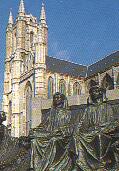
floor. Other unavoidable masterpiece is the SINT BAAFS KATHADRAAL. The St.Baafs
Cathedral is the pride of Ghent with his belfry and halls. The low and rather
squat façade doesn’t prepare us for its spacious and magnificent interior. A long period of refurbishing gave back
the majesty of the church. The present construction started in 1290 on the site
of a roman church. Only the crypt (open to the public) survived that era. The
dominant style is gothic but the building of the edifice lasted from the 13th
to the 16th century. The choir flamboyant gothic, the tower, the
nave, the transept late gothic. The future emperor Carolus Quintus was baptized
here. The Sint Baafs cathedral is a real museum. Her status of cathedral
its spacious and magnificent interior. A long period of refurbishing gave back
the majesty of the church. The present construction started in 1290 on the site
of a roman church. Only the crypt (open to the public) survived that era. The
dominant style is gothic but the building of the edifice lasted from the 13th
to the 16th century. The choir flamboyant gothic, the tower, the
nave, the transept late gothic. The future emperor Carolus Quintus was baptized
here. The Sint Baafs cathedral is a real museum. Her status of cathedral 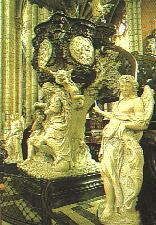 instigated
all the wealthy to build chapels, tombs, or decorate the interior with splendid
furniture and monumental paintings. Even baroque style was used and the pulpit
is pure rococo. Take your time and walk slowly to discover all the treasures displayed in the church. The cathedral is
plenty of artistic treasures, with a painting by Rubens. You can by for a cheap
price a folder at the entrance describing 41 of them. The most remarkable is the
pulpit (1741-1745) extraordinary wooden and marble Flemish rococo construction,
by Laurent Delvaux. You like or dislike. instigated
all the wealthy to build chapels, tombs, or decorate the interior with splendid
furniture and monumental paintings. Even baroque style was used and the pulpit
is pure rococo. Take your time and walk slowly to discover all the treasures displayed in the church. The cathedral is
plenty of artistic treasures, with a painting by Rubens. You can by for a cheap
price a folder at the entrance describing 41 of them. The most remarkable is the
pulpit (1741-1745) extraordinary wooden and marble Flemish rococo construction,
by Laurent Delvaux. You like or dislike.
After a visit to the crypt, don't miss the highlight, the supreme treasure of
the cathedral, Ghent and even Belgium: the polyptic of the "THE ADORATION OF THE MYSTICAL LAMB" by Jan van
Eyck!!
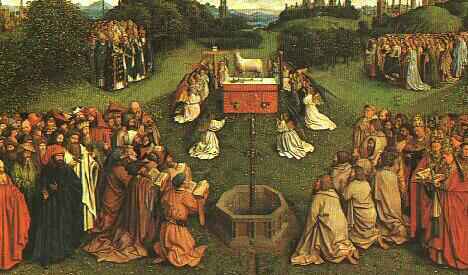
Even if you hate paintings, this is one you may not miss!!! It is one of
the most important works in the history of painting. A huge bibliography exists
about that work. Painted in 1432, it was supposed to be placed in the chapel of
the sleeping partner, Joos Vijd. This work is so meticulous that a jewel on the
robe of the singing angel reflects a stained window of the chapel. For security
reasons the polyptic has been taken out of its chapel in 1986 and is presented
now, rather poorly in a display window, sited in small room left of the main
entrance. The best way to look at it is to turn round the polyptic when the
panels are closed, so you can see the reverse. Return then in front of the
retable to receive the full shock of the revelation of the Mystic Lamb. God, the
Father presides the scene with full magnificence
(look at the crystalline
transparency of his sceptre, you can see the deflexion of the light: Van Eyck
was a master in optics). And what
to say about the fabulous precision of the tissues and jewels? Each stone of the
Virgins crown reflects the light supposedly coming from the right. The hairs
were painted one by one!!
The polyptic is composed by 12 oak
panels of which 8 can be folded to cover the main scene. Left and right, the
famous Adam and Eve, magnificent nude portraits, shocked emperor Joseph II so
much that he replaced them by dressed copies. Since the originals came back and
you can see the copies at the entrance of the cathedral. The extreme left lower
panel is a copy since the original was stolen in 1934. A lot of visitors are
surprised to see that the central element, the object of adoration is a simple
mutton, painted with an extreme realism. It’s a symbol of Christ, the
sacrifice lamb of the book of Revelations. This work alone, which had numerous
adventures, justifies the visit to Ghent. I could go on like this for hours, but
I leave you the surprise to see it for yourself.
Bibliography:
Guido
Deseyn, “Gids voor Oud-Gent (Antwerpen-Weesp 1984)-Clemens van Trefois,
“Ontwikkelingsgeschiedenis van onze landelijke bouwkunst” (Antwerpen 1950),
Gian Giuseppe Simeone, "Les Nouvelles du Patrimoine « Ghent »"
(ed.Casterman), Omer Vandeputte "Gids voor Vlaanderen ",
(ed.Lannoo), Noortje de Roy van Zuidewyn, « Reishandboek Belgie-Gent »
(ed.Elmar 1992)-Patricia Carson, « The Fair face of Flanders »
(1969)
|

