|
Back
to Cote d'Azur contents
Monaco, a police state?
Monaco
geographic and history
Visiting Monaco-the
Palace-the Cathedral and princess Grace
|
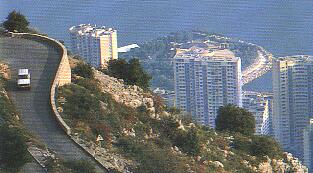 Let’s first look at the
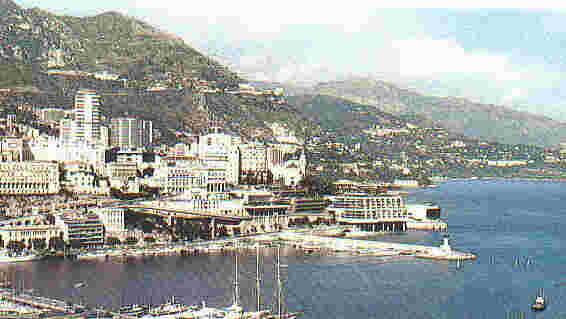
princedom through its world known geography. It is characterized by the 1. old,
but in the mean time outgrown harbour for super-luxury yachts. Eastwards it is
flanked by 2. Monte Carlo with its casino and the legendary hotel de Paris, on
the west side 3. the Rock with the princely palace, the cathedral and the
legendary musee océanographique. Behind the old port runs the boulevard Albert
1r after which the 4. Condamine begins, which means the Monaco shopping centre,
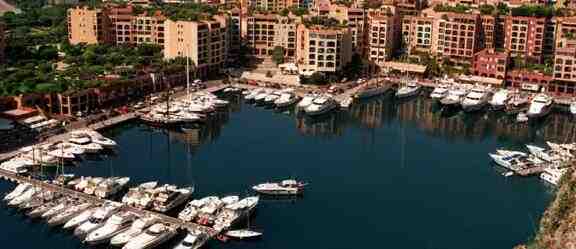
shortly said, the centre of the town. Finally, behind the rock lies Fontvielle
where the genie of the prince created a new yacht harbour, a gigantic sports
stadium and complete new series of high rise buildings built on ground conquered
on the sea. Let’s first look at the
princedom through its world known geography. It is characterized by the 1. old,
but in the mean time outgrown harbour for super-luxury yachts. Eastwards it is
flanked by 2. Monte Carlo with its casino and the legendary hotel de Paris, on
the west side 3. the Rock with the princely palace, the cathedral and the
legendary musee océanographique. Behind the old port runs the boulevard Albert
1r after which the 4. Condamine begins, which means the Monaco shopping centre,
shortly said, the centre of the town. Finally, behind the rock lies Fontvielle
where the genie of the prince created a new yacht harbour, a gigantic sports
stadium and complete new series of high rise buildings built on ground conquered
on the sea.
 |
|
Port of Fontvielle |
"To live in Monaco, all
you need is good taste and a lot of money" proclaims the principality's
"Society" magazine". And Monaco boast and idyllic natural setting
, glamorous residents , Americanised culture and international cuisine. Do you know a country that
small (195 ha) in the whole world, so famous and mediatized as Monaco? Mere
creativity cannot compete with financial talk. Residents of Monaco have
the highest per capita income in the world and given its size, Monaco arguably
has the greatest ratio of banks in the world. Myriads
of souvenir shops, tourist groups in close order, dreaming in this operetta
decorum about the tempestuous love affairs of Stephanie de Monaco or the
beautiful but sad idylls of Grace Kelly and prince Rainier, as well as Caroline
and Stefano (if this liaison is still on at the moment of this post ;-))
Tourism is king here! Each
year the princedom welcomes several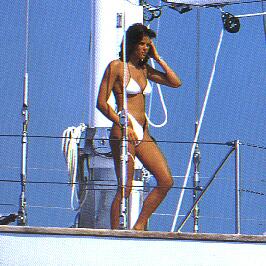 million tourists. million tourists.
But how did all this start?
Therefore we must take another history lesson! Those who hate history can stop
here and click on the link to next article about visiting Monaco. Those who are
interested in a very anecdotal and thrilling history of the princedom, please,
continue reading.
The Rock of Monaco was a shelter for primitive populations. Traces of their occupation were discovered in a cave in the Saint-Martin Gardens. The first sedentary inhabitants of the region, the Ligures, are described as a mountain people, accustomed to hard work and an exemplary frugality.
At the end of the 12th century B.C., the Romans occupied the region. During this same period,
Phoenician and Carthaginian sailors brought prosperity to the region. After the fall of the Roman Empire (5th century A.D.), the region was regularly sacked by different barbarian populations. It was only at the end of the X century, after the expulsion of the
Saracens by the Count of Provence, that the coast slowly became repopulated and Monaco became Genoan property.
Monaco is taken by the Genoese. The Grimaldi lays the first stone of the stronghold which today is the Prince's Palace.
From that date forward, the Rock becomes the object of the ongoing struggle between the two parties disputing power in the Republic of Genoa, the
Ghibelines, allies of the German emperor, and the Guelfs, faithful followers of the
Pope and the Comte de Provence. In 1308,
a Genoan Guelf, Grimaldi (nothing to do with the famous Italian Grimaldi family)
conquers the Monaco seignory and since that moment all heirs of the Grimaldi
house wear that name on their armouries. In 1346 Charles the 1st Grimaldi
acquires Menton and Roquebrune in 1355.
Many consider him to be the true founder of the Principality.
Being a lord in Monaco was
not always a piece of cake! The Grimaldis were not always that smiling and friendly
you see regularly in papers and tabloids. Terror, fear and murder were the main ingredients
of daily life in that era. Murdering brothers, slaughtering
his best friend was regarded as highly normal! Thus in 1505, Jean II was killed
by his brother Lucien. But there is a justice after all, thanks god: at his turn Lucien was assassinated by his nephew. What a
nice family !! And to stay in history books, Honore the 1st was simply thrown into
the sea by his subjects in 1604.
Augustin I, in disagreement with the French authorities, places Monaco under the protectorate of the Spaniard,
Charles-Quint.
Thus, from 1524 to 1641 Monaco was
a Spanish protectorate but after 10 years of
negotiation and thanks to the influence of Richelieu, the Treaty of Péronne is
signed which recognizes the sovereign right of Monaco and grants the Prince and his descendants an equality of rank with the highest French nobles. The French Kingdom thus ensures a protective friendship with the Principality of Monaco.
The Spanish garrison is evicted evicts from Monaco and they are replace by the French
garrison. But whoever ruled, the
name and shield of Grimaldi was attached to this territory. In 1792 Monaco was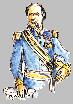 purely and simple annexed by France but regained its independence in 1814. But in 1848 Menton and Roquebrune declare
themselves free cities and the princedom was reduced to Monaco.
purely and simple annexed by France but regained its independence in 1814. But in 1848 Menton and Roquebrune declare
themselves free cities and the princedom was reduced to Monaco.
But under Charles II, the
east side of Monaco began to expand around 1860. Charles made an excellent
choice by giving François Blanc the leading of a poor and wretched gamblers
place. Blanc decided to give it a bit more lustre and aristocracy and picked out
the bare Rocher des Speluges to build a brand new casino, designed by Garnier
(builder of the opera in Paris) in 1879. When the buiding was finished this part
of Monaco was rebaptized (in honour of Charles) Monte-Carlo. Thanks to the
enormous funds the Societe des Bains de Mer is founded in 1861, the railway
arrives to Monaco, the splendid Hotel de Paris is build (for a long time the
leading hotel in Europe). In 1872 the casino counts 160.000 visitors.
But since silence is a MUST
in the princedom, nobody tells or reminds us about the number of poor wretches
shooting themselves through the head, poisoning themselves or throwing
themselves from the rocks into the sea, after having lost their entire fortune As for the prince of Monaco, feeling he had done
a good job by attracting big foreign fortunes, he abolished taxes.
But more and more the
mighty, powerful and wealthy of the earth let their money roll over the gambling
tables, expensive yachts threw their anchor in the harbour. Monte-Carlo became
the hiding place for princes and billionaires, rich good-for-nothing and sly
crooks. It was the battlefield where hope, despair and hard materialism fought a
cruel battle.
A severe blow was the
authorization of gambling in France and Italy in 1933....It meant the end of a
monopoly that made the fortune of the city. So
the expansion of Monaco restarted after WWII, not by building beautiful villas
and parks but by building those hideous skyscrapers, an outrage to the romantic
atmosphere that once was.
 |
|
Monte-Carlo
at the Casino side |
Rainier III played it very
well now. He worked out a new, special fiscal system that would attract the
whole French business milieu and a lot of foreign companies. He made it into a
fiscal paradise. But president de Gaulle didn’t agree to lose that much of tax
money and threatened to cut off gas and electricity forbid French citizens to
take advantage of it. Finally an agreement was reached: Frenchmen living 5 years
or more in Monaco would have not to pay taxes to the French government. Foreign societies and firms, attracted by the
fiscal privileges, continue to pour in and more and more skyscrapers rise
randomly to house them all. Monte-Carlo looks today as a “Manhattan “skyline
and I don’t like it!
Bibliography:
Mary
Blume, "Cote d'Azur. Inventing the French Riviera" (Thames and Hudson,
London 1982) Stephen Liegeard, "La Cote d'Azur (Ed.Serre, Nice 1988),
Patrick Howarth, “When the Riviera was ours” (Century, London 1977), Michel
de la Torre, Alpes-Maritimes 06 (ed.Nathan, later Deslogis-Lacoste),
Pemble.J., “the Mediterranean Passion” (ed.Oxford University Press 1988)
|
Back
to Monaco contents
Visiting
Monaco-the Musee Oceanographique
Visiting Monte
Carlo-Casino-Hotel de Paris-Jardin Exotique
|