|
Back
to Cote d'Azur contents
Monaco, a police state?
Monaco
geographic and history
Visiting Monaco-the
Palace-the Cathedral and princess Grace
|
The princedom is divided into several areas: the city
Monaco on his rock, with palace, cathedral, gardens and museum. The “new
city” La Condamine that connects it to the luxurious area of Monte-Carlo with
hotels and casino.
Please,
be clever and leave your car in one of the numerous parkings in town. Walk
to the rock and its interesting sites or take the bus if the distance seems a little
too far. Just be aware that buses connect you easily with places like the
Jardin exotique or to the beaches. You can buy tickets for 4 or 8 trips, much
cheaper than per one ticket. To access the rock and its different levels, Monaco
did it well: you access by escalators and
elevators- it's astounding how many elevators there are in this city!-- to the
old town.
Let’s first climb the rock, 300 meters wide, moving
forward 800 meters into the sea, along a large road “the rampe Major”,
sometimes with stairs. Avoid at all costs the "Monte-Carlo Story":
only for the fanatics of royal gossip and absolute uninteresting show of 30 min
about the lives of princes of Monaco! Pass through the medieval entrance gates
which were closed at night until 1863, much to the annoyance of sociable
Monegasques. Follow a few curves and you’re
standing on the PLACE DU PALAIS. Architecturally this place is not very interesting but it is
dotted with old canons and a salmon-pink pale
yellow palace, that stood there and was used to be the old
palace, built in 1215 for the power hungry Grimaldis. It was
redesigned by Princess Grace. Prince
Rainier III himself treats state affairs and “quite numerous scandals” today
in this palace at the highest “top secret level”. The view on the city and the ports is
phenomenal.
But let’s describe briefly the palace, Rainier's official winter residence. Three grey
crenelled towers surround the building where a richly sculptured portal and old
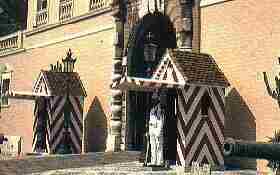
canons with their piles of bullets form the main entrance. Soldiers, dressed in
coloured operetta uniforms stand guard and the changing of the guard happens
every day at 11.45 in front of an incredible amount of tourists (especially in
high season). I never grasped the interest of all this, but who am I? A small
detail for those who are interested: the soldiers are dressed in black during
the winter and white during the summer. The State Apartments are sumptuous
recreations of palatial 17th and 18th century decor.
 |
|
Guard at Monaco palace |
On your way to the musee
oceanographique, you can stroll through the old quarter leading to the Cathedral,
an area of labyrinths, covered passageways, tiny squares, fountains and
tangerine -coloured passages. When you’re on the
rue Colonel Bellando de Castro, stop at no. 4 and look at the CATHEDRAL since
you’re standing in front of it! Where the 12th century St.Nicolas church used to
stand this pseudo neo-roman, clinical edifice in white stone of La Turbie has risen in
1884. It dominated a rocky spur, like the figurehead of a boat. The church is nothing extraordinary,
majestic and oppressive at the same time, but it has, as soon as you enter,
that atmosphere of a convivial living room, despite the
presence of two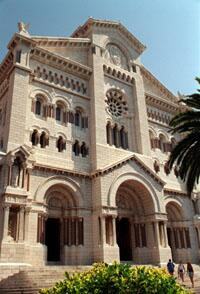 important altarpieces by Louis Brea, “Retable de
Saint-Nicolas” and “Pieta du Cure Teste”. But one particular spot is THE
attraction of this cathedral: the tomb of Grace Kelly, always buried under an
excess of flowers. Hundreds of tourists, freshly disembarked out of dozens of
tourist buses stay in sincere emotion around the grave of Gracia Patrizia. By
the way, the memory of princess Grace doesn’t give in Monaco any sign of cheap
sentimentalism. But in the inner circle of power, funny things happen as soon as
we would make some remark about her that doesn’t fit the official version and
this is not only the case for the Kelly question…. To be a perfect Monaco
princely family admirer and believer of official versions, it would be a shame
to name the miscreant American journalist James Spada, who wrote already several
years ago a world best-seller biography about Grace Kelly. It would me most wise
to express our disdain about this scribe, it would have been better not to name
him at all;-). Imagine, this vile wretch had the nerve, despite the heavy
opposition of the princely family, to publish his book and tell us that Grace
was already used to a lot of passionate love stories before marrying in pure catholic tradition with her dream-prince; and numerous other affairs that
didn’t prejudice the Grimaldis in any way (only in the eyes of the
short-sighted court). And if I want to be mean until the end, I would say that
the statue, in the middle of a green lawn, surrounded by a rose-garden
of Fontvielle, of a crumpled looking princes Grace harms her more than the book
of James Spada.
important altarpieces by Louis Brea, “Retable de
Saint-Nicolas” and “Pieta du Cure Teste”. But one particular spot is THE
attraction of this cathedral: the tomb of Grace Kelly, always buried under an
excess of flowers. Hundreds of tourists, freshly disembarked out of dozens of
tourist buses stay in sincere emotion around the grave of Gracia Patrizia. By
the way, the memory of princess Grace doesn’t give in Monaco any sign of cheap
sentimentalism. But in the inner circle of power, funny things happen as soon as
we would make some remark about her that doesn’t fit the official version and
this is not only the case for the Kelly question…. To be a perfect Monaco
princely family admirer and believer of official versions, it would be a shame
to name the miscreant American journalist James Spada, who wrote already several
years ago a world best-seller biography about Grace Kelly. It would me most wise
to express our disdain about this scribe, it would have been better not to name
him at all;-). Imagine, this vile wretch had the nerve, despite the heavy
opposition of the princely family, to publish his book and tell us that Grace
was already used to a lot of passionate love stories before marrying in pure catholic tradition with her dream-prince; and numerous other affairs that
didn’t prejudice the Grimaldis in any way (only in the eyes of the
short-sighted court). And if I want to be mean until the end, I would say that
the statue, in the middle of a green lawn, surrounded by a rose-garden
of Fontvielle, of a crumpled looking princes Grace harms her more than the book
of James Spada.
Let’s continue to our next stop: the wonderful, certainly
most interesting site of Monaco: the MUSEE OCEANOGRAPHIQUE. But that’s for next article.
Bibliography:
Mary Blume, "Cote d'Azur.
Inventing the French Riviera" (Thames and Hudson, London 1982) Stephen
Liegeard, "La Cote d'Azur (Ed.Serre, Nice 1988), Patrick Howarth, “When
the Riviera was ours” (Century, London 1977), Michel de la Torre,
Alpes-Maritimes 06 (ed.Nathan, later Deslogis-Lacoste), Pemble.J., “The
Mediterranean Passion” (ed.Oxford University Press 1988),”V.Van Hulst “The
Rock at the sea”, (ed.Casterman 1998)
|
Back
to Monaco contents
Visiting
Monaco-the Musee Oceanographique
Visiting Monte
Carlo-Casino-Hotel de Paris-Jardin Exotique
|