|
Back
to Saint Tropez contents
A not so kind introduction
Ancient
history and
musée de l'Annonciade
Modern
history and stars
|
How easy it is to forget in
this “mundane “ surrounding that also Saint-Tropez has a long history. This
exceptional bay had to attract, of course, all kinds of conquerors. Ligurians,
Celts, Greeks and evidently Romans fell in love with the site.
In a document of 1055 a certain “Ecclesia Sancti Torpetis”
is mentioned, in relation to a saint ”Torpes”, a Roman centurion steward to
the Emperor Nero’s palace, who became Christian and was beheaded for his faith
in the year 68. Legend says that the head of the beheaded corpse was thrown
together with a rooster and a dog, supposedly to gnaw what was left of him, in a
small boat. Cast adrift the boat landed 19 days later on the coast of the
contemporary Saint-Tropez. The horrifying contents were found by a certain
Celestina, Christian herself, who hid the corpse of the martyr, and build him a
chapel who buried the body. What happened to the dog and rooster, legend
doesn’t tell us…. You don't believe that story? Check the names of 2 nearby
villages Cogolin (meaning in old French: small rooster) and Grimaud (meaning:
dog in old French). This holds the legend alive!
The town was sacked and its population killed or dispersed by Saracen
raiders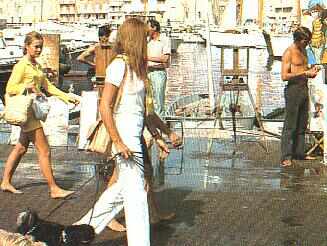 after their defeat at Poitiers in the 7th and 9th century.
The citadel overlooking the town dates from the ensuing period of well-organized
security.
after their defeat at Poitiers in the 7th and 9th century.
The citadel overlooking the town dates from the ensuing period of well-organized
security.
In the 15th century, under Genoan rule, up to the 17th, the city became a
"ville franche" where no taxes were paid and which could have its own
army, until Raffaele de Garezzio received the order to repopulate and
fortify the city with more Genoan families. The city became prosperous and wealthy.
But then the pain in the ass, Colbert, minister of Louis XIV ended all this in
1672 , since Louis XIV didn't want any city to have special privileges.
In the 19th century, the city of Saint-Tropez was mainly a tuna fish harbour in the late 19th
century. The bombing-raids of the landing of 15th of August 1944, caused severe
damages but luckily after the war, St.Tropez had very clever administrators who
didn't allow real estate promoters to destroy the old charm of the city. It was
rebuild on the same model, giving today a faithful image of what the
city was 400 years ago.
 |
|
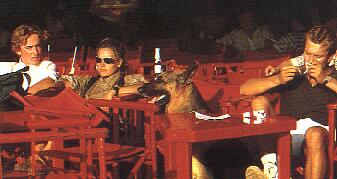
Watching from Senequier terrace |
The center of Saint-Tropez is the old
port enclosed by the long stone Jean Revelly jetty extending
outwards from the squat, round 15th century Portalet Tower, All along
the quays you have fashionable cafés, notably the all-red Senequier, still
famed for its nougat, and, stern to the quays, great yachts, futuristic
plastic white gin palaces or gleaming teak classics, with uniformed crews and,
increasingly, non-sailing corporate chatterers. Between the new port and the
sea-front heliport is a huge, continually packed car-park, with a small shaded
area for dogs with bowls of water and an attendant, financed by the Brigitte
Bardot foundation.
On the west side of the old
Port is the “musee de L’ANNONCIADE, a marvellous museum, housed in an early
16th century chapel, imaginatively renovated for the purpose. The
works were bequeathed by a certain Georges Grammont, manufacturer of deep-sea
wires, native of Lyon, to the city of Saint-Tropez, which turned the existing
chapel into this museum and opened in 1955 with a stunning impressionist
paintings collection.
 |
|
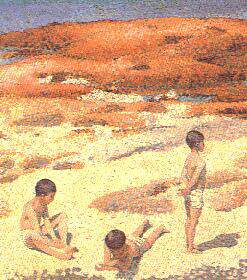
Boys on beach by Henri
Cross
|
In 1956 the museum was
robbed of almost his entire collection!!! Miraculously, the whole collection
popped up the year after. For someone not knowing about the museum and not
asking about it, would never find it!!
Besides four Maillol sculptures, the museum has works by Paul Signac (10
watercolours and five oils rotating), Van Dongen, Matisse, Seurat, Bonnard,
Rouault, Utrillo and Dufy. They worked with idea of having their works exposed
in the local museum. Let’s pay a tribute to Mr. Grammont, the deep sea wires
manufacturer with an infallible taste of art.
Next a stroll through Saint-Tropez.
Bibliography:
Mary Blume, "Cote d'Azur. Inventing the French Riviera" (Thames and
Hudson, London 1982), Stephen Liégeard, "La Cote d'Azur" (Ed.Serre,
Nice 1988 a reprint), " Roman remains of southern France ", by James
Bromwich (Routledge London 1993, "Guide du Routard 1999", (ed.
Hachette), "Dorpjes rond het St.Tropez schiereiland", by J.
Helperszoon (Alk 1996), Calvin Tomkins, “Living well is the best revenge” (E.P.Dutton)-“Les
Pointillistes en Méditerrannée”, by Ger.Dumortier ed. Livres
Bruxelles 1998), “St. Tropez baai and hinterland », by Joop van
Nieuwenhuizen (ed. Hansma, Maastricht 1995)
|
Back to Cote d'Azur contents
A
charming walk through
the city
Up
to the beaches
|