|
One of the most visited sites in France, the Mont-Saint Michel is a must, but out of season, if you 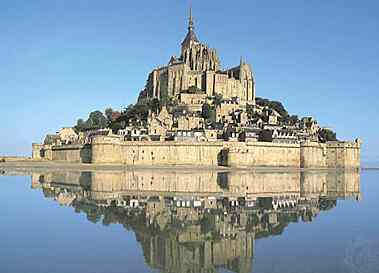 can. July and especially August, is more a Golgotha burden than a visit. A textbook definition of a tourist trap, it is most impressive when seen from afar, with its famous silhouette rising above the hazy sands and salt marshes like a heavily fortified breast. Today's exploitation unfortunately adds, souvenir boutiques and all sorts of tourist traps to this picture. That's the way it is. can. July and especially August, is more a Golgotha burden than a visit. A textbook definition of a tourist trap, it is most impressive when seen from afar, with its famous silhouette rising above the hazy sands and salt marshes like a heavily fortified breast. Today's exploitation unfortunately adds, souvenir boutiques and all sorts of tourist traps to this picture. That's the way it is.
This islet lies at the southern most point off the Normandy coastline, just before Brittany to the west. This is the base of a Bay of Mont Saint-Michel that opens into La Manche [channel waterway between England and Northern France]. The islet consists of a nearly 80 meters high rock with a circumference of about 8 km. It is connected to the mainland by a very narrow and long causeway. The Mont is half surrounded by water, except twice a day it is besieged by swift moving tides that leave only the causeway route for access. Defenders of this fortress abbey have the advantage of its Saint Aubert's spring. Nearby is a smaller islet, called 'Tombelaine Island', which is very bare and was used to discipline individuals.
|
|
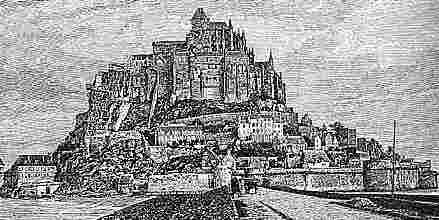
Mont-Michel in 1896
|
Let's assume, we ignore all the tourist traps and let's start the introduction, visit and more anecdotes. Let's begin with the legend.
The archangel St. Michel decided one day (708) to appear in a dream of the bishop of Avranches, Saint Aubert, and ordered him to erect on his behalf a sanctuary on Mont Tombe. Suspicious, the bishop chose to ignore the celestial order, all the more so because Mont Tombe's rock rose far from any roman way at the time, deep inside the vast forest of Scissy inhabited by wolves and wild beasts. The archangel apparead again to the bishop who was terrified but only prayed and fasted without accomplishing the command. Wrathful, Saint Michel intervened again. He brandished a blazing finger on top of the unbelieving bishop's head and hit him.

|
|
Archangel's finger
|
The archangel left a deep mark, as big as the hole, in the bishop's skull. Le "doigt de feu" (fire finger). Aubert go the message now, which got the message through. Maybe St. Michel was a bit brutal, but if you can visit the result in Avranches, at the treasure of the church St. Gervais. There they will show you the time-tanned skull of St. Aubert residing in a reliquary.
Aubert started to build a small oratory on the top of the rock, thus laying the foundations of what has since become the top tourist attraction in France (2 million visitors a year), except Paris.
A monastery was started in 1017, with stones hauled at low tide from the mainland in Brittany and soon became one of the most important destinations for pilgrims in the world. It attracted a throng of the faithful - and was in competition with Santiago de Compostela in Spain as a place of pilgrimage. It took six centuries to build this superhuman construction compressed onto the tip of a rock thrust out of the waters of the bay. By the time of William the Conqueror, the abbey benefited from many noble protectors.
|
|
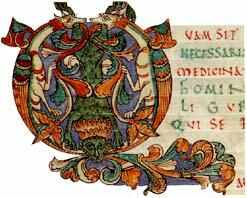
Manuscript
|
The abbot Robert de Thorigny administered the abbey at its peak of fortune. The shrine has seen is number of miracles and fostered many legends. Site of early medieval religious feasts and ceremonies. Blanche of Castile, regent of France, ordered the gothic cloister in 1211 added to the earlier Carolingian abbey. A town developed at the base. Both the abbey and the town had fortified defences. Mont Saint-Michel was besieged and taken as part of Philippe Auguste's conquest of Normandy from the Plantangenets in 1214. The site continued to have an increased role in medieval European pilgrimages. Sometimes it was the destination, and at others it was only a stop for those travelling to sites further south. Lower class pilgrims were quartered in the town, but nobles were received by the abbot in the grand abbey.
A stronghold during the Hundred Years War, during and after the French Revolution it became a prison, which closed only in 1863, following a lengthy campaign initiated by Victor Hugo. Eleven years later, the monastic grouping was designated as a historical monument.
Next post about the dangers of the bay.
Bibliography
Le Mont-Saint-Michel pierre à pierre by Marc Deceneux (Éditions Ouest France 1996), Millénaire monastique du Mont-Saint-Michel, by Michel Nortier( ed. Lethellieux Paris 1993),Le Mont-Saint-Michel,Histoire (Éditions du patrimoine), L'abbaye du Mont-Saint-Michel (Les grands sites et monuments du monde at Gallimard, Le Mont-Saint-Michel, monastère et citadelle by Lucien Bély (Éditions Ouest France 1996)
|