|
Paris, a sea of 19th
century houses. Nevertheless the city counts more than 340 parks or woods. One
of the most beautiful is the PARC DES BUTTES CHAUMONT, here in the 19th
arrondissement (entrance rue Botzaris, rue Crimée) in the north.
Since Napoleon III gave Haussman the assignment to put a “green lung” for
the workmen in this area, there is nothing more left from the bold hillock that
used to be here. The park, 25 hectares, received a maze of trails and paths of a
length of 5 km. They all lead to an artificial lake (where you can row), with in
the middle a rocky island of 50 meters height with on its top the
“Sybille-Temple” from where you have a wonderful view on Montmartre. Two
bridges give you access to the island and the “Chemin des Aiguilles”, 220
steps carved into the rock give you the possibility to climb to the top. Aragon
was enthusiastic about this park in his outburst: “Jardins, vous etes les
femmes de l’esprit!!”.
Notice the old roller skate track surrounded by an iron ramp, from the times
that children behaved properly and leisure was codified!! ;-)
At the east side of the lake there is another grotto, 15 meters deep with an
artificial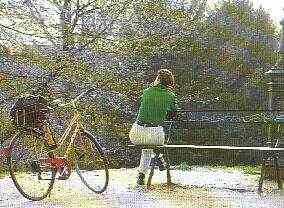 waterfall. It’s here that gyps were found beginning 19th
century. Next to the gate of the main entrance, facing the west shore of the
lake you can see a map with information about the exotic plants in the park.
Open air performances of the puppet theatre, across the entrance are especially
popular with the young children. They are in action from spring to fall,
depending on the weather. When the sun shines, the 18 benches are packed. During
the summer you can enjoy concerts given in a small music pavilion. And after
that you can savour some dish in the beautiful restaurant La Puebla. waterfall. It’s here that gyps were found beginning 19th
century. Next to the gate of the main entrance, facing the west shore of the
lake you can see a map with information about the exotic plants in the park.
Open air performances of the puppet theatre, across the entrance are especially
popular with the young children. They are in action from spring to fall,
depending on the weather. When the sun shines, the 18 benches are packed. During
the summer you can enjoy concerts given in a small music pavilion. And after
that you can savour some dish in the beautiful restaurant La Puebla.
Now I’m going to take you on a very special and rare tour. You must know that
there still are in Paris oases of greenery that have resisted the stress and
attraction of concrete and high rise. Those who don’t believe me should go and
have a walk in this underestimated part of the capital. Don’t expect grandiose
monuments, photographed on all sides by hoards of tourists. No particular
impressive and spectacular architectures, but some beautiful, unexpected secret
gardens with adorable small houses, pavilions, all covered by ivy. Except the
local inhabitants you will only encounter some groups lead by a French guide,
specialize in these unusual visits. But no English speaking! These guides are
usually old retired university professors who discovered this area also. By the
way, it is by taking such a tour a few years ago that I discovered the area of
the MOUZAIA, where I will lead you in my next article.
Bibliography
--Vie
et histoire des arrondissements de Paris, ed.Hervas (1985-1988--Nouvelle
Histoire de Paris, ed.Hachette--Le Pieton de Paris, by L.P.Fargue, ed.Gallimard
1997--Dictionnaire historique des rues de Paris, by J.Hillairet, ed.Minuit
--Guide du Routard 1998-1999 (Ed.Hachette)--Paris, 2000 d'histoire, by J.Favier,
ed.Fayard 1997 --Paris 19eme siecle, l'immeuble et la rue, by F.Loyer, ed.Hazan,
1994- Paris inconnu, quartiers tranquilles, by B.Beyern (own folder)
|
