|
 I
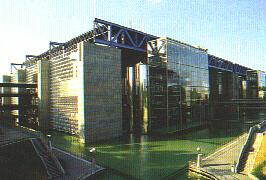
told you already about the enormous scandal in the 60’s when a megalomaniac
project for modern slaughterhouses became a total failure and engulfed billions.
Luckily the president of that time, Valery Giscard d’Estaing, had the
brilliant idea to transform the shopping hall into a “science city”. An architect was
appointed, the Jewish Adrien Fainsilber, proposing to be aware of the stakes of scientific research,
industrial investments and the progress of technology. The company which built
it finally was the same company that masterminded the moving of the temple of
Abu Simbel. Fainsilber built a futurist temple from a carcass. This was a not an
easy task, all the exhibits had to be obligingly interactive, with buttons,
keyboards, levers and screens to keep mind and body alert. I
told you already about the enormous scandal in the 60’s when a megalomaniac
project for modern slaughterhouses became a total failure and engulfed billions.
Luckily the president of that time, Valery Giscard d’Estaing, had the
brilliant idea to transform the shopping hall into a “science city”. An architect was
appointed, the Jewish Adrien Fainsilber, proposing to be aware of the stakes of scientific research,
industrial investments and the progress of technology. The company which built
it finally was the same company that masterminded the moving of the temple of
Abu Simbel. Fainsilber built a futurist temple from a carcass. This was a not an
easy task, all the exhibits had to be obligingly interactive, with buttons,
keyboards, levers and screens to keep mind and body alert.
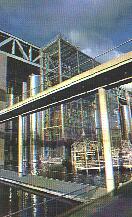
Exactly on the day of the appearance of the Haley comet, 13th March
1986, the Cité des Sciences et d’Industrie was taken into operation.
The enormous hall of this museum is 270 meters long, 110 wide and 49 metres
high, totalling 165.000 square meters! Three themes guide the conception of the
building: water, vegetation and light. The vegetation enters through three large
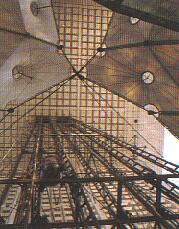
green bio-climatic greenhouses, turned towards the park, the light
"energy source of the living world" lightens the spaces of the permanent
exhibition thanks to two cupolas of 1 m diameter.
 There
is a constant exhibition called “Explora” divided into 4 departments: From
earth to the universe, the adventure of life, the tool and human work, language
and communication. Kids are especially enthusiast about the “Inventorium”.
Then you’ll find a planetarium in the section of "the extreme
environments”, a mediatheque and three enormous plant glass-cases. “The world of Sounds and Mathematics”: games of sensitivity to
maths and the physics of sound (test the level of finesse of your hearing,
discover the spectre of your voice....). Let me draw you attention to another
particularity of this complex: it's a complete interactive place. The displayed
technologies and objects and the visitor exchange and participate. You can touch
and move everything, play the electronic piano, surfing with computers. Another
exhibition tries to let you discover and comprehend the climatology, the ecology
and the great environmentalists challenges of this end of century. A
meteorological station is accessible to you, you can manipulate joysticks, play
and search, there is everything for all ages. A very surprising and agreeable
text you see everywhere is “please touch!!” There
is a constant exhibition called “Explora” divided into 4 departments: From
earth to the universe, the adventure of life, the tool and human work, language
and communication. Kids are especially enthusiast about the “Inventorium”.
Then you’ll find a planetarium in the section of "the extreme
environments”, a mediatheque and three enormous plant glass-cases. “The world of Sounds and Mathematics”: games of sensitivity to
maths and the physics of sound (test the level of finesse of your hearing,
discover the spectre of your voice....). Let me draw you attention to another
particularity of this complex: it's a complete interactive place. The displayed
technologies and objects and the visitor exchange and participate. You can touch
and move everything, play the electronic piano, surfing with computers. Another
exhibition tries to let you discover and comprehend the climatology, the ecology
and the great environmentalists challenges of this end of century. A
meteorological station is accessible to you, you can manipulate joysticks, play
and search, there is everything for all ages. A very surprising and agreeable
text you see everywhere is “please touch!!”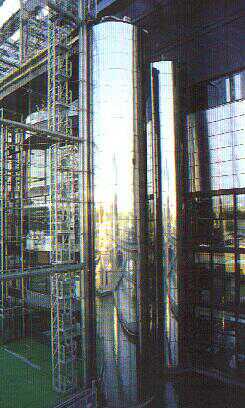 Rotating exhibitions about scientific, technical and industrial subjects are
going on all the time. For instance a computer with 2 TV screens propose an
immense electronic spectacle to make you understand what is an ecosystem with
sounding small scales of the tropical forest, an African desert, cyclones, or
ocean currents circulation. Also all the answers about air pollution and water pollution, toxic waste, acid rains, etc..
Rotating exhibitions about scientific, technical and industrial subjects are
going on all the time. For instance a computer with 2 TV screens propose an
immense electronic spectacle to make you understand what is an ecosystem with
sounding small scales of the tropical forest, an African desert, cyclones, or
ocean currents circulation. Also all the answers about air pollution and water pollution, toxic waste, acid rains, etc..
In the first five years 21 million visitors visited the complex and it increases
every year. Foreigners are a minority but they 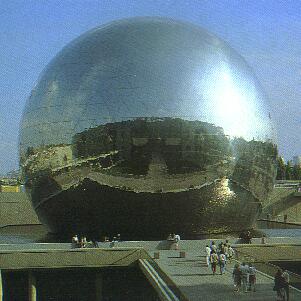 are not forgotten. The staff
speaks several languages and for special exhibitions they provide cassettes in
English, Spanish and German. But be warned: to see everything in the Cite you
need at least 30 hours. The “General introductory Tour” last already 2 to 3
hours. are not forgotten. The staff
speaks several languages and for special exhibitions they provide cassettes in
English, Spanish and German. But be warned: to see everything in the Cite you
need at least 30 hours. The “General introductory Tour” last already 2 to 3
hours.
To visit the Cite you have a lot of different systems proposed to the visitor:
"Scientific animators" help the public in her discovery of the Cite,
her exhibitions and shows. You can rent "audio-headsets in 4 languages and
there is a special arrangement foreseen for handicapped people (orientation stripes glued to
the floor, Braille texts on different objects with schemes in relief)
On level -2 you are suddenly plunged at the bottom of the Mediterranean. On 250
sq.m. The Aquarium houses more than 2000 species of fish on three levels.
I could go on much longer with the GEODE (giant movie with an hemispheric
screen) or CINAXE (mobile movie theatre, set on paws, who moves in function of
the movements proposed by the projected images). Quite impressive. Your need a
solid stomach!
Also l’ARGONAUTE (a real submarine).
Bibliography
--Vie et histoire des arrondissements de Paris, ed.Hervas
(1985-1988--Nouvelle Histoire de Paris, ed.Hachette--Le Pieton de Paris, by
L.P.Fargue, ed.Gallimard 1997--Dictionnaire historique des rues de Paris, by
J.Hillairet, ed.Minuit --Guide du Routard 1998-1999 (Ed.Hachette)--Paris, 2000
d'histoire, by J.Favier, ed.Fayard 1997 --Paris 19eme siecle, l'immeuble et la
rue, by F.Loyer, ed.Hazan, 1994-
Nouvelle architecture, l’ère Mitterand , by J.Daniel (Grasset,
1997)-Sciences a Paris, by J.Dupleix (ed.Lecourbe 1996), La Cite des Sciences
(folder at redeption)
|
