|
 |
|
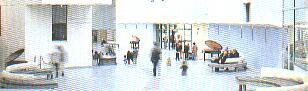
Lobby of the musee
and concert hall |
La CITE DE LA MUSIQUE was
realized by architect Christian de Portzamparc. On the premises we can also see
the "CONSERVATOIRE DE LA MUSIQUE" characterized by her undulating roof
of corrugated iron, her pillars piercing through iron VULVAS and the heavy waves
it shows.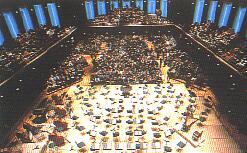 Joyful architecture, as usual, a very original concept with the enormous
cylinder with inclined dome of the " concert hall", ready to accept
1200 "melomanes" rookies or confirmed. On the programs, classical and
big shots, William Christie, John-Elliot-Gardiner or Pierre Boulez but also jazz
(Max Roach, Cecil Taylor) or the "chanson francaise". Also smaller
concert halls are available. Let's emphasize the good acoustics of the halls,
the quality of the concerts, the reasonable prices.
Joyful architecture, as usual, a very original concept with the enormous
cylinder with inclined dome of the " concert hall", ready to accept
1200 "melomanes" rookies or confirmed. On the programs, classical and
big shots, William Christie, John-Elliot-Gardiner or Pierre Boulez but also jazz
(Max Roach, Cecil Taylor) or the "chanson francaise". Also smaller
concert halls are available. Let's emphasize the good acoustics of the halls,
the quality of the concerts, the reasonable prices.
In 1997, the MUSEE DE LA MUSIQUE opened as a modern 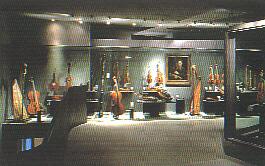 concept
centred on musical heritage. It's priceless collections imposed embracing
ambitious policies of acquisition and restoration. With a surface in excess of
over 3000 square meters, the halls of the permanent exhibition deploy 900
instruments, paintings and divers objects. It boasts an extraordinary rich
collection, with 17th century archlutes from Venice, remarkable collection of
French and Flemish instruments from the 18th and 19th centuries, violins from
the famous Cremona school (Amati, Stradivarius, concept
centred on musical heritage. It's priceless collections imposed embracing
ambitious policies of acquisition and restoration. With a surface in excess of
over 3000 square meters, the halls of the permanent exhibition deploy 900
instruments, paintings and divers objects. It boasts an extraordinary rich
collection, with 17th century archlutes from Venice, remarkable collection of
French and Flemish instruments from the 18th and 19th centuries, violins from
the famous Cremona school (Amati, Stradivarius, Guarnerius del Gesu), recorders by Hotteterre, Flemish harpsichords by the
famous Antwerp Ruckers dynasty, pianofortes from Erard and Pleyel, an
exceptional ensemble of brass by Adolphe Sax (did I tell it already he was from
Namur-Dinant in Belgium?), instruments of the 20th century such as an electric
violin by Frank Matthews, Frank Zappa’s E-Mu synthesizer or percussion
instruments from Edgar Varese.
Guarnerius del Gesu), recorders by Hotteterre, Flemish harpsichords by the
famous Antwerp Ruckers dynasty, pianofortes from Erard and Pleyel, an
exceptional ensemble of brass by Adolphe Sax (did I tell it already he was from
Namur-Dinant in Belgium?), instruments of the 20th century such as an electric
violin by Frank Matthews, Frank Zappa’s E-Mu synthesizer or percussion
instruments from Edgar Varese.
Infrared headsets enable visitors to penetrate" sound pockets", and to
listen to explanations and extracts of important works played by the instrument
displayed before their eyes as they tour the various levels. The visitors who
penetrate the halls of the museum are at once stuck by the feeling of being
elsewhere, in a concert hall, at a recital....
The museum is divided in 9 spaces or chapters setting the instruments within the
historical, social and cultural contexts that saw their emergence. These nine
spaces constitute major landmarks in the museum’s itinerary; yet another
parallel itinerary is available to the visitor. Showcases situated at the
various levels presents families of instruments, punctuating the chronological
tout at key instants in the history of a given instrument. These showcases also
present monographs of instrument makers such as Sellas, Stradivarius, Amati, Sax
(Belgian!), Vuillaume…..In each case, a common device makes it possible to
literally see a given work. In the case of Monteverdi's Orfeo for
instance, a model of the ducal palace of Mantova, where the work was created,
shows the positioning of the orchestra.
|
|
|
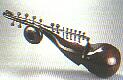
Bengal luth |
The museum shows superb
Flemish and Italian harpsichords, archiluths, clavichords, cistresand other old
and forgotten instruments as the mega double bass, 3 to 4m high! And all this
illustrated by the sound and musical excerpts of these instruments brought to
you through your infrared ear sets. The excerpts of opera, concertos or jazz,
soberly commented, charm your ear and educate your mind. You can't get enough! I
spent there 3 h easily, without realizing time was going by so quickly!
Web site www.cite-musique.fr
Bibliography
Nouvelle architecture, l’ère
Mitterand , by J.Daniel (Grasset, 1997)-Cite de la Musique, (folder and
handbook)
|
