|
 At the beginning, the
Parisians, used to be buried along their churches were reticent to be
"expatriated" so far from Paris. The cemetery had no success at all
despite an extraordinary well-kept garden. To be convinced have a look indicated
in the old logbook of the cemetery: At the beginning, the
Parisians, used to be buried along their churches were reticent to be
"expatriated" so far from Paris. The cemetery had no success at all
despite an extraordinary well-kept garden. To be convinced have a look indicated
in the old logbook of the cemetery:
1804……..113 1805……..14 1806……….19
1807……....26 1808…......51 1809…..........66
1810……….96
1811…….130 1812……..130
1813……..242 1814….......509
1810.........635
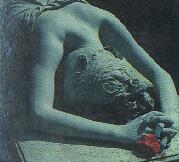
So the authorities did some marketing trick and organized with great publicity
the transfer of the remains of Heloise and Abelard in 1817 and the supposed
remains of Moliere and La Fontaine were put in two very representative
sarcophagi and buried in the cemetery of Pere –Lachaise. The idea to be buried
aside such famous deaths provoked of course a sort of infatuation. 15 years
later the cemetery reached already the number of 33,000.
A lot of people wonder how many people are buried in this necropolis. Paul
Albert, in 1936 puts the number of 835,278 in his book “Histoire du Pére–Lachaise”
ed.Gallimard. The cemetery designers of the 19th century, certainly
not deprived of humour called one of the side streets of the cemetery “rue du
repos” (resting street).
From 1815 on the cemetery pursued a more peaceful existence, despite the time
slowly degrades the chapels and crumbles the statues. But in all seasons the
Pere-Lachaise receives its amount of lovers: necrophilia looking to decipher an
illegible tombstones, lost souls, peaceful young mothers with their children,
tourists, a sympathetic gang of statue fetishists, diverse mystics. But also
perverts, lovers searching erotic pleasures, voyeurs (a corollary of the
precedent), poets, chlorophyll amateurs, adorable little oldies and simple
strollers. I don't have the pretension to make an exhaustive inventory of the
cemetery. The tastes and phantasms of my readers are naturally so different that
I would need an Encyclopaedia. May you'll bump into one of those extraordinary
specialists of the Pere Lachaise, like Vincent de Langlade or Bertrand Beyern,
always ready to give info or to tell you a funny anecdote
Let’s start a visit for those who dispose of a limited schedule. (1 hour)
You can have a fragmentary view on the main alley but you must see the romantic
little valley where Chopin is buried, the point of view on the chapel, the
dolmen of Alain Kardec, the obelisque Beaujour, the sarcophagi of Delacroix, the
Descent of the Cross by Del Duca, the bust of Musset and the imposing death
monument of Bartholomé. All these tombs will be explained in more details
during my walk for those disposing a whole afternoon and even that will not be
enough.
Access through the boulevard de
Menilmontant, the main entrance. In
front of you the sumptuous death monument, "Monument aux Morts". The day of inauguration, the
authorities required that the sheet covering the monument should not be
completely taken off, so that the sight of the statues nude buttocks would not
horrify the crowd! At the first
crossroad turn right (avenue du Puits), immediately cut by the avenue latérale
sud.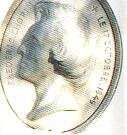 Take this one to the left. You continue this very romantic path until you
are stopped by the chemin Denon. Take this chemin and you’ll see successively
the tombs of BRANLY, CHERUBINI and the most important: FREDERIC CHOPIN. Return
to take the allée latérale sud to the terrasse de la Chapelle. But first make a
left to discover the statue of the great painter GERICAULT, sculpted by Etex.
Return to the chapel. This tiny edifice is overshadowed by the mausoleum, a
megalomaniac edifice dedicated to ADOLPHE THIERS, (died 1877). He was a French
politician of the 19th century, who became finally president in 1871 after
having slain the French Commune revolution in blood and tears): ugly, heavy and
without any taste, resembling to the sinister personage. The mausoleum was
damaged a few years ago by a plastic explosion. After long years of
administrative problems it was repaired. During my last visit I noticed the
repaired damage: the new plaster shows very clearly the fix!! Thiers, not being
my favourite French historic figure, didn’t deserve such a mausoleum after
all!! The interior that you can visit only on Nov 1 is splendid: a sarcophagus,
copied of that of Napoleon, in green porphyry. Crazy Parisians… Take this one to the left. You continue this very romantic path until you
are stopped by the chemin Denon. Take this chemin and you’ll see successively
the tombs of BRANLY, CHERUBINI and the most important: FREDERIC CHOPIN. Return
to take the allée latérale sud to the terrasse de la Chapelle. But first make a
left to discover the statue of the great painter GERICAULT, sculpted by Etex.
Return to the chapel. This tiny edifice is overshadowed by the mausoleum, a
megalomaniac edifice dedicated to ADOLPHE THIERS, (died 1877). He was a French
politician of the 19th century, who became finally president in 1871 after
having slain the French Commune revolution in blood and tears): ugly, heavy and
without any taste, resembling to the sinister personage. The mausoleum was
damaged a few years ago by a plastic explosion. After long years of
administrative problems it was repaired. During my last visit I noticed the
repaired damage: the new plaster shows very clearly the fix!! Thiers, not being
my favourite French historic figure, didn’t deserve such a mausoleum after
all!! The interior that you can visit only on Nov 1 is splendid: a sarcophagus,
copied of that of Napoleon, in green porphyry. Crazy Parisians…
Turn your back to the chapel and
admire the view of Paris, unfortunately masked by trees.
 |
|
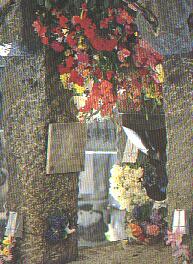
Alain Kardec Tomb |
Go back a few steps and
take the avenue des Feuillants to the left, but at the Avenue Transversale no.1
you turn left to the avenue de la Nouvelle Entrée and after the crossing with
the chemin de Quinconce, you will finally discover the dolmen-tomb of ALAIN
KARDEC(d.1869), most famous celebrity of spiritism. I’ll have a few anecdotes
about him too in my more detailed promenade. Redescend the avenue des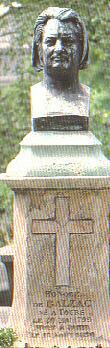 Feuillants
but turn left at the Allée Transversale no.1 towards the huge lighthouse,
16-meter height, and the highest monument of the cemetery. Descend again the
chemin Casimir Delvigne, passing the grave of BALZAC and you’ll arrive at a
square with a high-relief representing the tomb of the historian MICHELET. Just
make an incursion in the chemin Delacroix giving you the opportunity to admire
the beautiful sarcophagi of this great painter. Take now the chemin de Montlouis
until the intersection with the avenue de la Chapelle to admire one of the most
interesting sculptures of the cemetery: the "Pieta" on the tomb of
CINO DEL DUCA, the one who made millions of young girls dream about love with
the magazine "Nous Deux". Pieta extraordinary of realism, represented
standing up, for the first time. When you arrive at the level of the
avenue de la Chapelle at the first angle of the terrace, turn right to see the
stele (medallion) of the grand painter David (whose corpse is still in
Brussels!!) Feuillants
but turn left at the Allée Transversale no.1 towards the huge lighthouse,
16-meter height, and the highest monument of the cemetery. Descend again the
chemin Casimir Delvigne, passing the grave of BALZAC and you’ll arrive at a
square with a high-relief representing the tomb of the historian MICHELET. Just
make an incursion in the chemin Delacroix giving you the opportunity to admire
the beautiful sarcophagi of this great painter. Take now the chemin de Montlouis
until the intersection with the avenue de la Chapelle to admire one of the most
interesting sculptures of the cemetery: the "Pieta" on the tomb of
CINO DEL DUCA, the one who made millions of young girls dream about love with
the magazine "Nous Deux". Pieta extraordinary of realism, represented
standing up, for the first time. When you arrive at the level of the
avenue de la Chapelle at the first angle of the terrace, turn right to see the
stele (medallion) of the grand painter David (whose corpse is still in
Brussels!!)
Continue straight on now. The path, very narrow, descends on different platforms
in front of the tombs of painter BAUDRY, ALFRED DE MUSSET AND VISCONTI.
Now take frankly the main avenue to admire the death monument. You finished the
very rough and short visit now.
Bibliography
--Vie et histoire des arrondissements de Paris, ed.Hervas, 1985-1988, 20 volumes- Le piéton de Paris, by L.P. Fargue, ed.Gallimard 1997- Guides du Routard 1998, ed.Hachette, Parijs, een wereldstad, by Hilaire Verbert, ed. Nelle 1996-Guide de Cimetieres de Paris, by M.Le Clere, edHachete 1990, --Promenade au Pere Lachaise, by Bertrand Beyern, own folders.
|
