|
 For a long time a certain
bashfulness stopped historians to enter upon the problem of death. For a long time a certain
bashfulness stopped historians to enter upon the problem of death.
I will not be like that. I want to unveil and draw attention to Paris cemeteries
because the destiny of a humane being doesn’t stop at the moment you put him
in a coffin and bury. Funeral monuments remind the image that the dead person
wished to leave to his posterity (or that other wished to leave). The mass grave
skirts the statue: on one side, anonymous, on the other posthumous glory.
The history of cemeteries is entangled with economic, social, political and
artistic history.
If you think a little bit about it, cemeteries are crossroads of reflection,
privileged enclaves for loitering, spots where you can knit your life upon other
people’s graves. When you walk in the city’s public parks, you often see
idle and sophisticated women sitting on a bench trying to read some
“intellectual” and gloomy literature. And what about the red, sweating, fat,
choking exhibitionists wiping of the sweat of their foreheads and trotting like
labour horses, trying to lose some pounds they will never lose? And what about
the begging professionals, loudmouths, tanning maniacs, inelegant ice-cream
eaters, shrieking babies, and my list is far from complete…. Well, despite
they certainly are all respectable, I prefer the ones haunting the cemeteries. A
part from the visitors wearing a black ribbon, looking up their beloved, you can
see discrete moms giving their children the needed chlorophyll while others look
for a silence only disturbed or if you want, enhanced, by the symphony of the
birds between the tombs. Inevitable tourists appear from time to time. We can
divide them into two groups: those who, grouped, do their cultural duty on the
double in quick step. Armed with the inevitable camera, they visit the tombs of
Piaf, Chopin, Balzac or other first class stars. They do what I would call
“necropolis star visit” Anecdotes and small history doesn’t interest them.
Then you have those who, ignoring the hit parade, go individually to more
discrete graves like Oscar Wilde, Marcel Proust, Appollinaire, Eluard etc…
The articles
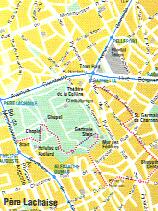
that will follow will have the PERE LACHAISE as subject. It’s a unique
promenade destination for those who have seen the main Paris landmarks and want
something else, peculiar and unexpected. A crazy afternoon with the most
sympathetic deaths of the Earth. It can be tragic, joyful, playful, and even
erotic and sensual (YES, YES!). I will put a lot of anecdotes in my next
articles, so follow the thread!
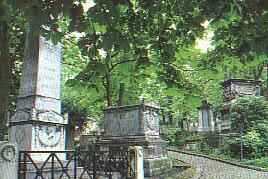
How can I describe such a resting place? 44 planted hectares with 12,000 trees,
it has no match to any other cemetery. It’s the largest park of the capital.
Its steep alleys, twisted paths and slopes make it to a sort of privileged
island in the city. More than a necropolis, it’s a place with a special
atmosphere where arthritic pavements, leprous and cracked monuments survived the
centuries.
But before prosing a walk in this unique place, let’s learn some history
first.
The first question is of course: who is that pere Lachaise? François d’Aix de
La Chaise was the confessor of Louis XIV in 1675 which was not an easy task when
you know that Louis XIV lived for over 20 years in total adultery and that the
protocol compelled him to celebrate Eater every year in front of the whole
court. The priest was a sly fox in these difficult circumstances….like
pretending “diplomatic illnesses”. Saint-Simon wrote about him that he was a
mediocre mind but had a straight character, soft and moderated, quick to change
when he saw he was wrong…Anyway, La Chaise received for his services a
propriety called then “Mont-Louis “ where soon an “orangerie “ was
built.
In 1762, a quarrel about debts and rents made that the domain changed hands and
finally in 1804 the cemetery of Pere Lachaise was created.
Bibliography
--Vie et histoire des arrondissements de
Paris, ed.Hervas, 1985-1988, 20 volumes- Le piéton de Paris, by L.P. Fargue,
ed.Gallimard 1997- Guides du Routard 1998, ed.Hachette, Parijs, een wereldstad,
by Hilaire Verbert, ed. Nelle 1996-Guide de Cimetieres de Paris, by M.Le Clere,
edHachete 1990, --Promenade au Pere Lachaise, by Bertrand Beyern, own folders.
|