|
The
Pere-Lachaise is romantic as hell and certain of its tenants overload the charge
but it is in fact unrealistic to hope to see over a thousand interesting
sepultures in a few hours: more than 10 miles of avenues, roads, paths, trails.
Fortune made the first choice between the deceased, than the posterity and
finally art and notoriety. We will leave a side a few big names but try to limit
it to reasonable proportions.
Like before we enter the cemetery through the boulevard de Menilmontant, facing
the rue de la Roquette (metro: Pere –Lachaise). Continue the main avenue until
the avenue du Puits where one of the first tombs is that of COLETTE (a French
writer). A moving grave of a blind man just in front.
 |
|
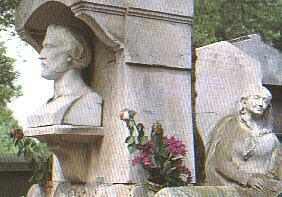
Alfred de Musset |
Return to the avenue
principale and at the left side the tomb of ALFRED DE MUSSET. It has of course
an epitaph in form of a poem: " My dear friends, when I'll die, plant a
willow in the cemetery...I like its wining foliage, its pallor is sweet and dear
to me and its shadow will be light..to the soil where I will sleep….”
" But willow trees died quickly and must be replaced frequently. Continue
along the avenue Principale until the monument aux morts (we will see that at
the end of the promenade)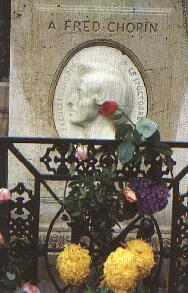 and take at the right the chemin Denon. After the grave of CHERUBINI the tomb of
Frederic CHOPIN (1810-1849) The petite muse in white marble decorating the
sepulture is not a pure masterwork, but it has something very moving. Sculpted
by Clesinger, a brother in law of George Sand. Being afraid to be buried alive,
Chopin insisted that his heart should be taken out of his body. His body rests
here, but his heart is inside one of the pillars of the Saint-Cross church in
Warsaw. Despite of that, each time Poles come to Paris, they cannot resist the
temptation to honour one they consider as theirs. His tomb, well maintained is
always flourished but in an extremely sober way. Notice that the toes and
fingers of the muse are constantly mutilated by fanatic admirers. Not far,
another musician, BELLINI. Just beneath, the tomb of Baron Haussman. In front a
lot of known French , ARAGO, LEDRU-ROLLIN. FELIX FAURE, deceased in the Elysee,
in the arms of his mistress, is represented on his tomb, wrapped in the French
flag. One could swear it are the bed sheets!
and take at the right the chemin Denon. After the grave of CHERUBINI the tomb of
Frederic CHOPIN (1810-1849) The petite muse in white marble decorating the
sepulture is not a pure masterwork, but it has something very moving. Sculpted
by Clesinger, a brother in law of George Sand. Being afraid to be buried alive,
Chopin insisted that his heart should be taken out of his body. His body rests
here, but his heart is inside one of the pillars of the Saint-Cross church in
Warsaw. Despite of that, each time Poles come to Paris, they cannot resist the
temptation to honour one they consider as theirs. His tomb, well maintained is
always flourished but in an extremely sober way. Notice that the toes and
fingers of the muse are constantly mutilated by fanatic admirers. Not far,
another musician, BELLINI. Just beneath, the tomb of Baron Haussman. In front a
lot of known French , ARAGO, LEDRU-ROLLIN. FELIX FAURE, deceased in the Elysee,
in the arms of his mistress, is represented on his tomb, wrapped in the French
flag. One could swear it are the bed sheets!
Look up now the avenue Casimir Perier turn round the rond-point Casimir Perier
to the left and you’ll see the tomb of MONGE whose body was transferred to the
Pantheon on Dec 12 1989 and a more picturesque one, the tomb of RASPAIL. The
most radical of the revolutionaries, ancient seminarist. You must turn around
his grave to discover the sepulture of CHAMPOLLION, decoder of the hieroglyphs.
It’s with an infinite emotion that we pass to the next client, a remarkable
one, the poet GUILLAUME APOLLINAIRE (1880-1918). His tomb is enhanced by a
granite needle. He is buried with his wife, Jacqueline (d.1967). But this
sepulchre never sees the crowds like the ones around the tomb of someone like
EDITH PIAF not easy to find because it's in an interior line. On 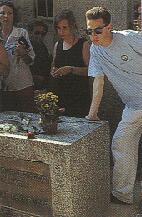 the
same high is the tomb of FERNAND LEGER. MODIGLIANI is in front, a little more
west. the
same high is the tomb of FERNAND LEGER. MODIGLIANI is in front, a little more
west.
Take now the chemin Serre and Maison, until the crosspoint with the chemin de
Lesseps. In principle, the fans of JIM MORRISON, lead singer of the DOORS chalk
the path to his tomb who is a little excentred in the 6th division. You can not
miss his grave. Always crowded with hippies from the seventies, pot smoking boys
and girls, burning candles, listening to Morrison's music on portable CD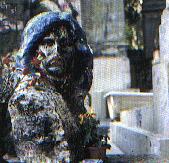 players with loudspeakers lying around the tomb . It's a real happening every
day and quite an experience ! One can wonder what brought this singer to
Paris to die in a sordid hotel room, stuffed with alcohol and drugs?
players with loudspeakers lying around the tomb . It's a real happening every
day and quite an experience ! One can wonder what brought this singer to
Paris to die in a sordid hotel room, stuffed with alcohol and drugs?
Bibliography
--Vie et histoire des
arrondissements de Paris, ed.Hervas, 1985-1988, 20 volumes- Le piéton de Paris,
by L.P. Fargue, ed.Gallimard 1997- Guides du Routard 1998, ed.Hachette, Parijs,
een wereldstad, by Hilaire Verbert, ed. Nelle 1996-Guide de Cimetieres de Paris,
by M.Le Clere, ed.Hachete 1990, --Promenade au Pere Lachaise, by Bertrand
Beyern, own folders.
|
