|
The
main pulsing artery of the area, where a lot of handy craftsmen still work
mainly in the artisan furniture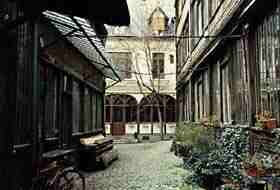 manufacturing is the RUE DU FAUBOURG-SAINT
ANTOINE one of the most picturesque of Paris. At each side of the rue de Faubourg St.Honore, a lot
of passages and narrow streets where you can see cabinet-makers,
tapestry-workers, gilders, etc... in superb courtyards, lined with splendid
hotels particuliers.The area is named after the name of the abbaye Saint-Antoine
des Champs founded in the 12th century. But in the 15th century it obtained a
rare privilege. Louis
XI gave full liberty to the guilds working in wood full and a total tax
exemption by letting them settle down in this labyrinth of courtyards and narrow
alleys.They developed new techniques in marquetterie for the cabinet
makers. En 1700, five hundred carpenters and 400 cabinet makers were counted.
The rue du faubourg Saint-Antoine kept his century old organization with
its 2-3 level buildings and the craftsmen ateliers in the back alleys and inner
courtyards. manufacturing is the RUE DU FAUBOURG-SAINT
ANTOINE one of the most picturesque of Paris. At each side of the rue de Faubourg St.Honore, a lot
of passages and narrow streets where you can see cabinet-makers,
tapestry-workers, gilders, etc... in superb courtyards, lined with splendid
hotels particuliers.The area is named after the name of the abbaye Saint-Antoine
des Champs founded in the 12th century. But in the 15th century it obtained a
rare privilege. Louis
XI gave full liberty to the guilds working in wood full and a total tax
exemption by letting them settle down in this labyrinth of courtyards and narrow
alleys.They developed new techniques in marquetterie for the cabinet
makers. En 1700, five hundred carpenters and 400 cabinet makers were counted.
The rue du faubourg Saint-Antoine kept his century old organization with
its 2-3 level buildings and the craftsmen ateliers in the back alleys and inner
courtyards.
Since
the 80's new inhabitants came to settle down , belonging to show and art
business, attracted by the low rents and was recently accelerated by the
building of the new Opera Bastille. A lot of
passages and courts still look very romantic. Skilful craftsmen, liberated of
coercion and restraint, can live out freely their creativity. Particularly the wood works and
furnishing industry developed there.
When you walk now through the faubourg Saint-Antoine you see magnificent
display-windows of furnishing shops. Everybody can find something for everyone.
Take care of the attractive talk of sales men on the sidewalks, trying to sell
something.
Notice the nice facades of no.14, 16 , sculptured above the high windows. At n° 50,
the passage de la Boule-Blanche (13) (closed Saturday and Sunday) comes out on
the rue de Charenton facing the hospital of Quinze-Vingts (n° 26-28).
At n° 56, la cour de Bel-Air has its south facades covered with wild grape.
Stairway G, nicely wooden sculpted.
At n° 66, le passage du Chantiers is paved
with big stones and has very narrow sidewalks whether you can see the old
workshops of grinders and lacquerers. It's there that the first bronze
decorations were made, the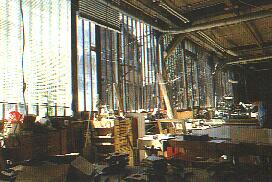 first marquetry, inlaid-works, and that the most beautiful furnishing style
Louis XIV, Louis XV or Louis XVI, were born. Like the works of the famous Boulle,
whose tables and chairs went to ornate Versailles and other palaces. Opposite is
the fontaine Trogneux,1719, sculpted with dolphins, lion heads and stone
pilasters.
first marquetry, inlaid-works, and that the most beautiful furnishing style
Louis XIV, Louis XV or Louis XVI, were born. Like the works of the famous Boulle,
whose tables and chairs went to ornate Versailles and other palaces. Opposite is
the fontaine Trogneux,1719, sculpted with dolphins, lion heads and stone
pilasters.
At n° 75, la cour de l'Etoile d'Or : the 17th century pavilion under which you
pass has a 1751 sun-dial. At n° 81, la cour des Trois-Frères is still in full
works. At the corner with rue Saint-Nicolas, a statue of the archbishop protects
the pedestrian. At no. 100 a characteristic post-Haussman house. There are still
ateliers in the passage de la Bonne Graine at no.115.
Today, we cannot imagine how difficult it was to keep the high standards of
manufacturing at those times when regulations were very strict. Most of them had to work "a boutique ouverte" (open boutique) so that
everybody could verify the quality of the used materials. A lot of these
workers were actively involved in the revolutionary days and stormed the
Bastille, made the revolutions of 1830 and 1848 and the Commune in 1870.
Take the rue de la Forge Royale to the left if you come from Bastille and continue to rue St.Bernard. At no.36 the church of SAINTE MARGUERITE, built in
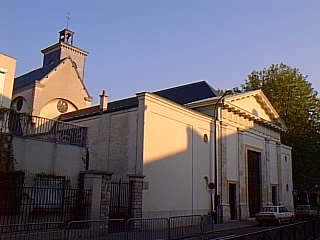 the 17th and 18th
century, lies in the
middle of varnishers and cabinet-makers. It’s one of the most seducing I know.
Victor
Louis, architect of this church involved the Italian artist Brunetti for the
building. Brunetti was the painter of the backstage of the Comedie Française.
And thus a real master in still- life deceptions. This is very visible in the
highly unusual decorations of the church. He imagined an Ionic pillar gallery
around the chapel faced by sensible sculptures. The interior is of a real
architectural refinement. Astounding relief effects and a lot of elegance and
grandeur. Nice sculpted wooden pulpit. the 17th and 18th
century, lies in the
middle of varnishers and cabinet-makers. It’s one of the most seducing I know.
Victor
Louis, architect of this church involved the Italian artist Brunetti for the
building. Brunetti was the painter of the backstage of the Comedie Française.
And thus a real master in still- life deceptions. This is very visible in the
highly unusual decorations of the church. He imagined an Ionic pillar gallery
around the chapel faced by sensible sculptures. The interior is of a real
architectural refinement. Astounding relief effects and a lot of elegance and
grandeur. Nice sculpted wooden pulpit.
The supposed young son of Louis XVI (Louis XVII) is said to be buried in the
adjacent cemetery at the age of 10. But the mystery stays since
recent studies proved it are not the bones of the son of Louis XVI that are
buried there. Probably
it’s one of the numerous “fake “Louis that was named “XVII”.
Bibliography
--Vie et histoire des arrondissements de Paris,
ed.Hervas (1985-1988--Nouvelle Histoire de Paris, ed.Hachette--Le Pieton de
Paris, by L.P.Fargue, ed.Gallimard 1997--Dictionnaire historique des rues de
Paris, by J.Hillairet, ed.Minuit --Guide du Routard 1998-1999 (Ed.Hachette)--Paris,
2000 d'histoire, by J.Favier, ed.Fayard 1997 --Paris 19eme siecle, l'immeuble et
la rue, by F.Loyer, ed.Hazan, 1994-
Faubourg Saint-Honore, histoires vraies,
J.Dutourdens (ed .Julliard 1992)
|
