|
High
and old place of Parisian history, the Bastille fortress didn’t play for a
long time the role of a bastion protecting Paris. It’s as a prison and a
symbol of royal absolutism that it gained notoriety and occupies a large place
in our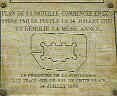 imagination and in the collective symbolism. From the 17th century on
the Bastille was used by Richelieu to imprison personalities he didn’t
especially like Nicolas Fouquet, finance super intendant of Louis XIV, guilty of
being richer than Louis XIV himself, and in the 18th
century a lot of known people had their second residence (?) there like
Voltaire, the marquis de Sade and he count of Cagliostro. Detention was quite
comfortable for those who had the financial possibilities and relations and the
prisoner could give parties, and organize suppers…. But some unfortunate were
simply forgotten and died completely lonely.
imagination and in the collective symbolism. From the 17th century on
the Bastille was used by Richelieu to imprison personalities he didn’t
especially like Nicolas Fouquet, finance super intendant of Louis XIV, guilty of
being richer than Louis XIV himself, and in the 18th
century a lot of known people had their second residence (?) there like
Voltaire, the marquis de Sade and he count of Cagliostro. Detention was quite
comfortable for those who had the financial possibilities and relations and the
prisoner could give parties, and organize suppers…. But some unfortunate were
simply forgotten and died completely lonely.
 |
|
Storming Bastille |
But the Bastille fortress was used less and less, and when the famous 21st
of July 1989 arrived, the people stormed the bastion, which housed only seven
prisoners of which four were money counterfeiters, the sick minded and the Count
of Solages, imprisoned under the accusation of incest. The governor and the
whole garrison were murdered and the mob looted all the weapons.
Louis XVI was unimpressed and recorded in his diary: "Today, nothing".
Following the dismantling of the Bastille, an enterprising workman, named Palloy,
made sculptures of the prison from the rubble, and sold them to local councils,
who were denounced as anti-republican if they refused the high price demanded.
The rest was used to finish the Pont de la Concorde.
Behind the Bastille was the famous Faubourg Saint-Antoine, always the first to
get into a popular fight or revolution. Read Victor Hugo's " Les Miserables"
again and again.
The Bastaga area became an unsafe area, numerous anecdotes and incidents took
place in this area in the second part of the 19th century,
shoot-outs, robberies and other pleasant facts. Above the brasserie “La
Rotonde", 17 rue de la Roquette, Verlaine lived from 1881-1882 with his
mother. Be aware that in the years 1880-1890 that a lot of craftsmen in the
furnishing manufacturing were foreigners: Belgians, Germans, Italians, Russians and
 others.
There is a sector called “little Turkey”. Survivors of a Jewish-Spanish community immigrated
in France before WWII. The Turks didn’t chase them, but the cruel Spanish
inquisition made them flee to France in the 16th century. The synagogue, 7 rue
Popincourt, first floor, is still a
witness of the great faith kept by these Sepharad Jews. Every Sabbath the place
is packed. others.
There is a sector called “little Turkey”. Survivors of a Jewish-Spanish community immigrated
in France before WWII. The Turks didn’t chase them, but the cruel Spanish
inquisition made them flee to France in the 16th century. The synagogue, 7 rue
Popincourt, first floor, is still a
witness of the great faith kept by these Sepharad Jews. Every Sabbath the place
is packed.
Then
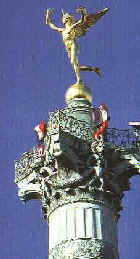
the actual column of the Bastille was erected, or Colonne de Juillet, a monument to the revolution of 1830 (yes, another revolution).The column is engraved in gold with the names of Parisians who died during the revolution. The gold-covered statue at the top is called the Génie de la Révolution (the Genesis of the Revolution, approximately) and is interesting in that it also appears on French ten-franc coins
, as homage for the victims of the
1830 revolution, called "les Trois Glorieuses". The corpses of the
victims were buried under the column.
Today, besides of still being a symbol for democracy and the starting point of a
lot of protest demonstrations heading for the place de la Republique, the area is dominated by another manifestation of the building rage of statesmen: since 1989 the new Opéra de Paris or Opéra-Bastille has opened its doors (Monday-Saturday 10am-6.30pm). This gigantic glass cage has seats for a 2,700 strong audience. The opera has totally transformed the character of the district.
But it must be said that the opening of the Opera Bastille started definitively the renewal of the area,
as well as his sociological overturning.
Today, on the spot where the prison used to stay, special pavements show you the
limits of the fundaments (between 5, place de la Bastille and 49, boulevard
Henri IV). The original remains of the Bastille prison are a few
rocks in the square Galli, in Sully-Morland, some stones on the metro line
Pantin-Italie (direction Pantin), a Bastille-souvenir carved in original
Bastille stone displayed at the musee Carnavalet and the ancient chime of the
Bastille inside the "Hippopotamus" restaurant on the place de la
Bastille.
The neighbourhood became a trendy sector for gallery owners and young artists.
For nightlife, have a walk in the rue de Lappe. It’s in the shadow of the new
opera building (the Bastille opera is in the 12th arrondissement) a
lot of new restaurants and cafes opened and only for that reason the Parisians
see the area as a new Saint-Germain des Pres.
And who didn’t live far from here? Yes, the legendary commissioner Maigret,
main character of the Belgian writer Georges Simenon.
The area all around is absolutely a must visit which I will develop in my
further articles.
Bibliography
--Vie et histoire des arrondissements de
Paris, ed.Hervas (1985-1988--Nouvelle Histoire de Paris, ed.Hachette--Le Pieton
de Paris, by L.P.Fargue, ed.Gallimard 1997--Dictionnaire historique des rues de
Paris, by J.Hillairet, ed.Minuit --Guide du Routard 1998-1999 (Ed.Hachette)--Paris,
2000 d'histoire, by J.Favier, ed.Fayard 1997 --Paris 19eme siecle, l'immeuble et
la rue, by F.Loyer, ed.Hazan, 1994-
Faubourg Saint-Honore, histoires vraies, J.Dutourdens (ed .Julliard
1992)
|