|
Behind
the synagogue you’ll find the Passage Charles Dallery and the Passage Bafroi.
Tumbledown walls, cobblestone paved streets and dark interior courtyards remind
the old Paris that Victor Hugo described with so much talent. The whole quartier
is stuffed with "passages", you have to discover one after another.
The rue de la Roquette stays animated and lively until late night. You have to
hurry to breathe. atmosphere of the area. All changes so quickly!
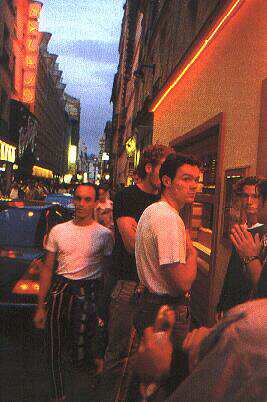
Real estate speculation is in full boom. Prices of the square meter ten folded
in 10 years. Night owls, who seem never to get tired, can stay at the cafes
“Iguana” (no.15) or La Rotonde (no.17), with also numerous Thai, Japanese,
South-American and Russian restaurants, and “jet-set places” like “Gouts
et Couleurs” at no.22. In the rue de Lappe you can dance all night at the “Balajo”,
where young and old swing and dance to the nostalgic sounds of cha-cha-cha, rock
and roll and hits from the sixties. If you plan to go, inform first what kind of
music they are planning, it’s changing constantly. In the Chapelle des
Lombards you can enjoy tropic rhythms and Jazz.
The lodgings of all that poor people of the Bastoche, who gave the Paris and the
area in particular, that savour without equal, are disappearing. A good example
is when you go from the Passage Charles Dallery and arrive via the Passage
Balourde in the rue Keller. This street is plenty of galleries now, something
else is born, " a new art area". Here you find about twenty art
galleries one next to each other. Almost every avant-garde tendency is
represented: photo, video-art, minimal art but also figurative painting. The
non-amateurs will find it too much but those who are interested can buy a
catalogue with detailed info about all galleries. Today, one seems to have
completely forgotten that popular inhabited Bastaga, who survived until ten
years ago. In Paris, people are frivolous, not very keen on popular history and that makes all these changments. At the Bastille, the population was always very
mixed. Rue de Lappe is like "Alphonse Daudet" wrote like an"
Auvergnat ghetto".
that makes all these changments. At the Bastille, the population was always very
mixed. Rue de Lappe is like "Alphonse Daudet" wrote like an"
Auvergnat ghetto".
Walking rue de Charonne, direction metro Charonne have a look at no. 94. Built in 1912 in the style
of that era, with brick and ceramics. The Salvation Army bought it in 1926 to
house poor women. The rooms decorated with wood and ceramics are worth a visit.
In this street also a lot of old passages, houses and old boutiques all along
the way. Two of the most known antique boutiques are Lavigne-Bastille and Nane
Stern at 26, passage de l'Homme, under the porch of a nice home. Have a look in
the display windows of these antiquaries, more specialized in furniture and
other objects of the fifties and sixties. It’s not easy but a stubborn
collector could do sometimes a good business.
At the corner of rue Faubourg-Saint-Antoine, you see the fountain Trogneux, from
the 18th century.
Finally, at the corner of the rue Ledru-Rollin the historical coffeehouse “la
Palette”, with a 1900 façade, where you can take a rest after your tiring walk.
Under the iron balcony you see a gilded inscription:
“Au Vrai Saumur, café à 10 centimes la tasse”. It is quite more expensive
today ;-).
Bibliography
--Vie et histoire des arrondissements de
Paris, ed.Hervas (1985-1988--Nouvelle Histoire de Paris, ed.Hachette--Le Pieton
de Paris, by L.P.Fargue, ed.Gallimard 1997--Dictionnaire historique des rues de
Paris, by J.Hillairet, ed.Minuit --Guide du Routard 1998-1999 (Ed.Hachette)--Paris,
2000 d'histoire, by J.Favier, ed.Fayard 1997 --Paris 19eme siecle, l'immeuble et
la rue, by F.Loyer, ed.Hazan, 1994-
---Faubourg Saint-Honore, histoites vraies, J.Dutourdens (ed .Julliard
1992)
|
