|
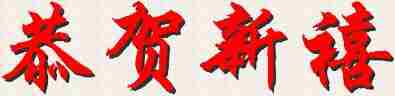 The 13th arrondissement is also THE quarter of the Asiatic Parisian population: Chinese to be more precise. The "Golden Triangle" between the avenue d'Ivry, avenue de Choisy (metro Tolbiac or porte d'Ivry), is a genuine Chinatown or also known as "Hong-Kong sur Seine". Practically totally owned by Asiatic, flourishing hotels, restaurants and commerces. An official estimate gives 300,000 Asiatics for Paris of which 95,000 live in the 13th, mostly former boat people. And not only Chinese but also Cambodians, Laotians, Vietnamese, Thais who are as different as the European countries are different one from each other. As you can figure, it is not a homogenous community. But in business, the Chinese are the most active with their own shops and import companies. The 13th arrondissement is also THE quarter of the Asiatic Parisian population: Chinese to be more precise. The "Golden Triangle" between the avenue d'Ivry, avenue de Choisy (metro Tolbiac or porte d'Ivry), is a genuine Chinatown or also known as "Hong-Kong sur Seine". Practically totally owned by Asiatic, flourishing hotels, restaurants and commerces. An official estimate gives 300,000 Asiatics for Paris of which 95,000 live in the 13th, mostly former boat people. And not only Chinese but also Cambodians, Laotians, Vietnamese, Thais who are as different as the European countries are different one from each other. As you can figure, it is not a homogenous community. But in business, the Chinese are the most active with their own shops and import companies.
Looking at the grey, unsympathetic buildings and high-rise, let's admit the Chinese succeeded to create a world of colour, adorable small restaurants with Chinese or Fareast specialities. Neon and menus are decorated with Chinese
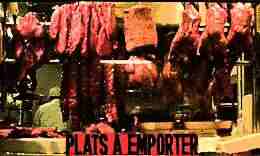 motives. Old women in dark blue trousers and Chinese embroidered jacket hurry to do their shopping. A few steps further the sharp odour of sesame oil, prune wine or steamed rice tickle your nostrils. Chinese music comes out a record or video shop, packed with kung-fu movies. motives. Old women in dark blue trousers and Chinese embroidered jacket hurry to do their shopping. A few steps further the sharp odour of sesame oil, prune wine or steamed rice tickle your nostrils. Chinese music comes out a record or video shop, packed with kung-fu movies.
Looking on official papers, it seems as the citizens of Chinatown live forever, are blessed with eternal life. How come? Because most of the deceased are never declared! There is an infallible logic. If the deceased is not declared, his papers can be used again for an illegal immigrant, giving him the opportunity to start a new life.
Indeed, Chinatown, for immigrants, is the first place in Paris where they can find some shelter, with family, acquaintances or employers. As soon as one of these succeeds to climb higher in the social ladder, they move out to "better " neighbourhoods.
Something that Asiatic communities never did, was to stretch out the hands to take welfare from official institutions of the country that adopted them. It's not on their character and with great devotion and determination they find work in businesses already set up by their compatriots. And the fact that they are often over qualified doesn't play any role. Professors becoming dish washers, engineers or commercial staff change into office clerks and errand boys,
 etc…..They have an own financing system to give people the opportunity to stand on their own feet. Certain persons work in a financing group, where everybody puts a certain amount in a common fund. A sort off lottery gives the lucky winner the possibility to take some capital from this fund. Back payment is a question of trust. There are no etc…..They have an own financing system to give people the opportunity to stand on their own feet. Certain persons work in a financing group, where everybody puts a certain amount in a common fund. A sort off lottery gives the lucky winner the possibility to take some capital from this fund. Back payment is a question of trust. There are no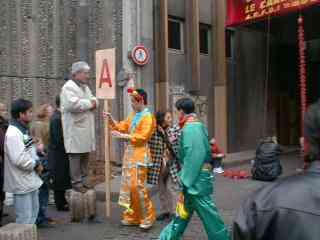 contracts. Finally they own numerous boutiques and enterprises: restaurants, supermarkets, jewelry shops, insurance offices, medical assistance, etc... contracts. Finally they own numerous boutiques and enterprises: restaurants, supermarkets, jewelry shops, insurance offices, medical assistance, etc...
They try to live as good neighbors with the French but are nevertheless very attached to their traditions, language, culture. They manage also to keep their severe hierarchic family relations. It is obvious that criminality figures are very low, since their own social control seems to work pretty well. It is unclear how much the Asiatic mafia or triads are involved in daily life. The rule of silence works here very well.
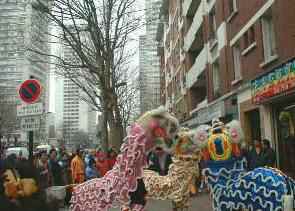
A big celebration drives all Chinese out of their rockers, once a year. Savage looking, multicolored and meters long dragons dance all over the streets for the Chinese New Year. Tremendous fireworks, rice rain and everybody wishes everybody a happy new year. More and more French participate every year.
Bibliography
--Vie et histoire des arrondissements de Paris, ed.Hervas (1985-1988--Nouvelle Histoire de Paris, ed.Hachette--Le Pieton de Paris, by L.P.Fargue, ed.Gallimard 1997--Dictionnaire historique des rues de Paris, by J.Hillairet, ed.Minuit --Guide du Routard 1998-1999 (Ed.Hachette)--Paris, 2000 d'histoire, by J.Favier, ed.Fayard 1997 --Paris 19eme siecle, l'immeuble et la rue, by F.Loyer, ed.Hazan, 1994-Americans in Paris- An Anecdotal Street Guide, by Brian Morton, (The Olivia & Hill Press, Ann Arbor, 1984), Around and About Paris, Volume 3: New Horizons: Haussmann's Annexation (Arrondissements 13 - 20), Chinatown in Paris, by Rafael Garcia.
|
