|
The 13th arrondissement used to be an area with a lot of workshops and a vast majority of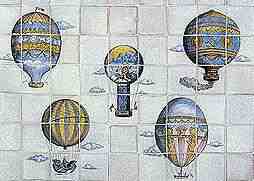 the working class, has been sanitized profoundly and it didn't improve the beauty of the area. In fact, it has not much to offer to the visitor, except the "quartier "around the Butte aux Cailles, where the first hot air balloon (Montgolfière) with Pilatre de Rozier landed in 1783 (let's be honest and say crashed on where is today the underground parking of the ensemble "Galaxie") after having been in the air over 9 km in 25 min. Benjamin Franklin came
in person to witness the landing of the Montgolfiere.Also worth a visit is the Manufacture des Gobelins, a workshop for tapestries, located on 42, avenue des Gobelins, founded in the 15th century but fame came when Colbert, minister of Louis XIV, promoted it to a Royal
Manufacture (see description of visit in later essay).
the working class, has been sanitized profoundly and it didn't improve the beauty of the area. In fact, it has not much to offer to the visitor, except the "quartier "around the Butte aux Cailles, where the first hot air balloon (Montgolfière) with Pilatre de Rozier landed in 1783 (let's be honest and say crashed on where is today the underground parking of the ensemble "Galaxie") after having been in the air over 9 km in 25 min. Benjamin Franklin came
in person to witness the landing of the Montgolfiere.Also worth a visit is the Manufacture des Gobelins, a workshop for tapestries, located on 42, avenue des Gobelins, founded in the 15th century but fame came when Colbert, minister of Louis XIV, promoted it to a Royal
Manufacture (see description of visit in later essay).
This area, considered as the last vestige of the spirit of the 13th to 19th century was very, very, poor and it's not a coincidence that Victor Hugo situated several scenes of "Les Miserables" on different locations of this quarter. He couldn't know of course that his book would end some day into a musical!
Water mills lined up along the river Bievre, around which all life and work turned around until beginning 20th century. It had a very bad reputation due to the tanneries that washed the leather in the river and left nauseous stenches float in the area. (until the beginning of the 20th century it was even considered dangerous and unsafe) Almost all inhabitants of the Butte worked at those tanneries. The river flowed a long time in open air, uncovered, leather-dressers settled down on its embankments (the name rue des Tanneries proves it). A dyer, Jean Gobelin, opened an atelier in the 15th century and made a fortune by discovering the scarlet dyeing proceeding. Hence, the Bievre became so polluted that protests rose from all sides. From 1671 to begin 20th century, numerous regulations and decrees tried to reduce this pollution.
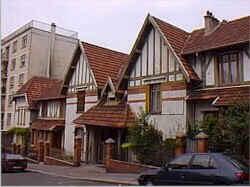 The
population of this area became known for their warm-blooded character and were
always the first to participate in popular uprisings like in 1848 and 1871. They
stayed together like one big family, their miserable lives made that a great
solidarity grew between them and they didn’t want to leave their
arrondissement. They were proud of it. They didn’t need to go “abroad”
like they said about Paris. La Butte aux Cailles was their homeland where they
were born and where they would die. They had their cafes, shops, movie theatres
that gave them some kind of independence. The
population of this area became known for their warm-blooded character and were
always the first to participate in popular uprisings like in 1848 and 1871. They
stayed together like one big family, their miserable lives made that a great
solidarity grew between them and they didn’t want to leave their
arrondissement. They were proud of it. They didn’t need to go “abroad”
like they said about Paris. La Butte aux Cailles was their homeland where they
were born and where they would die. They had their cafes, shops, movie theatres
that gave them some kind of independence.
And with time passing by, the
authorities transformed the neighbourhood by renovating it. In 1910, all
tanneries, dyers, paper manufacturers were expropriated and the Bievre
definitively covered. Factories leave the arrondissement, space being too narrow.
Even the bridges are liquidated. Only
the Butte aux Cailles kept its spirit. Where it is possible to walk now in the
evening in a warm ambience.
Bibliography
Connaissance
du Vieux Paris , by J. Hillairet ,(éditions Gonthier 1954), Paris à Travers
les Ages, by F. Hoffbauer (éditions
Inter-Livres), Les Lieux - Histoire des Commodités, by Roger-Henri Guerrand,(Éditions
La Découverte), Paris - Ses origines, sa croissance, son histoire, by Blanche Maurel (Éditions Albin Michel (1932), Paris tel qu'on l'aime, by
different authors, ( éditions Odé - 1949)-Guide du Routard (1998)
|