|
Coming from the north, we enter the
Arles through the roman Via Agrippa. It's an endless sad street, baptized
"avenue de Stalingrad" after WWII. Our only comfort is the view of
St.-Trophime, far away at the horizon. In spite of impressive history as
"second Rome", Arles has nothing what could remind us the Eternal
City. Just that Saint-Trophime and the Roman arenas.
Dear readers, if you're just looking for
an absent-minded and distrait loitering, you can see Arles in half a day. The
touristy disadvantage of Arles is that it belongs to those kind of cities where
fascination only comes with science of history and traditions. So I'm afraid
that I will have to explain more as you maybe would like to and I will have to
ask your imagination to do a lot of work ;-).
Let's make a first statement: Arles is
absolutely different from Avignon, that fell back to provincial insignificance
after the departure of the popes, and doesn't resemble at all to Aix-en-Provence
that thanks to its university and city management traditions turned out to be a
wonderful, flourished place, and certainly not to Marseille, who proved over the
centuries that it could keep its independence of mind along all regimes.
 The history of Arles is as old as that
of our western world. It was not only an essential military base for the
war-seeking Julius Cesar, but four centuries later the last power center of the
dying Roman "provincia". The influence of Arles on the propagation of
young Christianity is still an endless theme of research.
The history of Arles is as old as that
of our western world. It was not only an essential military base for the
war-seeking Julius Cesar, but four centuries later the last power center of the
dying Roman "provincia". The influence of Arles on the propagation of
young Christianity is still an endless theme of research.
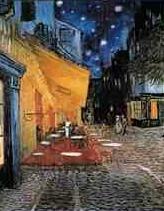
Arles is also the city of Vincent van Gogh, even if we find almost nothing left of his stay in this city. The
"yellow" house where he lived and
the prostitute area around the rue de la Cavalerie , disappeared after
bombardments of WWII. On the location of the "Cafe de nuit" they built
is a horrible Monoprix and the "Pont de Langlois" is replaced
by a new bridge on the wrong location! The
Tourist office in Arles tried to correct this situation and organizes commented
tours with an intelligent comment to show where Van Gogh rested his easel .
But let's start ourselves. Arriving from
the north, surviving the avenue de Stalingrad, we pass under two railway
viaducts and end up at the place
Lamartine. It's wise (and please be wise!) to park your car here, (for free, no
fee!) along the Rhone or in front of the numerous cafes at the north side of the
place and continue by foot into town. On top of this, we are already in the
middle of the Arlesienne world of Van Gogh. Stand with your back to the fountain
in the middle of the square and look! We recognize a few elements of
"Vincent's house "(Van Gogh museum, Amsterdam) just in front of us.
Then we see the two railway viaducts , as they are represented on the
right side of the canvas. The first one is not in use any more since a long time
but the second one still is. Van Gogh painted it also separately " Le
Viaduc" (Kunsthaus, Zurich). Now have a look at the high corner house on
the left side of the viaducts. That's now "Cafe La Civette
Arlesienne". On Vincent's painting it is partly hidden behind the painting
of his "yellow house". It is visibly, faithfully painted with
balconies and all.
Bibliography: --Henry James, "A
little tour in France" ( a lot of publishers)
|