|
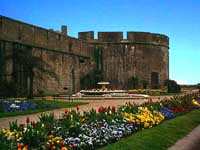 Besides, they shelter fine sandy beaches and safe waters fro swimming and sailing. It is remarkable that these ramparts survived the terrible shelling and bombardments of 1944:bravo Vauban!! Besides, they shelter fine sandy beaches and safe waters fro swimming and sailing. It is remarkable that these ramparts survived the terrible shelling and bombardments of 1944:bravo Vauban!!
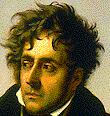
You can see the small island Le Grand Blé, where the great French writer Chateaubriand is buried in a very modest grave. It is accessible at low tide.
 |
|
Chateaubriand |
Nice also is the National Fort, which was
designed to defend the Malouins from the British and Dutch seeking revenge from the harassment of Malouin pirates on their vessels. It was built in1689 and is used sometimes to house conferences of French high functionaries. Also only reachable at low tide, from Easter to September. It is a genuine bastion built by Vauban, the master architect for fortresses and military constructions. If you want to have a swim, you'll have to exit through the Porte St.Pierre, towards the Plage de Bon Secours, where you will find a public swimming pool.
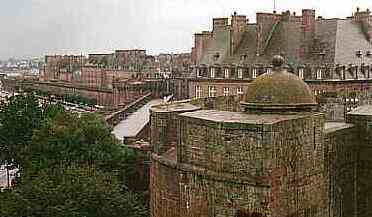 The largest gate is the Porte St.Vincent, but the Grande Porte at the end of the rue Jacques Cartier, is also impressive with its two machicolations. Next to the porte de Dinan you can find the house where Surcouf lived his last 30 years.
But Saint Malo is more than a walled city. Besides some characterless parts extra-muros, including the casino, Palais des Congrès, railway station and two yacht marinas, all with sand beaches stretching out to Rochebonne. The aquarium is not big, next to Porte St.Thomas, but has interesting species to show.
In fact, Saint Malo is a complex of resorts running one into another like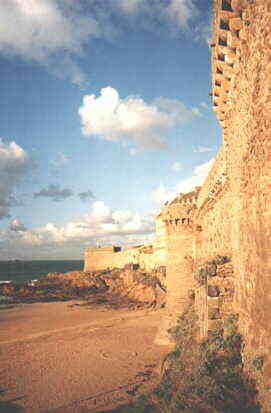 Paramé, a beach resort and a spa with a large for the seawater treatments. Rotheneuf, a shrine for those who love naive sculpture like the Rochers Sculptés, the lifetime labour of a 19th century priest, Abbé Fouré. Saint Servan, less elegant and more workaday, but a popular fishing place and gifted with an enormous beach, hence somewhat less crowded. You cannot miss the three towers of the 14th century Tour Solidor, commanding a tip of a small promontory. Today, it is the home of the Musée International du Lon-Cours cap-Hornier, with ship small-scale models, memorabilia of Cape Horn sailors, among them Sir Francis Drake and Captain Cook. Nautical instruments, compasses and even a big stuffed albatross. Paramé, a beach resort and a spa with a large for the seawater treatments. Rotheneuf, a shrine for those who love naive sculpture like the Rochers Sculptés, the lifetime labour of a 19th century priest, Abbé Fouré. Saint Servan, less elegant and more workaday, but a popular fishing place and gifted with an enormous beach, hence somewhat less crowded. You cannot miss the three towers of the 14th century Tour Solidor, commanding a tip of a small promontory. Today, it is the home of the Musée International du Lon-Cours cap-Hornier, with ship small-scale models, memorabilia of Cape Horn sailors, among them Sir Francis Drake and Captain Cook. Nautical instruments, compasses and even a big stuffed albatross.
Beyond Rotheneuf are a scatter of coves at the foot of pin-clad hillsides. The attraction of their setting, however, is spoiled by the savage camping and caravan sites which are, after all, not so a pretty sight.
A promenade along the ramparts of Saint-Malo can be done in one hour.
Bibliography
Saint-Malo et ses environs, by Gaston Robert de Salles-Hotels et maisons de Saint-Malo : XVIe-XVIIe-XVIIIe siècles, by Philippe Petout -Les derniers corsaires malouins by F. Robidou-Saint-Malo et le pays d' Emeraude, by Jean-Yves Ruaux
|