Brittany and its long historical struggle Site Home - What's New? -Feedback - About Jack- Travel/Art Links

Brittany
|
Brittany and its long historical struggle Site Home - What's New? -Feedback - About Jack- Travel/Art Links |
|
|
|
Brittany |
|
Cuisine
|
Brittany-A long struggle to make history |
Treguier, lawyers pilgrimage and Lannion Auray, St.Goustan and the Quiberon peninsula. Gulf of Morbihan, its fisher ports and more Guerande and salt, and La Baule, beautiful beach resort Nantes, visit of this elegant city, shopping,churches, museums(2) |
||
|
The Breton peninsula was part of the major area of Celtic influence around 200 BC. After 49 BC, it became part of the Roman province conquered by Julius Caesar in the Gallic Wars and became part of the province of Lugdunensis of Gallia and when this was divided into three, was included in one of the Imperial provinces, Lugdunensis. After Roman authority weakened, the Huns overran Gaul but they withdrew after the battle of the Catalunian fields in 451. During this time, Britons from were settling the area from across the channel that gave it its modern name. The area was a part of ancient Armorica, and it received its modern name when it was settled (c. 500) by Britons whom the Anglo-Saxons had driven from Britain. Brittany was never entirely part of the Frankish Empire although it lost land in the reorganisation of the Breton March in 811.
From about
844-940, it was a centre of Viking activity.
The 16th and 17th century were generally peaceful in Brittany,
but the region, never reconciled to centralized rule, became one of the early
centres of revolt in 1789. However, its staunch Catholicism and conservatism
soon transformed it into an anti-Revolutionary stronghold; the Chouans
(anti-Revolutionary peasants) were never fully subdued, and in S Brittany and
the neighbouring Vendée the Revolutionary government The Chouans, by Honoré de Balzac - Brittany and the Angevins, by J. A. Everard (Cambridge University Press) - The Creation of Brittany, by Michael Jones (Hambledon and London Ltd) - Ecclesiastic and Civil History of Brittany, by Pierre Hyacinthe Morice |
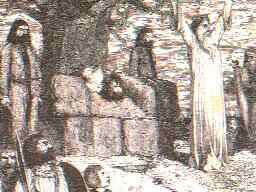
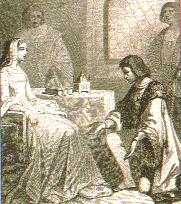 (1341-65), a part of the Hundred
Years War (1337-1453). With the end of the Breton war, the house of Montfort won
the dukedom. The dukes of Montfort tried to secure Brittany's neutrality between
France and Britain during the remainder of the Hundred Years War. The
unsuccessful rebellion of Duke Francis II against the French crown led to the
absorption of Brittany into France after the accession of his daughter, Anne of
Brittany, in 1488 until the French annexed it in 1491. Brittany's provincial
parliament met at Rennes, and its provincial assembly remained powerful until
the French Revolution.. King Francis I formally incorporated the duchy into
France in 1532.
(1341-65), a part of the Hundred
Years War (1337-1453). With the end of the Breton war, the house of Montfort won
the dukedom. The dukes of Montfort tried to secure Brittany's neutrality between
France and Britain during the remainder of the Hundred Years War. The
unsuccessful rebellion of Duke Francis II against the French crown led to the
absorption of Brittany into France after the accession of his daughter, Anne of
Brittany, in 1488 until the French annexed it in 1491. Brittany's provincial
parliament met at Rennes, and its provincial assembly remained powerful until
the French Revolution.. King Francis I formally incorporated the duchy into
France in 1532. 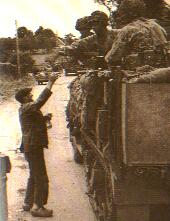 resorted to ruthless
reprisals.
resorted to ruthless
reprisals.