|
Some touristy place, that CARNAC!! It is said in all travel guides that Carnac cannot be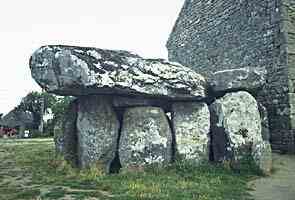 missed. I agree but I must say that I understand the statement that the famous French writer Gustave Flaubert once did about Carnac: "Carnac has more pages of rubbish written about it than it has standing stones-and there are more than 5,000 stones!" missed. I agree but I must say that I understand the statement that the famous French writer Gustave Flaubert once did about Carnac: "Carnac has more pages of rubbish written about it than it has standing stones-and there are more than 5,000 stones!"
Nevertheless, people are stunned by these thousands of "megaliths", some over 5,000 years old. But, except from the deeply serious dolmen-fancier, this famous site can become a big disappointment. You have to like stones, that's for sure!!
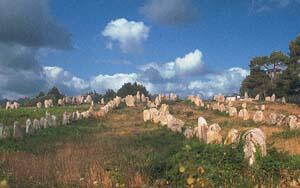 At dusk, however, when the crowds and cars have disappeared and you are left alone with a serried rows of megaliths and their shadows people the flat, inhospitable, desolate scrubland, you might feel a bit of their strange power. It's the mystery that we don't know exactly why they are there, their origins are lost in the mists of time, which adds to their other-worldliness. Some pretend they are religious symbols, others think they had some astronomical function, a sort of calendar.. At dusk, however, when the crowds and cars have disappeared and you are left alone with a serried rows of megaliths and their shadows people the flat, inhospitable, desolate scrubland, you might feel a bit of their strange power. It's the mystery that we don't know exactly why they are there, their origins are lost in the mists of time, which adds to their other-worldliness. Some pretend they are religious symbols, others think they had some astronomical function, a sort of calendar..
Who erected these enormous stones? Where do they come from?
The three most important locations of Carnac are a little bit out of town. KERMARIO has a dolmen (stone table), and more than 1,000 menhirs (one is in the form of a fist), all aligned in long rows (alignements). The other locations are KERLESCAN and LE MENEC, which is the largest with almost 1,100 menhirs (the famous Le Menec lines) of which 70 form a "Cromlech" (stone circle).
 |
|
Kermario megaliths |
To make you a general view about the megaliths in Brittany, consider the stones of
Carnac, nearly a mile in length and numbering 11,000 ranged in eleven rows -- being twin sisters of those at Stonehenge. The conical menhir of Loch-Maria-Ker in Morbihan, measures twenty yards in length and nearly two yards across. The menhir of Champ Dolent (near St. Malo) rises thirty feet above the ground, and is fifteen feet in depth below. Such dolmens and prehistoric monuments are found in almost every latitude ... in the Mediterranean basin; in Denmark, in Shetland and in Sweden ... in Germany where they are called the giant tombs; in Spain and Africa; in Israel, Palestine, and Algeria; in Sardinia; in Malabar in India, where they are called the tombs of the Daityas and the Rakshasas; in Russia and Siberia where they are known as the Koorgan; in Peru and Bolivia, where the tombs of the Daityas and the Rakshasas; in Russia and Siberia where they are known as the Koorgan; in Peru and Bolivia, where they are termed the chulpas or burial places.
For a quick view of the area, climb on the top of the cumulus Saint-Michel. This tumulus is probably one of the oldest monuments, built by men, a graveyard, at least 5,000 years B.C. It is 120 metres long and 12 metres high, composed by two funeral rooms you can visit (for a fee).
A 15th century cross stands on top, together with a chapel and an orientation table from where you have a splendid view on the Carnac region. All the objects that were found here are to see in the "Musée de la Préhistoire" in Carnac.
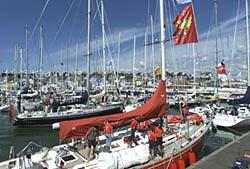 To get out of all that mystery, a little excursion to the small port of LA-TRINITE-SUR-MER, with a very mundane yacht harbour. It lies a little further east on the D 816. It is renowned to sailors as the destination of a tough sailing race, a favourite pull-up for all manner of boats. It's agreeable to stroll along the unsteady pontoons of the marina to peer down on the multinational owners and their crews, and sit out a few bars along the quays, alive with multi-tongues customers. One big gap: there are no fish restaurants around the harbour to lend local colour and atmosphere. Season is short and the town dies when the yachtsmen leave. To get out of all that mystery, a little excursion to the small port of LA-TRINITE-SUR-MER, with a very mundane yacht harbour. It lies a little further east on the D 816. It is renowned to sailors as the destination of a tough sailing race, a favourite pull-up for all manner of boats. It's agreeable to stroll along the unsteady pontoons of the marina to peer down on the multinational owners and their crews, and sit out a few bars along the quays, alive with multi-tongues customers. One big gap: there are no fish restaurants around the harbour to lend local colour and atmosphere. Season is short and the town dies when the yachtsmen leave.
Bibliography
A Guide to the Stone Circles of Britan, Ireland and Brittany,by Aubrey Burl, (Yale, 1995)-L'astrologie Celtique, by Carol Carnac (Sand Paris) 1986-Carnac, une porte vers l'inconnu by Pierre Mereaux- Megalithic Sites in Britain by A. Thom, (1967)-A Breton Landscape , by Grenville Astill, Wendy Davies (1998)-Le Golfe du Morbihan , by Yvon Mauffret-A Breton Landscape , by Grenville Astill, (Wendy Davies (1998)
|