|
The most Breton city of this part of France is certainly QUIMPER!
" Kempert " means " confluence of rivers ", the Odet, Steir and Jet.
Quimper used to be the capital of " Cornouaille ", a medieval duchy. The old city passed WWII without any great damage, seen it was of no strategic importance. It is laden with historic buildings. The old quarter of the city, bounded by two rivers and the cathedral is ranged around the rue Kereon. Well preserved half-timbered houses and an enticing selection of shops are delightful. And don't miss the COVERED MARKET, for the pottery workshops (Faienceries, part of the traditional, pottery-making in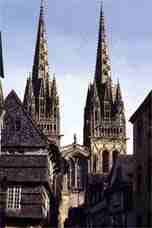 Quimper. Quimper.
Like the soaring cathedral dedicated to Saint Corentin, built between 1239 and 1515 and the most complete cathedral in Brittany.
Legend says that Quimper's first bishop (Corentin) came from Cornwall and established a little Britain here. When YS, king Gradlon's legendary city was swallowed by the sea, he traveled inland and founded its new capital at Quimper. The cathedral has enormous stained glass windows (15th century). Best is to visit during a mass. Built from the local had granite, this massive cathedral is decorated by decorative features which prove once again how skillful the medieval stonemasons were. Next to the cathedral, the BISHOP'S PALACE, a 16th century building with a remarkable spiral staircase, beneath a splendidly carved oak canopy. It is now the MUSEE DEPARTEMENTAL DU FINISTERE.
 |
|
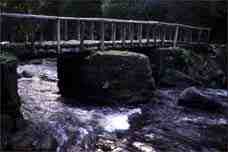
Bridge over the Odet |
For art lovers, just a quick visit to the MUSEUM OF FINE ARTS, 16th to 20th centuries, including the local Pont Aven school (the likes of Paul Gauguin and Emile Bernard).
You want a nice high-rise view of the city? Cross de Odet and climb the 82 meters high MONT FRUGY, where you have a magnificent view on the medieval town. Have a drink at the bar ""L'Eppe".
And then you have the PONT MAX JACOB (born Tal-Coat), the largest and biggest bridge in Quimper, named after the Jewish poet and writer, one of the first surrealists, who inspired a lot of contemporary writers. He was deported as Jew by the german gestapo French police and sent in 1944 to Drancy were he died of starvation and tortures.
Second half of July, Quimper is the place of the "Fete de la Cornouaille", the biggest celebration and tradition of Breton culture. Concerts, street parades in original clothing and street musicians everywhere. Then it is THE place to be!!
Let's finish with a quick visit to CONCARNEAU, an unspoilt fisher's village, but now a modern tuna port. The old, walled city "intra-muros" is named "ville close" and lies on a small island in the middle of the harbor. The tourists all flock to the old town in the summertime.
The beaches here, although extensive, are something of a disappointment, not very appealing at low tide. The resort is too heavily built up.
Biblioghraphy
Monographie de la Cathédrale de Quimper (Quimper, 1877)- Quimper hier et aujourd'hui (1998) de Colette Jehl, Philippe Malot-Le piéton de Quimper (1994)de Pierre Jakez Hélias-Concarneau (1 mai 1980)
de Querre et Querre
|