|
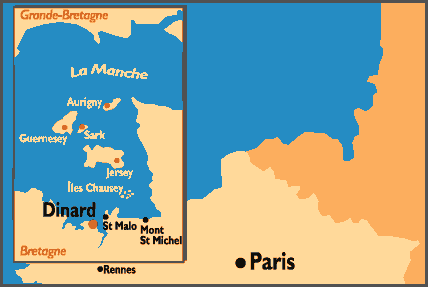
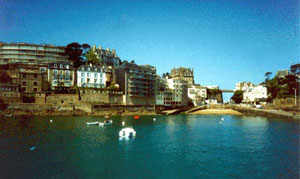 At the other side of the river Rance, lies the chic city of DINARD. It seems not far on a map, but imagine that until 1967, getting from one side to another you had to drive up a long way along the river, up the river, and equally long one back down. You could cross directly with motor launches, quite costly, which still exist, by the way, named "vedettes blanches ou vertes". Now you can drive on the D 169, which traverses an 800-metres long dam on the Rance, the Rance Barrage, the world largest tidal barrage. The Malouins, when they are in a bad mood, complain that this road unfortunately, brought Dinard much nearer. Another proof of the independent spirit of St.Malo. At the other side of the river Rance, lies the chic city of DINARD. It seems not far on a map, but imagine that until 1967, getting from one side to another you had to drive up a long way along the river, up the river, and equally long one back down. You could cross directly with motor launches, quite costly, which still exist, by the way, named "vedettes blanches ou vertes". Now you can drive on the D 169, which traverses an 800-metres long dam on the Rance, the Rance Barrage, the world largest tidal barrage. The Malouins, when they are in a bad mood, complain that this road unfortunately, brought Dinard much nearer. Another proof of the independent spirit of St.Malo.
Dinard is one of the oldest sea bath resorts in France, often called "Nice du Nord". Maybe it was at a certain epoch, when the British aristocracy invaded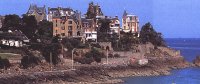 the then tiny fishers village and settled down because of its special mild climate. Yes, the British even founded here the first French tennis club (1879) and the second French golf club (1888). Pau is the eldest course in France. It has the privilege to be the eldest in the world ... except the United Kingdom and India. The one in Dinard was built in 1856 well before golf spread out in the United-States. Imitation Tudor villas and baroque mini-palaces are still visible along the cliffs above the mound of the Rance and the gulf of Saint Malo. I would better call it a small Brighton, like Brighton must have looked in the second half of the 19th century. the then tiny fishers village and settled down because of its special mild climate. Yes, the British even founded here the first French tennis club (1879) and the second French golf club (1888). Pau is the eldest course in France. It has the privilege to be the eldest in the world ... except the United Kingdom and India. The one in Dinard was built in 1856 well before golf spread out in the United-States. Imitation Tudor villas and baroque mini-palaces are still visible along the cliffs above the mound of the Rance and the gulf of Saint Malo. I would better call it a small Brighton, like Brighton must have looked in the second half of the 19th century.
Then the Americans discovered the place suddenly. A millionaire named "Coppinger" built a mansion in the turreted style, which became Dinard's singular contribution to the French architecture.
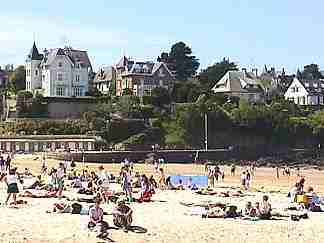 But be warned that Dinard is in a sharp contrast with the city of Corsairs. It may have
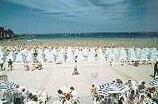 been the Nice of the North" one day, but today it is the queen, and not an undisputed one, it is true, for La Baule, much more to the south, on the Atlantic coast. A Brittany port with palms, camellias and tamarisks, you have to see it to believe it! If the climate is curiously mild, Dinard possesses also wonderful beaches, and where the French exercised their extraordinary skill in bringing amenities into every milieu. You can stroll along the orange beach "Plage de l'Ecluse", an attractive promenade (Promenade du Clair de Lune) along the coastline towards the Pointe du Moulinet where the Grande Plage is located. On the boardwalk you can sip your pre-lunch aperitif followed by a four-course meal. You may be British, but here you eat French J. And you are entitled to lurk at the tanned bodies on the sand below! Notice that been the Nice of the North" one day, but today it is the queen, and not an undisputed one, it is true, for La Baule, much more to the south, on the Atlantic coast. A Brittany port with palms, camellias and tamarisks, you have to see it to believe it! If the climate is curiously mild, Dinard possesses also wonderful beaches, and where the French exercised their extraordinary skill in bringing amenities into every milieu. You can stroll along the orange beach "Plage de l'Ecluse", an attractive promenade (Promenade du Clair de Lune) along the coastline towards the Pointe du Moulinet where the Grande Plage is located. On the boardwalk you can sip your pre-lunch aperitif followed by a four-course meal. You may be British, but here you eat French J. And you are entitled to lurk at the tanned bodies on the sand below! Notice that
the tide goes out a long way, like in all Breton resorts. There is a seawater pool, shrill with children in the summer, catered for in a supervised beach play area with swings and slides.
The Casino, the garden terraces and Greek urns are still a reminder of the wealth in this city.
A not to miss event is the MARKET, one of the most typical in the region, only on Saturday morning. Crowded, colourful and much ambience.
Dinard is a fair weather sort of place, but you can always while away a wet day at its aquarium and marine museum or at the musée historique.
Bibliography
Walking Through Brittany (Footpaths of Europe) (September 1991)-Legends and Romances of Brittany by Lewis Spence ( 1997)
Saint-Malo, Dinard, Dinan, par la Rance , by Pierre-Jean Yvon-Les derniers corsaires malouins by F. Robidou-"Dinard, son histoire", by Marius Mallet
|