 |
|
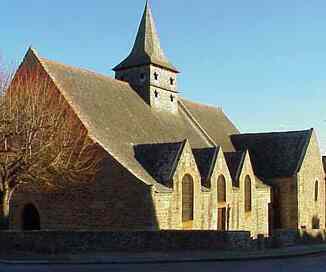
Church of St.Lunaire |
Let's explore
the Cote d' Emeraude now, starting west of the Rance, leaving Dinard. Here we
are in the heart of Brittany's gamily resorts, with safe beaches, even if
frequent visitors have their particular favourites, picturesque villages. It
boils down to personal taste.
But the Cote d'Emeraude honours its name, even on stormy winter days, when it
rains on the moor covered beaches of Cap Frehel. If you look well, the sea has
not that grey, but a superb emerald gem colour. No problem to walk along the
cliffs.
Taking the road D 786 you next come to SAINT-LUNAIRE, some lesser Dinard, but
with two nice beaches, of which one is wonderfully protected by pine trees. The
city itself has an 11th century church, where the remains of an Irish missionary
are buried, Saint Lunaire. Guess who gave the city its name?
Further on, with pretty coves, at the mouth of the river Fremur is SAINT
BRIAC-SUR-MER, other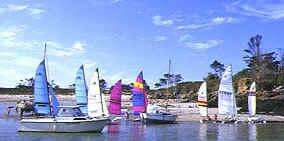 nice beaches and small islands along the coast. The Fete des Mouettes, on the
second Sunday in August is quite famous, with a parade in town, folk dances and
a fest-noz.
nice beaches and small islands along the coast. The Fete des Mouettes, on the
second Sunday in August is quite famous, with a parade in town, folk dances and
a fest-noz.
Cross the 300 metres bridge over the Fremur and you land in LANCIEUX, unspoiled
with its white rocks. Across the bay of Lancieux is JACUT-DE-LA-MER, also named
after Irish missionaries who crossed the sea to 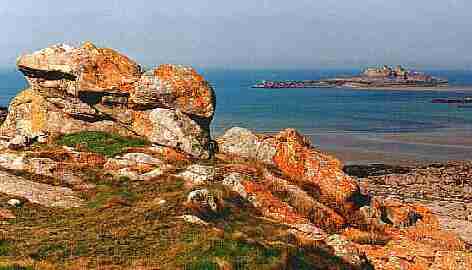 convert
the locals. It is now a small fishing port, popular for sailing, campings and
caravan sites. convert
the locals. It is now a small fishing port, popular for sailing, campings and
caravan sites.
And we can go like this all the time: ST-CAST-LE-GUILDO, with its seven
beautiful beaches bordered by high rocks, boats and picturesque port as a bonus
at the ST.CAST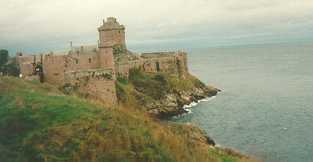 POINT. POINT.
The western flank of St.Cast point forms the tip of LA FRESNAY BAY, a deep,
rectangular inlet at the end of whose other arm is the medieval FORT LA LATTE,
only visitable with a guide.
Another
defensive fortress built by Vauban, and build by pirates. You can still the oven
where thecanon balls were manufactured to be fired upon the English! It is
peculiar that the road to the fort is guarded by a menhir (standing stone),
called "Doigt de Gargantua" (finger of Gragantua).
Now the road turns northward to Cap Frehel and we drive through the most
majestic of the entire Brittany coast! High cliffs, snow white, endless beaches,
the road rises above the granite rocks, which whip the water into angry, white
froth to the lighthouse on its peak. Juts behind are the Fauconnière rocks,
nesting place for all sorts of sea birds.
The D 34 take s you to SABLES-d'OR-LES-PINS, with a gold coloured beach,
surrounded by 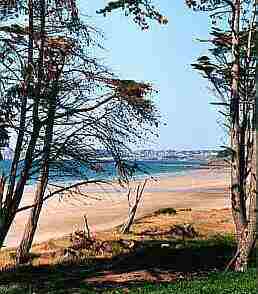 pinewoods.
Further on, the land rises to CAPE ERQUY. The village of ERQUY is famous because
of its mussels, often to find on local menus. Scallops are another specialty of
this place with a huge selection of coves, beaches and resort facilities. If you
have time, make a jump to the delicious village of VIEUX BOURG DE PLEHEREL, high
on the top of a cliff. pinewoods.
Further on, the land rises to CAPE ERQUY. The village of ERQUY is famous because
of its mussels, often to find on local menus. Scallops are another specialty of
this place with a huge selection of coves, beaches and resort facilities. If you
have time, make a jump to the delicious village of VIEUX BOURG DE PLEHEREL, high
on the top of a cliff.
BIENASSIS, with its 15th century castle was one of the last fortified chateaux
built in France. Rebuilt in the 17th, it is worth the detour.
At PLENEUF-VAL-ANDRE, you have another magnificent view on endless, deserted
beaches, you ca watch the fisher fleet coming in, bringing the rare and so
delicious coquilles Saint-Jacques.
Finally PORT DAHOUET is a small yacht and fishing harbour set in a deep inlet of
gorse-covered cliffs.
More about Brittany on my web site.
Bibliography
La Bretagne face á l'Europe et á l'le-de-France, by Pierre-Yves Le Rhun-
Bretagne/Normandie: Pictorial Journey Through Brittany and Normandy (with
captions in French/German/English) , by France Varry-
Cotes du Nord, Finistère, Ille-et-Vilaine,Loire-Atlantique, Morbihan guide by
Benoit Dufournier- Ar Mor : marins, ports et bateaux de Bretagne by Henri
Queffelec
|