|
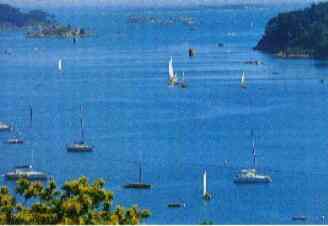 The bay of Paimpol is one of those jagged northern peninsulas but despite many travel guides describe PAIMPOL as a cute, lively fisher port with a rich maritime past, I was not very impressed. From the old folklore, about which many France songs relate the heroic cod fisher adventures in Iceland and Newfoundland, nothing or almost nothing is left. The Quay Duguay-Troulin, once the pride of Paimpol, was razed to the ground and replaced by modern and interesting marinas. Paimpol is a fairly large city (10.0000 inhabitants) for a rural The bay of Paimpol is one of those jagged northern peninsulas but despite many travel guides describe PAIMPOL as a cute, lively fisher port with a rich maritime past, I was not very impressed. From the old folklore, about which many France songs relate the heroic cod fisher adventures in Iceland and Newfoundland, nothing or almost nothing is left. The Quay Duguay-Troulin, once the pride of Paimpol, was razed to the ground and replaced by modern and interesting marinas. Paimpol is a fairly large city (10.0000 inhabitants) for a rural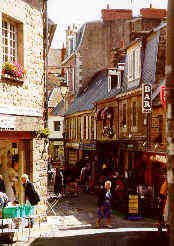 Brittany town and oyster basins, pleasure boating and tourism replaced the old traditions. It is today the main income of the village. You can still discover a few maisons de maitre and moving sea marina graves to remember the old times. Brittany town and oyster basins, pleasure boating and tourism replaced the old traditions. It is today the main income of the village. You can still discover a few maisons de maitre and moving sea marina graves to remember the old times.
It could be interesting to visit "Mad Alto": a restored Brittany fisher boat, lying between the yachts and used as a floating museum. "La Croix des Veuves" (Widow's Cross) is a moving reminder to personal dramas, where women stared the sea at the horizon, hoping their husbands would return alive.
Fishers may have disappeared but their memory is still honoured by a memory chapel in the rue Saint-Vincent. With a "Mur des Disparus " for all those who never came back.
Apart, Paimpol is best known in France as the home of the 189thy century novelist Pierre Loti who set his most famous book: "Pecheur d'Islande", in a Paimpol setting.
North of the jagged coast, above the "Pointe de l'Arcouest" lays the ILE DE BREHAT (2 miles by a mile). The Pointe de l'Arcouest is an excellent starting point for a daytrip. In high summer, one boat an hour, or else out of season every 2 hours. The journey lasts 10 minutes. During your trip, please admire the fine viewpoint overlooking the scattered offshore islands, like Brehat you have in front of you, and which is a place no visitor to Brittany SHOULD MISS!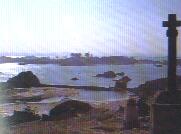
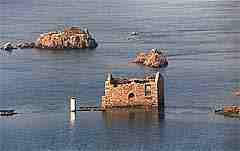 BREHAT, is a quiet island, where time has stopped. New housing is strictly forbidden, cars arte not allowed, which makes your stroll trough the narrow, small cobbles tones streets even more enjoyable. And if you like to Cycle, no problem, you can rent a bicycle and the pontoon of the port. The island is a paradise for bird life and in fact divided in two parts, connected by a bridge of the 18 th (Vauban off course) Brehat is a natural reserve with palms and fig trees, which proves that the climate here is milder than along the main coast. You will probably see eucalyptus, small stonewalls and odouring honeysuckles along the way. It is easy since the signposting is excellent. BREHAT, is a quiet island, where time has stopped. New housing is strictly forbidden, cars arte not allowed, which makes your stroll trough the narrow, small cobbles tones streets even more enjoyable. And if you like to Cycle, no problem, you can rent a bicycle and the pontoon of the port. The island is a paradise for bird life and in fact divided in two parts, connected by a bridge of the 18 th (Vauban off course) Brehat is a natural reserve with palms and fig trees, which proves that the climate here is milder than along the main coast. You will probably see eucalyptus, small stonewalls and odouring honeysuckles along the way. It is easy since the signposting is excellent.
Just take a few facts into consideration: during summertime, 350,000 visitors make the trip, Matisse and other painters couldn't resist this place and the hydrangea bushes have sometimes 300 flower-knobs!! Capital is "Le Bourg" and high on a hill stands the chapel Saint Michel. Two light beacons: le "Rosedo " and the "Paon" where thousands of pink granite blocks continue into the sea. An incredible place!
Bibliography
La Bretagne face á l'Europe et á l'Ile-de-France , by Pierre-Yves Le Rhun, Le Voyage à Paimpol, by Dorothée Letessier, )Paris: Seuil, 1980 ), The Harmonia Macrocosmica of Andreas Cellarius transferred to Paimpol during the French Revolution in 1796- Pecheur d'Islande by Pierre Loti.
|