|
The COTE D'ARMOR, a long, very attractive stripe of coastal resorts, (former Cotes du Nord), got his name from "Armorica", meaning, "land of the sea". The hinterland is a patchwork delight of fields, ancient castles, towns and villages. Middle Age magic is perceptible in DINAN and TREGUIER, where only cars and traffic remind us we are in the 21st century!
And what about the doll villages along the coast like PAIMPOL and BINIC, where the view on the sea is spectacular. The surrealistic COTE DE GRANIT ROSE, west of Paimpol, is a not to miss marvel of nature. Resorts like TREBEURDEN, TREGASTEL and PERROS-GUIRREC are very popular with the French. And the already named ILE DE BREHAT, is a peaceful haven, where cars are forbidden and numerous French prefer to pass their holidays, rather than at the Cote d'Azur.
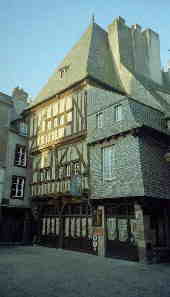 One way of exploring the seaside is to use an inland town as a base for daily excursions, and I would advise the adorable medieval town of DINAN. Try to approach it from the side of the river Rance, spreading like a chain of lakes, passing gorges, inlets and riverside villages and arriving among jostling stone houses and a little Gothic bridge under Dinan's ramparts. Steep streets, crooked houses, winding and cobbled paths, take your walking shoes with you! And if you decide to skip Dinan, you really don't know what you miss. This city has the best-conserved citadel in Brittany, of which the 3 km long wall is still intact. A rarity! One way of exploring the seaside is to use an inland town as a base for daily excursions, and I would advise the adorable medieval town of DINAN. Try to approach it from the side of the river Rance, spreading like a chain of lakes, passing gorges, inlets and riverside villages and arriving among jostling stone houses and a little Gothic bridge under Dinan's ramparts. Steep streets, crooked houses, winding and cobbled paths, take your walking shoes with you! And if you decide to skip Dinan, you really don't know what you miss. This city has the best-conserved citadel in Brittany, of which the 3 km long wall is still intact. A rarity!
 |
|
Porte Jeruzal |
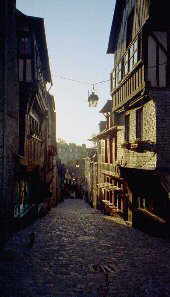
Walk through the narrow streets where 15th and 16th century ateliers give you a gooddea about old professions. Start from the Porte Jeruzal, once the most important of the town's four gates, leading you up to town along the rue des Petits Forts. The climb is steep, but can be relieved by frequent halts to admire the ancient corbelled buildings. They turned into creperies, potteries, weaver's workshops, wood turners and antique reproduction makers. They are so skilled that it is hard to distinguish original from modern. Notice the Governor's house, an admirable building. The Tourist office is housed in the magnificent hotel de Kératry, rue de l'Horloge. Not far from here stands the TOUR de L'HORLOGE, a 15th century, square clock tower on which top you have a great view on the city.
Dinan transports you into the past, making it easy for you to remind its history. Many battles were fought at that time and when William the Conqueror besieged the city in
 1065, his nickname failed him once, since he couldn't vanquish the Bretons. In 1359 the city was again besieged, this time by the duke of Lancaster and a certain Breton soldier, the famous
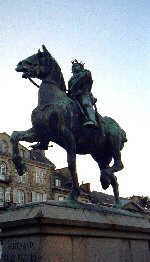
DU GUESCLIN, now a symbol and hero of Brittany and also of France, vanquished Thomas of Canterbury in a single combat. Du Guesclin has its equestrian, sword-brandishing statue on the place Du Guesclin, centre town, today used as a market place on Wednesday, parking spot the other days .Du Guesclin's body is preserved in the 12th century Saint Sauveur basilica, a landmark for miles around. But a fantastic view on the medieval town, the river Rance and the port is to see from the Jardins Anglais (English gardens), behind the basilica. You can see also a 40 km long viaduct, called Vieux-Pont, built in 1852. 1065, his nickname failed him once, since he couldn't vanquish the Bretons. In 1359 the city was again besieged, this time by the duke of Lancaster and a certain Breton soldier, the famous
DU GUESCLIN, now a symbol and hero of Brittany and also of France, vanquished Thomas of Canterbury in a single combat. Du Guesclin has its equestrian, sword-brandishing statue on the place Du Guesclin, centre town, today used as a market place on Wednesday, parking spot the other days .Du Guesclin's body is preserved in the 12th century Saint Sauveur basilica, a landmark for miles around. But a fantastic view on the medieval town, the river Rance and the port is to see from the Jardins Anglais (English gardens), behind the basilica. You can see also a 40 km long viaduct, called Vieux-Pont, built in 1852.
I see this post is getting quite extensive, so I will continue another day, still with some reflections about Dinan.
Bibliography
Brittany and the Angevins, by J. A. Everard (Cambridge University Press) - The Creation of Brittany, by Michael Jones (Hambledon and London Ltd) - Ecclesiastic and Civil History of Brittany, by Pierre Hyacinthe Morice, Dinan : guide de découverte des maisons á pans de bois-Les remparts de Dinan, by Stephane Gesret-Saint Malo, Dinard, Dinan, par la Rance by Pierre-Jean Yvon.
|