|
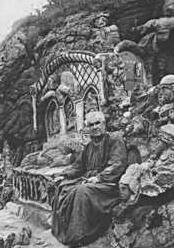 Up the coast, east of Saint Malo, is ROTHENEUF, famous for its sculpted rocks, "rochers sculptés". They are the lifetime work of a priest, abbé Fauré, and form bizarre collections of animals, plants and people. It looks grotesque, but it is interesting to see how Up the coast, east of Saint Malo, is ROTHENEUF, famous for its sculpted rocks, "rochers sculptés". They are the lifetime work of a priest, abbé Fauré, and form bizarre collections of animals, plants and people. It looks grotesque, but it is interesting to see how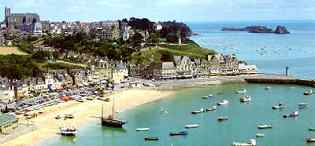 humans can have a focus in life and maintain it. You can ask about the Manoir de Limoelou, which was the country home of Jacques Cartier, now housing a museum of memorabilia. We are heading for what should be a superb scatter of coves, situated on each side of the headland Port Grouin, but the attraction of their setting, however, is spoiled by numerous camping and caravan sites. humans can have a focus in life and maintain it. You can ask about the Manoir de Limoelou, which was the country home of Jacques Cartier, now housing a museum of memorabilia. We are heading for what should be a superb scatter of coves, situated on each side of the headland Port Grouin, but the attraction of their setting, however, is spoiled by numerous camping and caravan sites.
Round the point Grouin lies the holiday resort of CANCALE, busy fisher port famous for its oysters. Huitres creuses! They even call themselves, the oyster capital of Brittany. Anyway, I know from reliable source that the top restaurants in Paris are furnished mostly by Cancale oyster dealers. And not only contemporary Paris but also even Louis XIV had his oysters coming from Cancale to Versailles and they had to be fresh!!).
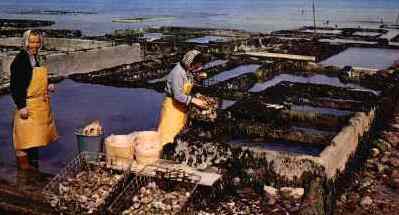 The trade still flourishes and the beds, visible at low tide, cover 730 hectares producing about 25,000 tons a year. They are to see along the rue des Parcs, near the pier at the harbour. You can see stalls on the beach where they are sold in baskets (bourriches) or per piece. Many shellfish, restaurants and cafes offer deputations all over town, more specially on the main square of Cancale. A lot of bars help you to wash away the oysters with a delicious Muscadet! Not bad J The trade still flourishes and the beds, visible at low tide, cover 730 hectares producing about 25,000 tons a year. They are to see along the rue des Parcs, near the pier at the harbour. You can see stalls on the beach where they are sold in baskets (bourriches) or per piece. Many shellfish, restaurants and cafes offer deputations all over town, more specially on the main square of Cancale. A lot of bars help you to wash away the oysters with a delicious Muscadet! Not bad J
But Cancale does not only produce oysters. Delicious "pré-salé" lambs meat, coming form the sheep raised in salt-water swamps. Also mussels and rows of posts on which they hang in clusters, like blue-black grapes in a marine vineyard. You can see them from the shore. A fishing fleet, still in operations brings lots of soles, plaice and turbot.
But if you are like me, you don't lie to stay every available minute on the beach and like to move around.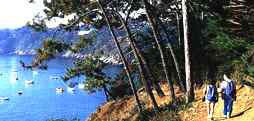 Therefore the Cancale footpaths are pleasant passé-temps to explore. Therefore the Cancale footpaths are pleasant passé-temps to explore.
Among them the famous SENTIER DES DOUANIERS, which was used by coastguards and customs men, when the European Union was a far away mirage and smuggling flourished! It leads to the Point Grouin, and if you are the Hercules type, you can go on to Rotheneuf, Paramé and Saint-Malo.
In the town itself, the Musée des Arts et Traditions in a restored church, the Musée de l'Huitre (that's' not a surprise) and that's' about all. If you except of course the exceptional restaurant with one of the best cuisiniers in France, Olivier Roellinger, leading its prestigious restaurant I will review in my restaurant recommendations of Cancale, still to be written (later).
East of Cancale, the landscape has no major interest any more, flat and monotonous. Behind stretches a bleak, featureless plain, which is in fact reclaimed land to grow cereals, vegetables and fruit. You can continue up to Le Vivier, one of the largest Franc's mussel-farms producing between 10,000 and 12,000 tonnes a year.
Next post we will wander out of Dinard to the west of the Rance river.
Bibliography
Saint-Malo et ses environs, by Gaston Robert de Salles- Saint-Malo et le pays d' Emeraude, by Jean-Yves Ruaux-Les ports huitriers de Bretagne, by J.De La Couste (ed. Le Marais-Brest), La bisquine de Cancale et de Granville , by Jean Le Bot
|