|
A
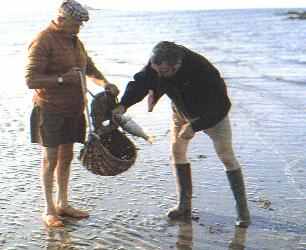
lonesome, bent figure looking for mussels, colourful fishing boats anchored in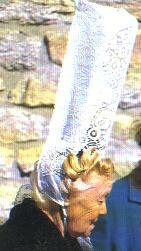 picturesque small ports, sea birds flying like acrobats between the capricious
rocks, ladies all dressed up in black, sitting on a bench to hear and tell the
latest gossips. This is the image we all have of Brittany, "Bretagne "
in French and that's how I will name it in the rest of my series about this
region.
picturesque small ports, sea birds flying like acrobats between the capricious
rocks, ladies all dressed up in black, sitting on a bench to hear and tell the
latest gossips. This is the image we all have of Brittany, "Bretagne "
in French and that's how I will name it in the rest of my series about this
region.
In fact it is a land of contrasts, the "unmanageable" element of
France, like the
historian Jules Michelet wrote once. This is the land that has seen a terrible
fight of man against nature and against the whims of history. It can satisfy the
most hackneyed demand of travel writers and I will certainly not deprive myself!
What do we really know about this outraveled country, making a fist towards the
Ocean? About the wild seas that buffet its jagged coastlines, reshaping the
ancient granite. And what about the surprising contacts of land and sea like the
"abers", how some estuaries are called (in the Cote des Legendes,
Aber-Wrac'h, Aber-Benoît, Aber-Ildut). Celtic names given to rivers,
which spectacle is unforgettable at high tide.
 Inland, the quiet villages and eerie forests seem not to obey the laws of time.
On the northern coastline, cities like Saint-Malo, old corsair's town, Dinard,
self-proclaimed Queen of the Emerald Coast. To the west the "Granit Rose
"coast offers great seascapes wit its attractive pink boulders, unspoilt
sandy beaches and quiet little resorts. Then comes the more rugged Finistère
with its steep, rocky cliffs, the port of Brest, its "parish-clos"
villages preserving the old tongue and the old ways, and the southern Morbihan,
its superb beaches, the industrial port of Lorient, medieval towns and the
sophisticated resort of La Baule. Next, Nantes, Brittany's old capital is a
Inland, the quiet villages and eerie forests seem not to obey the laws of time.
On the northern coastline, cities like Saint-Malo, old corsair's town, Dinard,
self-proclaimed Queen of the Emerald Coast. To the west the "Granit Rose
"coast offers great seascapes wit its attractive pink boulders, unspoilt
sandy beaches and quiet little resorts. Then comes the more rugged Finistère
with its steep, rocky cliffs, the port of Brest, its "parish-clos"
villages preserving the old tongue and the old ways, and the southern Morbihan,
its superb beaches, the industrial port of Lorient, medieval towns and the
sophisticated resort of La Baule. Next, Nantes, Brittany's old capital is a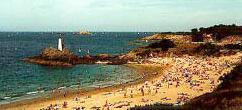 bustling city with wide boulevards and elegant shops.
The more east you travel, the more history deepens the once very violent
relations of Brittany with France. Often ignored is central Bretagne, but an
ideal area for those who love to walk and wander. Much history was made here,
legends of the forest of Paimpont, and Merlin is still said to conjure up rain
and thunder.
The Bretons (inhabitants of Bretagne) managed to earn their living during the
past centuries by fishing, 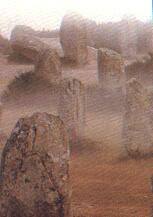 smuggling,
expeditions and piracy. Today, some pirates (but not all off course), got into
the hotel and restaurant business, so be careful not to be robbed or ripped off
like we say today. But Brittany didn't learn yet all the tricks of the game and
is rather unspoilt, when they are without any gas oil supertanker breaking in
two in front of their coastline (see the Erika). smuggling,
expeditions and piracy. Today, some pirates (but not all off course), got into
the hotel and restaurant business, so be careful not to be robbed or ripped off
like we say today. But Brittany didn't learn yet all the tricks of the game and
is rather unspoilt, when they are without any gas oil supertanker breaking in
two in front of their coastline (see the Erika).
Another Bretagne mystery and uniqueness is their spiritual union with stones.
Yes, stones! Or what do you call "menhirs"? Like the famous in Carnac
on the south coast of Bretagne or the stone carved "calvaires"
(calvaries) in the Leon region (north). The Bretons like and are proud of their
traditions as strong as the granite of which many a farm was built.
Finally, Rennes, as the capital of Bretagne, looks more as and is a market town,
mixing medieval past with modern times.
Bibliography
Early
Brittany by Chadwick (Cardiff: University of Wales Press.(1969)
The Bretons Blackwell's Peoples of Europe Series by Galliou, Patrick and Michael
Jones. (1991)-Walking Through Brittany (Footpaths of Europe) (September
1991)-Legends and Romances of Brittany by
Lewis Spence ( 1997)
|