|
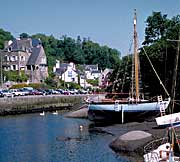 PONT-AVEN! Since I love art and more especially Gauguin, Gauguin's view of Brittany's landscapes didn't leave mind. This was the Brittany in my childhood's mind, the old churches, the Pont Aven scenes that ended up on his canvases, painters that came from all over the world, with different ages and backgrounds. Their lives were fascinating and filled with anecdotes. PONT-AVEN! Since I love art and more especially Gauguin, Gauguin's view of Brittany's landscapes didn't leave mind. This was the Brittany in my childhood's mind, the old churches, the Pont Aven scenes that ended up on his canvases, painters that came from all over the world, with different ages and backgrounds. Their lives were fascinating and filled with anecdotes.
I could see why, exploring the area around Pont-Aven and the city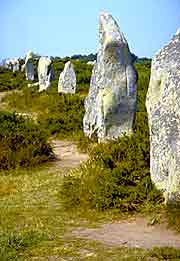 itself: a wild, mysterious Brittany, even exotic, with its residents in their bright costumes. This was a trip through eternal Brittany, between Armor and Argoat, and I appreciated what I saw and experienced. The setting offers artists stunning natural beauty, from wide, white sand beaches and dramatic coastal cliffs to rolling green hills marked by ancient stone walls, thatch-roofed farmhouses, and brilliantly colored flowers. The carved stone crosses, called Calvaires, simple granite 16th century chapels, and prehistoric stone menhirs and dolmens (standing stones) are unique to Brittany. Gauguin painted some of them, including the 16th century wooden figure of Christ in the TREMALO itself: a wild, mysterious Brittany, even exotic, with its residents in their bright costumes. This was a trip through eternal Brittany, between Armor and Argoat, and I appreciated what I saw and experienced. The setting offers artists stunning natural beauty, from wide, white sand beaches and dramatic coastal cliffs to rolling green hills marked by ancient stone walls, thatch-roofed farmhouses, and brilliantly colored flowers. The carved stone crosses, called Calvaires, simple granite 16th century chapels, and prehistoric stone menhirs and dolmens (standing stones) are unique to Brittany. Gauguin painted some of them, including the 16th century wooden figure of Christ in the TREMALO
 |
|
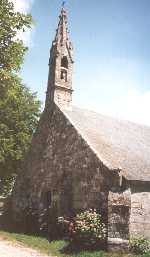
Tremalo chapel |
Chapel that was the model for his Yellow Christ, and the Romanesque cavalry in the little church nearby, which inspired the green Christ. Nizon. American artists had been working there for twenty-two years before Gauguin arrived in 1886 before he took himself to Tahiti in the South Seas. He stayed in the Hotel Ajoncs d'Or, next to the bridge
For over 130 years (1888), Pont-Aven has been renowned as an international artists' colony. Paul Gauguin, its best known artist-in-residence, was but one among many and certainly one of the founders. Despite that in 1866 a first artist's group, mostly Americans, established itself in Pont Aven, "the "seven original painters. Robert Wylie, Charles Way, Mores Wight, Shinn, Champney and Bridgman. It will not stop anymore, from Paris to Philadelphia, Pont Aven is THE place.
 |
|
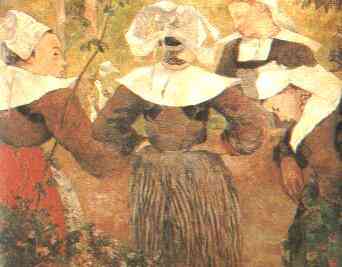
Bretonnes by Gauguin |
What is now the particularity of the painting school started by Gauguin? : it takes Impressionism a stake further by giving free rein to the intuitive feelings of the artist. Paul Gauguin and his followers at Pont-Aven brought about an artistic revolution. The paintings they created, characterized by vivid colors, simplified space, and sharply defined forms, established a new style and changed the direction of painting in the twentieth century.
Unfortunately you will not find many Gauguin pictures in the city museum's or galleries, but of some of his followers like Emile Bernard, Paul Serusier, Maurice Denis, Robert Wylie, and Charles Way.
About the town today? Although art galleries may have superseded the water mills, Pont Aven has not changed that all much since Gauguin's time. Take the lovely wooded walk to the Tremalo Chapel, through the Bois d'Amour, all-long which signposts indicate you the way.
Yu can visit the places, painted by the Pont Aven school painters, of Brittany peasants and fishermen, in the picturesque villages where they used to live.
The sculpture park at the nearby Domaine de Kerguéhennec demonstrate the region's commitment to experimental contemporary artistic exploration. Art History comes alive here, and artists may use the past to springboard ideas into the future. In the summer, Pont-Aven is a bustling melting pot of artists, tourists, and sailors who come from all over the world.
A few words about upstream particularities: an oak and beech forest of CAROET and the town of QUIMPERLE, an old place which shows its age well, particularly in the medieval streets grouped around the church Sainte Croix (12th century)
Bibliography
Pont-Aven,l'école buissonnière, par Antoine Terrasse, collection Découvertes, Gallimard, Paris 1993.
Le Peintres de Pont Aven , par André Cariou, conservateur en chef du musée de Quimper, éditions Ouest France, Rennes 1994.
Lettres de Gauguin à Daniel de Monfreid par Gauguin( Paris: G. Falaize, 1950),Gauguin, a Complete Life by Sweetman, David Paul London: Hodder & Stoughton, 1995.
Anciens villages, nouveaux villages : de Barbizon à Pont-Aven (1995)
de Isabelle de Lajarte
|