|
Brittany
music is rich and dense world to discover. A music that passes the barriers of
language, with a magical and vibrating force.
 |
|
Bombarde |
Music and history are
strongly entangled in Brittany, just like Ireland. A loud elegy, reminding
moving moments of Breton history, usually starts a Breton song. . Musicians,
playing the “bombard”, a harsh, wooden oboe-like instrument with a double
reed, the “biniou”, a Breton bagpipe, and sometimes the “telenn”, a
Celtic harp, usually surround the singer. But they don’t refuse to play the
flute, clarinet, violin and Irish drum.
Music has always been an important source of strength, inspired by themes and
musical styles of Celtic inheritance. Still very popular and gaining more and
more celebrity the last decade, its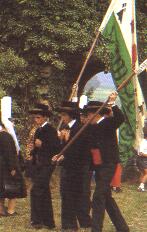 popularity is driven to the summit during
cultural events like the “boeuf”, a spontaneous musical feast, where local
musicians will pass the whole night, playing in a café. popularity is driven to the summit during
cultural events like the “boeuf”, a spontaneous musical feast, where local
musicians will pass the whole night, playing in a café.
But nothing can beat he “Fest-Noz”’, feast of the night, where hundreds of
villagers gather to dance whole night in enormous circles. They hold each other
by the hands, the arms, fists and even little finger and their movements match
perfectly to the rhythm of the exciting music, working everybody up to a
extraterrestrial trance, while they all sing “kan ha diskan. ”If you want to
know more about Brittany celebrations, popular dances and more, read the book
“La tradition populaire de Danse en Basse Bretagne”, by J.M.Guilcher
(ed.Mouton). Drinking is not prohibited and the cider flows as a fountain. I
don’t have to draw you a picture of how people look and feel next morning J
 |
|
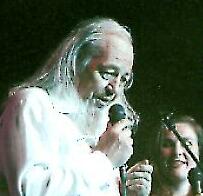
Glenmor |
The “festou-noz” are more particularly popular in the summer, when they are
held on the properties of old castles, church and village squares. But some
happen in the winter.
The “fest-noz” had its revival in 1960, the “bagadou” is back and even
the bards tradition returns. Young singers, inspired by the great GLENMOR (died
in June 1996), modernized the music but kept the old Celtic ambience and sound.
Known artists are Anjel I.K, Yann Raoul. Celtic rock is all around with the
group EV, MORENN, Matmatha. But the greatest of them all is undoubtedly
Alan Stivell, who learned the bagpipe and after a stay in Glasgow he founds the
group “ Bagdad Bleimor”. Mixing rock music and folk song tradition he
organizes in August 1972 the first Celtic pop festival in Kertalg. We can say
that he is one of the very few Breton singers that reached out to international
celebrity, where he brings his cultural message.
Celtic rock is all around with the
group EV, MORENN, Matmatha. But the greatest of them all is undoubtedly
Alan Stivell, who learned the bagpipe and after a stay in Glasgow he founds the
group “ Bagdad Bleimor”. Mixing rock music and folk song tradition he
organizes in August 1972 the first Celtic pop festival in Kertalg. We can say
that he is one of the very few Breton singers that reached out to international
celebrity, where he brings his cultural message.
Here are a few names of instruments and musicians, maybe they sound familiar.
The “fiddle”: violin playing a big part in Scottish and Irish folk music
 |
|
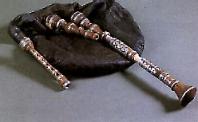
Biniou-Koz |
The biniou-koz is the most typical of Breton instruments. A bag, where the air
is blown through a small tube, and the musician plays the melody on another tube
with six holes. air
is blown through a small tube, and the musician plays the melody on another tube
with six holes.
The biniou-braz looks much like the Scottish bagpipe.
The “bagad”, (plural bagadou), is composed by a number of tabalarders
(bombarde players), biniou-braz players and percussionists.
The Celtic harp thanks it revival to Alan Stivell.And finally, like I mentioned already, a “kan ha diskan” is a song with a
refrain, a song to dance on.
Bibliography
“La
Bretagne et ses Traditions, by Paul-Yves Sébillot, “Bretagne et Bretons”,
by Gilles Henry, “La
tradition populaire de Danse en Basse Bretagne”, by J.M.Guilcher (ed.Mouton),“Une
enfance Bretonne, by Charles Le Quintrec
|