|
For the CATHEDRAL SAINT
PIERRE ET PAUL in NANTES, is in limestone, not the Breton granite, but something about the style looks familiar: Yes, it’s
Flamboyant Gothic. A lot of travelers compare this cathedral to Notre-Dame de
Paris, since it has a typical flamboyant art style. Built between 1434 et 1882,
there is no “Last Judgment” on the last tympani. Walls are consolidated by
arched vaults and pierced by numerous windows or a big glass-case, typical of
Gothic style.
Breton granite, but something about the style looks familiar: Yes, it’s
Flamboyant Gothic. A lot of travelers compare this cathedral to Notre-Dame de
Paris, since it has a typical flamboyant art style. Built between 1434 et 1882,
there is no “Last Judgment” on the last tympani. Walls are consolidated by
arched vaults and pierced by numerous windows or a big glass-case, typical of
Gothic style.
Inside, the height and light impression is given by the long pillars going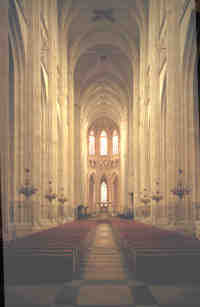
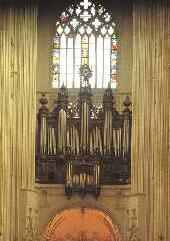 as
height as the ribbed vaults without ruptures and capitals. The stone cultures
are very fine and precise. On the northern portal you can the Anne de Bretagne
armories. The nave soars to a 39 meters height. as
height as the ribbed vaults without ruptures and capitals. The stone cultures
are very fine and precise. On the northern portal you can the Anne de Bretagne
armories. The nave soars to a 39 meters height.
This cathedral is a very fine church, which no visitor to Nantes should miss.
We are already in old town and let’s proceed to the place de la Psalette, a
delicious square on the south side of the church, surmounted by a 15th century
cloister. A quiet place.
The town itself conations many 18th and 19th century houses. Many fine examples
of elegant domestic architecture.
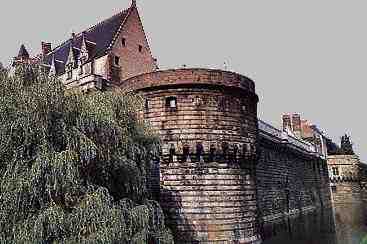 Stroll
west of the cathedral along the Cours Franklin Roosevelt, to the place du
Marechal Foch, a beautiful architectural ensemble of the 18th. Let yourself
attract by the mixture of steep streets beside the river and many fine squares.
Interesting buildings are especially gathered for you on the Place Graslin and
the Place Royale. Don’t forget that the famous Jules Verne was born in Nantes,
the famous general “Cambronne” is from here, who commanded the old guard at
the battle of Waterloo and gave the French the famous “word of Cambronne:
“MERDE”, refusing to surrender to the British. Other say, and himself in
later life said that he actually proffered: “La garde meurt mais ne se rend
pas!” Stroll
west of the cathedral along the Cours Franklin Roosevelt, to the place du
Marechal Foch, a beautiful architectural ensemble of the 18th. Let yourself
attract by the mixture of steep streets beside the river and many fine squares.
Interesting buildings are especially gathered for you on the Place Graslin and
the Place Royale. Don’t forget that the famous Jules Verne was born in Nantes,
the famous general “Cambronne” is from here, who commanded the old guard at
the battle of Waterloo and gave the French the famous “word of Cambronne:
“MERDE”, refusing to surrender to the British. Other say, and himself in
later life said that he actually proffered: “La garde meurt mais ne se rend
pas!”
Nantes is a very pleasant city, with excellent shopping of an almost Parisian
elegance.
But those visitors who crave culture have (besides the Ducal castle), many more
options to choose from.
The FINE ARTS MUSEUM has its own collection of Kandinsky's and is now also
showing the Kandinsky collection from the Beaubourg Museum in Paris, together
wit its own Ingres, Georges de la Tour and Courbet.
 |
|
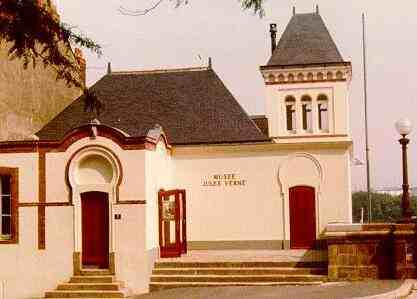
Jules Verne museum |
The JULES VERNE Museum is
in a charming 19th century house in the St.
Anne quarter. The heart of Anne of Brittany is contained in a reliquary in the
elegant THOMAS DOBREE Museum. One of the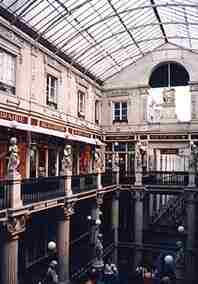 most striking sights in Nantes is the PASSAGE POMMERAYE. Built in 1843,
this shopping arcade is on three levels linked by wooden stairs and wrought-iron
balconies topped by statues. The adjacent Rue Crebillon is Nantes answer to the
Faubourg Saint Honore. Window gawking at the expensive stores is so prevalent
that the Nantais have a verb for it: crebillonner. At the top of the street, the
18th century Graslin Theater faces La Cigale, a restaurant with an elaborate
1900s decor, which is always buzzing with Nantais sipping cold Muscadet and
savoring oysters on the half shell. Want to die happy? Stop at the Gautier
confiserie and try a mascaron, a chocolate filled with muscadet.
most striking sights in Nantes is the PASSAGE POMMERAYE. Built in 1843,
this shopping arcade is on three levels linked by wooden stairs and wrought-iron
balconies topped by statues. The adjacent Rue Crebillon is Nantes answer to the
Faubourg Saint Honore. Window gawking at the expensive stores is so prevalent
that the Nantais have a verb for it: crebillonner. At the top of the street, the
18th century Graslin Theater faces La Cigale, a restaurant with an elaborate
1900s decor, which is always buzzing with Nantais sipping cold Muscadet and
savoring oysters on the half shell. Want to die happy? Stop at the Gautier
confiserie and try a mascaron, a chocolate filled with muscadet.
Apart of the cathedral, two other sights are well worth seeing: both Botanical
gardens, the JARDIN DES PLANTES and the ISLAND FEYDEAU, which is now attached to
the mainland. It used to be once a fashionable lively quarter
Nantes is well worth discovering. Visitors may even end up agreeing with
surrealist Andre Breton, who wrote: "Nantes, perhaps with Paris, is the
only city in France where I have the impression that something worthwhile might
happen." Like an urban beach.
Bibliography
Vie quotidienne à Nantes
au temps de la traite des Noirs
de Petre Grenouilleau-Nantes, 1830-1940 : une ville et ses écoles (
1999) de Marc Suteau-Nantes et la Côte de Jade (1992) de Guide
Gallimard-Les grandes heures de Nantes de Armel de Wismes(1992)
|